
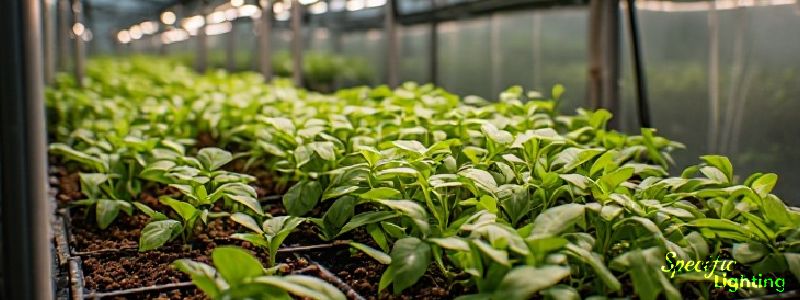
Grow lighting has come a long way from a few fluorescent tubes hanging over a tray of seedlings. Today, it plays a major role in indoor farming, commercial greenhouses, vertical farms, plant nurseries, and even professional sports stadiums. With the right lighting setup, growers can manage light exposure more consistently, improve growing conditions, and make better use of their available space.
But choosing grow lights isn’t just about picking a fixture with enough watts. Different plants need different amounts of light, and a small indoor growing room has very different requirements from a 10,000-square-foot greenhouse or a stadium pitch. Equipment prices, electricity consumption, installation costs, and expected returns also deserve a closer look before making a purchase.
Whether you’re growing leafy greens indoors, upgrading greenhouse lighting, planning a commercial vertical farm, or maintaining natural grass at a sports venue, understanding the technology and the numbers can help you make a more practical decision.
What Is Grow Lighting?
Grow lighting refers to artificial lighting designed to support plant growth when natural sunlight is insufficient, inconsistent, or unavailable. These systems provide light that plants can use for photosynthesis, the process through which they convert light energy into chemical energy for growth.
Unlike ordinary room lighting, grow lights are selected according to their output, spectrum, efficiency, and ability to deliver light evenly across a growing area. A fixture that looks bright to the human eye doesn’t necessarily provide the right amount of light for plants. That’s why professional growers rely on measurements such as photosynthetic photon flux density (PPFD) and daily light integral (DLI) when planning a lighting system.
Grow lighting can serve different purposes depending on the environment. An indoor farm may depend on artificial light for nearly all its production, while a greenhouse typically uses grow lights to supplement daylight during darker months. Stadium turf systems have another job – helping natural grass recover in areas where the roof, stands, or surrounding structures limit sunlight.
How Do Grow Lights Support Plant Growth?
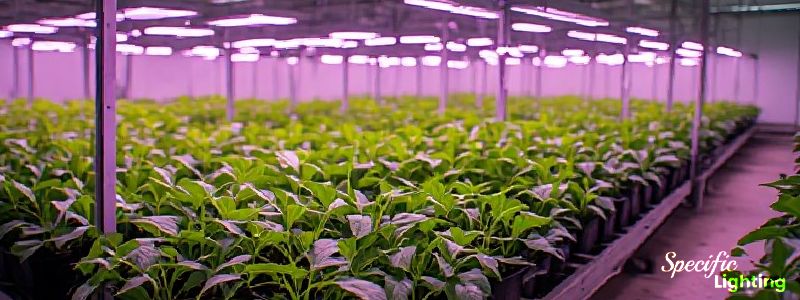
Plants respond to the amount of light they receive, the wavelengths within that light, and the length of their daily exposure. Red and blue wavelengths contribute strongly to photosynthesis, while other wavelengths can influence plant shape, leaf development, flowering, and other growth responses.
The right lighting setup helps growers provide a more consistent environment from one growing cycle to the next. For example, a leafy green crop may perform well under a carefully controlled lighting schedule, while flowering crops may require a different combination of light intensity, spectrum, and photoperiod.
More light isn’t always better. If the light intensity exceeds what a plant can use effectively, additional energy may deliver diminishing returns and create extra heat or operating costs. A good lighting design aims to provide the right amount of usable light for the crop rather than simply maximizing fixture output.
Grow Lights vs. Natural Sunlight
Sunlight provides a broad spectrum of radiation and is free at the point of use, making it a valuable resource for greenhouse operators. However, sunlight changes throughout the day and across seasons. Weather, roof structures, neighboring buildings, and greenhouse coverings can also reduce the amount of light that reaches the crop.
Artificial grow lights give operators more control over light intensity and timing. In an indoor farm, lighting can be designed around a specific production schedule. In a greenhouse, supplemental LEDs can help maintain more consistent conditions when daylight levels drop.
The trade-off is cost. Artificial lighting requires equipment, installation, electricity, and maintenance. For that reason, many greenhouse projects focus on adding light when crops need it most, rather than running every fixture at full output throughout the day.
Understanding PPF, PPFD, PPE, and DLI
A few lighting measurements make it much easier to compare products and plan installations.
Photosynthetic photon flux (PPF) measures the total amount of photosynthetically active photons a fixture emits per second, expressed in micromoles per second (µmol/s). It describes the fixture’s total light output, but it doesn’t tell you how much light reaches a particular plant.
PPFD measures the number of photosynthetic photons landing on a square meter each second, expressed in µmol/m²/s. It is particularly useful for checking whether a growing area receives enough light and whether some sections are brighter than others.
Photosynthetic photon efficacy (PPE) measures how efficiently a fixture converts electrical power into photosynthetic photons, expressed in µmol/J. For example, a fixture rated at 3.0 µmol/J produces more photosynthetic photons per unit of electricity than one rated at 2.0 µmol/J, assuming the ratings use comparable test methods.
Daily light integral measures the total photosynthetic light delivered over a day, expressed in mol/m²/day. A PPFD of 200 µmol/m²/s maintained for 16 hours delivers a DLI of approximately 11.52 mol/m²/day.
These measurements answer different questions. PPF tells you what the fixture produces, PPFD tells you what reaches the crop, PPE helps compare electrical efficiency, and DLI shows the total daily light exposure. Together, they provide a much better basis for purchasing decisions than wattage alone.
Types of Grow Lights – Which Technology Should You Choose?
LED technology is now widely used in horticultural lighting because it offers controllable output, good energy efficiency, and a range of fixture designs. However, other lighting technologies still appear in existing installations, and the best option depends on the project, budget, and operating requirements.
LED Grow Lights
LED grow lights use light-emitting diodes to produce light in selected wavelength ranges. Their output can be designed for general plant growth or tailored to particular crops and growing environments.
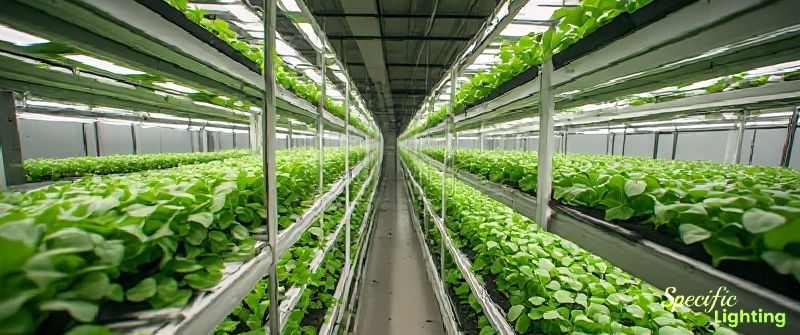
Commercial LED fixtures commonly offer features such as dimming, programmable controls, and different mounting configurations. Some models are designed for vertical farm racks, while others provide broad coverage over greenhouse benches or large cultivation areas.
Efficiency varies by product. As a general comparison, modern horticultural LED fixtures may offer PPE ratings around 2.5 to 3.5 µmol/J, although actual performance depends on the model, operating conditions, and measurement method. Buyers should check independently documented specifications rather than assume every LED product performs at the same level.
LEDs also provide flexibility in lighting design. A grower can select different power ratings, beam distributions, mounting heights, and control systems to suit the crop and facility. The initial purchase price may be higher than that of some conventional alternatives, but reduced electricity consumption and maintenance can help offset the difference over time.
High-Pressure Sodium Grow Lights
High-pressure sodium (HPS) lamps have been used for years in greenhouses and indoor cultivation facilities. They produce substantial light output and have a long track record in commercial horticulture.
Their limitations include lower electrical efficiency than many modern LED fixtures, substantial radiant heat, and fewer options for independently controlling spectrum and output. Replacing an existing HPS system with LEDs may reduce energy use, but the actual savings depend on the original equipment, new fixture performance, operating hours, and local electricity prices.
HPS can still be relevant when evaluating an existing installation or comparing retrofit options. The key is to assess the complete operating cost rather than the lamp price alone.
Ceramic Metal Halide and Fluorescent Grow Lights
Ceramic metal halide (CMH) lighting has been used in horticultural applications where its spectral characteristics are suitable. However, LED systems generally offer more flexibility in dimming, fixture design, and energy management.
Fluorescent lights have also been used for seed starting, propagation, and small growing areas. They can still serve simple applications, although LED fixtures are increasingly attractive because of their efficiency, durability, and broad availability.
For a new commercial project, it makes sense to compare the total cost of ownership of each option. That includes equipment, installation, electricity, replacement components, and the labor needed to maintain the system.
Full-Spectrum vs. Targeted-Spectrum Grow Lights
Full-spectrum grow lights are designed to provide a broad range of wavelengths suitable for plant growth. They are often used in mixed-crop environments or facilities that want a flexible lighting solution.
Targeted-spectrum fixtures emphasize selected wavelength ranges for particular applications. For example, a grower may use a specific spectral recipe as part of a crop production strategy, provided the recipe has been tested under relevant growing conditions.
Spectrum alone doesn’t determine performance. Light intensity, uniformity, photoperiod, crop genetics, temperature, humidity, and nutrient availability also influence plant growth. Buyers should compare spectral distribution alongside PPFD maps, PPE, and crop-specific trial data.
LED vs. HPS Grow Lights – Cost and Performance
Suppose a facility is comparing an LED fixture that draws 600 watts with an HPS fixture that draws 1,000 watts. If both systems provide the required light levels and operate for 16 hours per day, the LED system uses 9.6 kWh per day compared with 16 kWh for the HPS system.
At an electricity rate of US$0.15 per kWh, that equals US$1.44 per day for the LED fixture and US$2.40 for the HPS fixture. The difference is US$0.96 per fixture per day, or approximately US$350 per year over 365 days.
This is an illustrative calculation, not a guarantee of equivalent crop lighting or actual savings. A fair comparison must account for fixture efficacy, light distribution, usable light reaching the crop, replacement requirements, and any additional cooling costs. Still, it shows why energy consumption deserves as much attention as the purchase price when evaluating grow lighting.
Grow Lights for Horticulture – Solutions for Different Growing Environments
Horticultural lighting covers a wide range of applications, from a small seedling shelf to a commercial nursery producing thousands of plants each month. Each environment has different lighting requirements, so the goal is to match the fixture to the crop, growing area, and production schedule.
| Application | Main Purpose | Typical Lighting / Key Considerations |
|---|---|---|
| Indoor Gardening & Seedlings | Support early plant growth | PPFD: 100–250 µmol/m²/s; 12–16 hours/day |
| Herbs, Leafy Greens & Microgreens | Promote consistent crop growth | PPFD: 150–300 µmol/m²/s; 14–18 hours/day |
| Nurseries & Propagation | Support seedlings and transplants | Adjustable LEDs, uniform coverage, and dimming |
| Cannabis Cultivation | Manage crop growth and flowering | PPFD, DLI, spectrum, and energy use |
| Vertical Farms | Light multi-tier growing systems | Low-profile LEDs, automation, and cooling; 40 kW uses 640 kWh/day at 16 hours |
| Commercial Greenhouses | Supplement natural sunlight | Supplemental PPFD: 100–200 µmol/m²/s as a planning range; top lighting or interlighting |
| Indoor Farms & Hydroponics | Control crop-growing conditions | Uniform PPFD, dimming, and environmental controls |
| Stadium Grass & Sports Turf | Support grass recovery in shaded areas | Mobile lighting rigs, coverage, portability, and maintenance |
| Golf Courses & Sports Facilities | Support grass in low-light areas | Assess shade, grass type, installation, and operating costs |
Indoor Gardening and Seedlings
Indoor gardening often involves growing plants in spaces where natural light is limited, such as spare rooms, basements, or dedicated growing cabinets. Compact LED grow lights are popular because they provide controllable illumination without requiring a large electrical installation.
Seedlings generally need moderate light levels that support compact, healthy growth. Depending on the plant species and growth stage, a starting PPFD range of around 100 to 250 µmol/m²/s may be suitable, although some crops require different conditions. A photoperiod of 12 to 16 hours per day is common for many seedlings and leafy crops, but plant-specific requirements should guide the final schedule.
For a small growing shelf measuring 2 × 4 feet, a grow light drawing approximately 100 to 250 watts may be worth evaluating. The actual requirement depends on fixture efficiency, mounting height, shelf layout, and target PPFD. Rather than choosing a fixture based on wattage alone, growers should check its recommended coverage area and light distribution data.
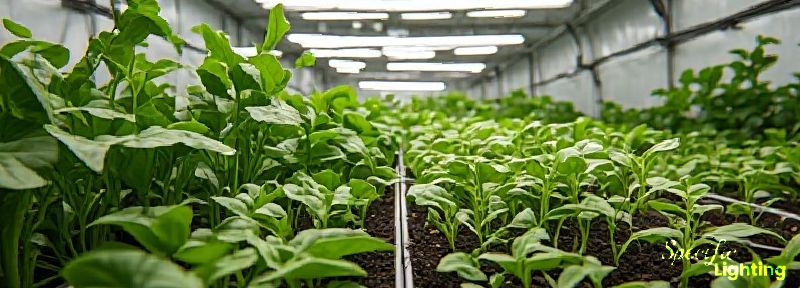
Herbs, Leafy Greens, and Microgreens
Leafy greens, herbs, and microgreens are common crops in indoor farms because they can fit well into compact production systems and relatively short growing cycles. However, their lighting requirements vary by species, cultivar, growth stage, and production method.
For many leafy greens, growers may investigate PPFD levels around 150 to 300 µmol/m²/s and photoperiods of 14 to 18 hours per day. These are planning ranges rather than universal prescriptions. Some cultivars perform well under lower intensities, while others benefit from different daily light levels when temperature, nutrition, and other growing conditions are properly managed.
Uniformity is particularly useful when growing plants on multi-tier shelves. If one section receives 280 µmol/m²/s while another receives only 140 µmol/m²/s, crop development may vary across the same rack. A well-designed system distributes light consistently while allowing the operator to adjust output as plants grow.
Plant Nurseries and Propagation
Commercial nurseries use grow lights to support seed germination, propagation, transplant development, and the production of ornamental plants. Different stages may require different light intensities and schedules, so adjustable fixtures can help operators manage changing needs.
Propagation areas also need practical fixture designs. Low-profile LEDs can fit above benches, while dimmable systems allow growers to increase output gradually as plants develop. In facilities with hundreds of trays, even a small improvement in usable growing space or crop consistency can influence daily operations.
When choosing nursery lighting, consider fixture spacing, bench dimensions, irrigation equipment, humidity, and cleaning procedures. A lighting layout should provide adequate illumination without obstructing routine plant handling or creating difficult-to-reach maintenance points.
Cannabis Cultivation
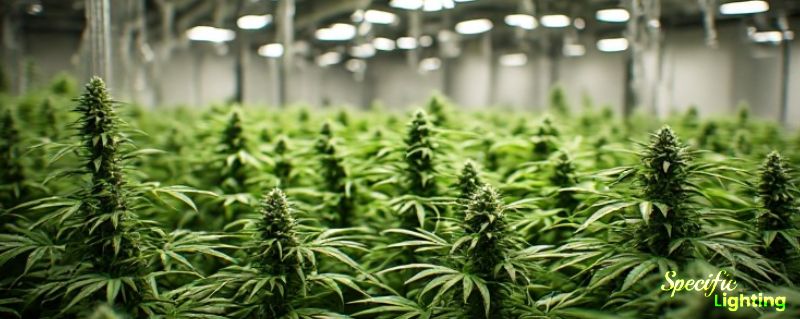
Cannabis cultivation is another application for controlled-environment lighting. Indoor growers typically evaluate PPFD, DLI, spectrum, canopy coverage, electrical efficiency, and dimming capability when selecting fixtures.
Lighting targets vary considerably by cultivar, growth stage, and cultivation strategy. High-intensity lighting can increase electricity consumption and heat loads, so environmental controls need to be considered alongside fixture selection. A system that delivers more light than the crop can use efficiently may increase costs without producing a proportional improvement in yield.
For commercial facilities, lighting plans should also account for ceiling height, mounting structures, electrical capacity, and local regulations. These factors affect installation cost and the amount of usable growing space.
Commercial Grow Lighting Solutions
Commercial grow lighting is a larger investment than a typical home setup, and the purchasing decision involves more than the fixture itself. Facility operators need to consider production targets, available floor space, energy use, installation access, automation, and ongoing maintenance.
The right solution should fit the way the facility operates, whether it relies on artificial lighting throughout the day or uses LEDs to supplement natural sunlight.
Vertical Farms
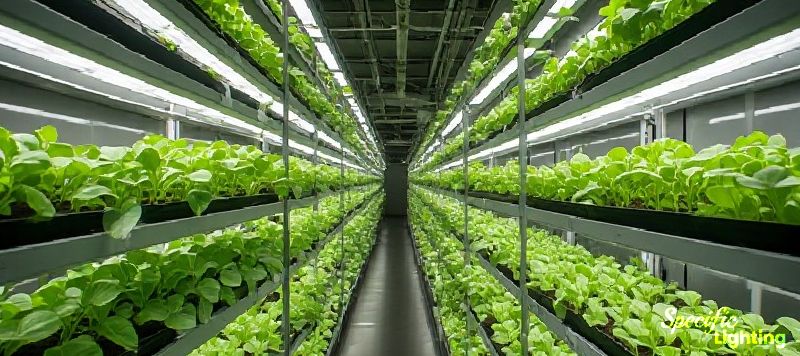
Vertical farming uses stacked growing layers to produce crops in a relatively small footprint. Since upper floors, neighboring buildings, or enclosed structures may limit access to sunlight, artificial lighting often supplies most or all of the light needed for crop growth.
LED fixtures are widely suited to vertical farms because their low-profile designs can fit between growing tiers. Many systems also support dimming and centralized controls, allowing operators to manage different zones or crop stages.
Consider a vertical farm with 100 growing racks, each covering 20 square feet. The total illuminated growing area is 2,000 square feet. If the design uses an average lighting power density of 20 watts per square foot, the connected lighting load would be 40,000 watts, or 40 kW.
Operating that system for 16 hours per day would consume 640 kWh daily. At US$0.15 per kWh, lighting electricity would cost approximately US$96 per day, or US$2,880 over a 30-day month.
These figures are an illustrative sizing scenario, not a universal vertical farming benchmark. Actual power density depends on fixture efficacy, target PPFD, light distribution, crop requirements, and whether the facility uses interlighting or other specialized arrangements.
Cooling and dehumidification can add to the energy bill. Nearly all electrical energy consumed by indoor lighting ultimately becomes heat within the facility, although the distribution and timing of that heat can vary. A vertical farm therefore needs to evaluate lighting and HVAC performance together.
Commercial Greenhouses
Greenhouses already receive natural sunlight, so their lighting strategy often focuses on supplementing daylight rather than replacing it entirely. Supplemental LEDs can extend the daily light period, compensate for cloudy weather, or improve growing conditions during darker seasons.
A greenhouse lighting design should begin with measurements of existing daylight. Roof material, structural shading, geographic location, seasonal conditions, and greenhouse orientation all affect the amount of light reaching the crop.
For example, a greenhouse may target a supplemental PPFD of 100 to 200 µmol/m²/s during low-light periods. Whether that range is appropriate depends on the crop, natural light contribution, and desired DLI. A facility growing tomatoes may require a different lighting strategy from one producing lettuce, ornamentals, or young transplants.
LED fixtures can also be arranged to accommodate different greenhouse structures. Overhead top lighting distributes light from above, while interlighting places fixtures within or between crop rows to reach lower leaves in taller plants. The latter may be useful in dense canopies, although installation access, fixture protection, and maintenance requirements need careful consideration.
Greenhouse operators should compare the expected improvement in crop performance with electricity and equipment costs. A system that runs only during low-light periods may have a different financial outcome from one operating for many hours every day.
Indoor Farms and Hydroponic Systems
Indoor farms provide a high degree of environmental control, making lighting one of the main variables operators can adjust. Hydroponic systems, which grow plants using nutrient solutions instead of conventional soil, are often used in these facilities.
Lighting must work alongside temperature, humidity, irrigation, nutrient delivery, and airflow. If the light intensity increases but the surrounding environment cannot support the crop’s needs, the expected production gains may not materialize.
For commercial indoor farms, useful design considerations include canopy-level PPFD, DLI, uniformity, fixture efficacy, dimming range, and compatibility with environmental controls. A central controller can coordinate lighting schedules across multiple growing zones, while sensors can help operators respond to changing conditions.
A good layout also leaves enough room for cleaning, harvesting, irrigation maintenance, and equipment replacement. Saving a little space by squeezing fixtures too tightly into a rack can create problems later if the design restricts airflow or makes maintenance difficult.
Stadium Grass and Sports Turf
Stadium turf lighting serves a different purpose from crop production lighting. Instead of growing vegetables for harvest, the goal is to help natural grass maintain coverage and recover from wear, especially in stadiums where stands, roofs, and other structures limit sunlight.
Professional football and soccer stadiums may use mobile grow light rigs equipped with horticultural lamps or LEDs. These units are positioned over sections of the pitch to supplement natural sunlight, often moving between areas according to turf condition and maintenance schedules.
The lighting strategy depends on grass species, season, field orientation, shade patterns, and the amount of recovery time available. Areas near stadium corners or beneath overhanging stands may receive substantially less sunlight than open sections of the pitch.
Unlike a simple greenhouse installation, stadium turf lighting may require mobile frames, motors, lifting equipment, protective structures, and dedicated electrical connections. Operators must also plan for safe movement around the field, storage space, and maintenance access.
LED turf systems may offer reduced electrical demand compared with some conventional lighting technologies, but performance depends on the equipment and the required light delivery. Turf managers should assess coverage, uniformity, portability, fixture durability, and operating schedules rather than compare wattage alone.
Golf Courses and Other Sports Facilities
Grow lighting can also support natural grass in selected golf course facilities, covered practice areas, indoor sports venues, and other locations where sunlight is limited. However, the requirements differ from one site to another.
For example, an indoor training field may need permanent overhead fixtures, while a professional stadium may use mobile rigs that can be moved to specific areas of the pitch. Golf course applications may be limited to specialized covered environments rather than large open fairways.
Before purchasing equipment, facility managers should map shaded areas, measure existing light conditions, identify the grass species, and establish the recovery or maintenance objectives. These steps help determine whether supplemental lighting is likely to provide enough value to justify the cost.
How to Choose the Best Grow Lights for Your Application
Once the growing environment is understood, the next step is to translate its needs into measurable equipment requirements. Comparing fixtures using consistent specifications makes it easier to avoid overspending or selecting a system that cannot deliver the desired light levels.
Calculate Light Intensity and Coverage
Start by identifying the target PPFD for the crop and growth stage. Then determine the illuminated area and how evenly light needs to be distributed across it.
Suppose a growing bench measures 3 × 6 feet, giving an area of 18 square feet, or approximately 1.67 square meters. If the design target is an average PPFD of 200 µmol/m²/s, the light reaching the bench would need to total approximately 334 µmol/s across that area.
This is a simplified estimate of photons reaching the crop, not the total PPF required from the fixtures. Some emitted light misses the growing area, and distribution losses depend on the mounting height, optics, spacing, and surrounding surfaces. Fixture selection should therefore use manufacturer photometric data and, where possible, a PPFD map for the proposed installation.
For commercial projects, a lighting simulation can estimate average PPFD, minimum PPFD, maximum PPFD, and uniformity before installation. On-site measurements can then confirm whether the finished system performs as planned.
Choose the Right Wattage and Lighting Efficiency
Wattage tells you how much electrical power a fixture draws, but it doesn’t tell you how effectively that power is converted into plant-usable light. That’s where PPE comes in.
Consider two fixtures with the same 600-watt input. If one delivers 2.5 µmol/J and the other delivers 3.2 µmol/J, their approximate PPF outputs would be 1,500 and 1,920 µmol/s, respectively, assuming those efficacy ratings apply at the stated operating conditions.
That difference can affect how many fixtures are needed to reach a target light level. However, a higher PPF doesn’t automatically guarantee better coverage. Optics, mounting height, beam distribution, and fixture spacing still matter.
Ask suppliers for verified power consumption, PPE, PPF, dimming performance, and photometric files. A complete comparison should also include the operating conditions under which the published specifications were measured.
Select Spectrum, Controls, and Environmental Protection
The best spectrum depends on the crop and production objective. Broad-spectrum fixtures are flexible, while specialized spectral configurations may suit specific crops or research requirements.
Dimming can help growers adapt light output to plant development, natural daylight, or changing electricity prices. Programmable schedules also make it easier to coordinate multiple zones without manually adjusting individual fixtures.
In greenhouses and humid growing rooms, check the fixture’s ingress protection (IP) rating and the manufacturer’s installation requirements. An IP65-rated enclosure, for example, is designed to provide dust protection and resistance to water jets under specified test conditions. It should not automatically be treated as suitable for every washdown procedure or immersion scenario.
Controls, drivers, connectors, and wiring need compatible environmental ratings as well. In large facilities, a well-planned control system can reduce manual work and make performance monitoring more consistent.
How Much Do Grow Lights Cost?
Grow light prices vary widely according to fixture size, efficiency, spectrum, construction quality, controls, and intended application. A small light for a seedling shelf may cost less than US$100, while a commercial LED fixture can cost several hundred dollars or more. Large-scale installations may involve substantial additional costs for electrical work, controls, mounting systems, and commissioning.
The figures below are broad planning estimates in US dollars, not current supplier quotations. Actual prices depend on the market, product specifications, order volume, shipping, and project requirements.
| Category | Estimated Cost / Figures |
|---|---|
| Consumer Grow Lights | US$20–US$150 |
| Hobbyist Grow Lights | US$100–US$500+ |
| Commercial LED Fixtures | US$200–US$1,000+ per fixture |
| Greenhouse Lighting | Several thousand to tens of thousands of US$+ |
| Stadium Turf Lighting Rigs | Several thousand to tens of thousands of US$+ per rig |
| Greenhouse (10,000 sq ft) | 100 kW; US$3,600/month electricity |
| Vertical Farm (2,000 sq ft) | 40 kW; US$60,000 for 200 fixtures; US$2,880/month electricity |
| Stadium Turf (10 Rigs, 12 Hours/Day) | US$180 per session |
| Lighting Upgrade | US$3,240 annual savings; US$18,000 extra investment; 5.6-year payback |
Note: Estimates assume electricity costs of US$0.15/kWh. Actual costs vary by project and operating conditions.
Grow Light Prices by Type and Application
Small consumer grow lights may range from approximately US$20 to US$150, depending on their design and output. Larger hobbyist fixtures can cost around US$100 to US$500 or more.
Commercial horticultural LED fixtures may fall within a broad range of approximately US$200 to US$1,000 or more per fixture. Higher-output products, specialized spectrum configurations, advanced controls, and demanding environmental specifications can push prices higher.
Greenhouse supplemental lighting projects may cost several thousand dollars for a small installation and tens of thousands of dollars or more for larger areas. Vertical farms can require substantial investment because each growing tier needs its own lighting, mounting, wiring, and control arrangements.
Stadium turf systems often require a different budget structure. Mobile rigs, mechanical frames, transport systems, and specialized installation work can make the total project cost much higher than the cost of the light sources alone. A reliable estimate should be based on field dimensions, shade conditions, turf requirements, and the number of rigs needed.
How Much Does a Commercial Grow Lighting System Cost?
A practical way to estimate lighting equipment requirements is to calculate the total connected load, then estimate the number of fixtures needed based on their actual output and coverage.
Consider a hypothetical greenhouse with 10,000 square feet of growing area. If the preliminary design uses 10 watts of supplemental lighting per square foot, the total lighting load would be 100 kW.
If the system operates for 8 hours per day, it would consume 800 kWh daily. At US$0.15 per kWh, the electricity cost would be US$120 per day, or about US$3,600 over a 30-day month.
At 300 operating days per year, the annual lighting electricity cost would be approximately US$36,000. If the system operated every day, the annual figure would be US$43,800.
The 10-watt-per-square-foot figure is an illustrative design assumption, not a recommended specification for every greenhouse. A real project should determine the target PPFD and DLI, account for available sunlight, and use fixture photometric data to calculate the required power and layout.
The initial project budget should also include electrical distribution, control equipment, mounting hardware, installation labor, commissioning, and any upgrades needed to support the additional electrical load.
How Much Does a Vertical Farm Grow Lighting System Cost?
Vertical farms can have high lighting costs because fixtures are installed across multiple growing levels. The budget depends on the number of tiers, rack dimensions, target light levels, and degree of automation.
Suppose a vertical farm has 2,000 square feet of illuminated growing area and requires an average connected lighting load of 20 watts per square foot. The resulting 40 kW installation would consume 640 kWh per day when operated for 16 hours.
At US$0.15 per kWh, that represents US$96 per day in lighting electricity. Over 365 days, the cost would reach US$35,040, before accounting for cooling, ventilation, and other facility loads.
If a project uses 200 fixtures drawing 200 watts each, the connected load would also be 40 kW. If each fixture costs US$300, the fixture purchase alone would total US$60,000. This example illustrates how equipment costs can accumulate, but the assumed fixture count and price are not a quotation or a recommended design.
A complete vertical farm budget should distinguish fixture purchases from installation, rack integration, controls, electrical infrastructure, HVAC, and commissioning. Evaluating the cost per square foot of growing area can help compare different layouts, provided the systems deliver comparable light levels and production capacity.
How Much Does Stadium Turf Grow Lighting Cost?
Stadium turf lighting costs depend on the size of the pitch, the amount of shade, the grass species, and whether the venue needs mobile rigs or a fixed installation.
For budgeting purposes, a specialized turf lighting rig may cost several thousand dollars to tens of thousands of dollars or more, depending on its technology and mechanical design. A project requiring multiple rigs can therefore reach a six-figure equipment budget, with installation, power distribution, storage, and maintenance adding to the total.
These figures are broad planning allowances rather than verified market prices. Stadium operators should obtain project-specific quotations that clearly distinguish the cost of light sources, mobile structures, controls, transport equipment, and servicing.
The operating cost also deserves attention. A 10 kW rig running for 12 hours consumes 120 kWh. At US$0.15 per kWh, that equals US$18 per operating session. If 10 rigs run for the same duration, the total electricity cost would be US$180 per session, before any additional energy or labor expenses.
Calculate Electricity Costs and Return on Investment
A simple electricity cost formula can help compare lighting options:
Annual electricity cost = fixture power in kW × operating hours per day × operating days per year × electricity price per kWh.
For example, a 30 kW lighting system running 12 hours per day for 300 days consumes 108,000 kWh annually. At US$0.15 per kWh, its annual electricity cost is US$16,200.
Now suppose a replacement system uses 24 kW while delivering the required light levels. Under the same schedule, it consumes 86,400 kWh annually, costing US$12,960. The estimated annual electricity saving would be US$3,240.
If the replacement project costs US$18,000 more than the alternative, the simple payback period would be approximately 5.6 years, calculated by dividing the additional investment by the annual electricity saving.
This calculation excludes financing, maintenance differences, changes in cooling demand, utility tariffs, and crop-related revenue. It also assumes that both systems deliver comparable lighting performance. For a more complete evaluation, include these variables and use the expected service life of the equipment.
Best Commercial Grow Lights – What Should You Compare?
Rather than choosing a product based on a headline efficiency rating, commercial buyers should compare fixtures against the requirements of their own facility. A greenhouse fixture and a vertical farm fixture may have different beam patterns, mounting needs, environmental ratings, and control features even when their electrical specifications look similar.
Specifications for Commercial LED Grow Lights
Start with PPF, PPE, power consumption, spectral distribution, dimming range, and light distribution. Then check the fixture’s operating temperature range, environmental rating, driver specifications, and expected service life.
Warranty terms deserve a close look as well. A five-year warranty and a claimed 50,000-hour lifetime describe different things, and neither guarantees that every component will perform identically for the full period. Ask how lifetime is defined and whether the warranty covers the driver, LEDs, controls, and labor.
For a commercial project, request a photometric layout or lighting simulation showing expected PPFD and uniformity across the growing area. That makes it easier to compare two systems based on what they deliver rather than on marketing language.
How to Choose a Grow Light Manufacturer or Supplier
A dependable supplier should be able to explain how its products fit your application, provide technical documentation, and support the installation after purchase. For larger projects, the supplier’s ability to handle custom layouts, controls, bulk orders, and replacement parts can affect long-term operating efficiency.
Check applicable safety certifications, product documentation, warranty coverage, and the availability of technical support. If the supplier offers OEM or ODM services, confirm the scope of customization, minimum order quantities, production lead times, and quality-control arrangements before placing an order.
It is also worth requesting references or project examples from comparable facilities. A supplier experienced in small indoor gardens may not have the same project capabilities as one that routinely serves commercial greenhouses, vertical farms, or sports stadiums.
Frequently Asked Questions About Grow Lighting
How Many Hours a Day Should Grow Lights Be On?
Most leafy greens grow well with around 14–18 hours of light per day, while other crops may need shorter or different schedules. The ideal duration depends on the plant type, growth stage, and daily light integral (DLI). Plants also need a suitable dark period, so keeping grow lights on 24 hours a day is not recommended for every crop.
Are LED Grow Lights Better Than HPS Lights?
LED grow lights generally offer better energy efficiency, adjustable light intensity, and greater spectrum control than traditional high-pressure sodium (HPS) lights. They also produce less radiant heat toward plants in many applications. However, performance varies by fixture and growing conditions. Compare light output, electricity consumption, maintenance costs, and upfront investment before choosing a system.
How Much Electricity Do Grow Lights Use?
Electricity consumption depends on fixture wattage and daily operating hours. For example, a 500-watt grow light running for 16 hours uses 8 kWh per day. At US$0.15 per kWh, that costs US$1.20 daily or approximately US$36 over 30 days. Commercial facilities should also account for the number of fixtures and the energy used by ventilation, cooling, and other equipment.
Can Grow Lights Replace Sunlight Completely?
Yes, grow lights can provide the light needed for indoor crop production when they deliver the appropriate spectrum, intensity, and daily light exposure. However, successful plant growth also requires suitable temperature, humidity, airflow, water, and nutrients. A well-designed indoor growing system manages all these conditions together.
How Long Do Commercial LED Grow Lights Last?
Many commercial LED grow lights are rated for 50,000 operating hours or more, depending on the model and manufacturer. At 16 hours of operation per day, 50,000 hours equals approximately 8.6 years. Actual service life depends on operating temperature, electrical conditions, component quality, and maintenance. Light output may also decrease over time.
What Is the Best Light Spectrum for Plant Growth?
The best spectrum depends on the crop and its growth stage. Blue light supports compact vegetative growth, while red light plays a major role in photosynthesis and flowering responses. Many commercial growers choose full-spectrum LED fixtures because they provide a balanced light output suitable for multiple growth stages. The ideal choice depends on crop requirements and production goals.
How Do I Calculate the Number of Grow Lights Needed?
Start by measuring the growing area and identifying the target photosynthetic photon flux density (PPFD). Then review each fixture’s light distribution, output, and recommended coverage area. For example, if a 1,000-square-foot growing area requires 200 µmol/m²/s, the lighting plan should be designed to achieve that level uniformly across the canopy. A professional lighting layout can help prevent dark spots and unnecessary energy use.
What Is the Difference Between PPFD and DLI?
PPFD measures the amount of photosynthetically active light reaching one square meter each second, expressed in µmol/m²/s. Daily light integral (DLI) measures the total amount of that light received over a full day, expressed in mol/m²/day. PPFD helps determine light intensity, while DLI helps growers assess whether plants receive enough light throughout the day.
Are Commercial Grow Lights Suitable for Greenhouses?
Yes. Commercial grow lights are commonly used in greenhouses to supplement sunlight during cloudy weather, winter months, and periods of shorter daylight. Growers can choose overhead LED fixtures or interlighting systems, depending on crop structure and canopy needs. A good design accounts for natural sunlight, target light levels, energy costs, and fixture protection against moisture.
Are Waterproof Grow Lights Necessary?
Water-resistant or appropriately rated fixtures are often recommended in greenhouses, hydroponic facilities, and other humid growing environments. The required ingress protection (IP) rating depends on exposure to moisture, dust, irrigation spray, and cleaning procedures. Always check the manufacturer’s specifications and follow applicable electrical safety requirements before installing fixtures in wet areas.
How Can I Reduce the Operating Costs of Grow Lighting?
Choose efficient fixtures, match light intensity to crop requirements, and use dimming or scheduling controls where appropriate. Regularly clean fixtures and inspect the system to maintain performance. For commercial projects, compare total ownership costs, including equipment, electricity, installation, maintenance, and cooling. A lighting audit can reveal opportunities to reduce energy use without compromising crop production.
Build a Grow Lighting System That Fits Your Project
Choosing grow lighting is ultimately about finding the right balance between plant performance, installation cost, electricity consumption, and long-term reliability. A small indoor growing shelf may need only a straightforward LED fixture, while a commercial greenhouse, vertical farm, or stadium turf project calls for a more detailed lighting plan based on measurable requirements and operating conditions.
Before investing, define your target light levels, estimate the connected load, compare fixture efficiency, and calculate the full project cost rather than looking at equipment prices alone. A well-planned system can make lighting performance easier to manage and provide a clearer picture of its expected operating costs.
If you’re planning a new installation, upgrading an existing facility, or comparing commercial LED grow lighting options, contact our team for a grow lighting consultation. We can help you evaluate your application, review lighting specifications, explore suitable fixture configurations, and develop a solution that aligns with your growing area, technical requirements, and budget.