
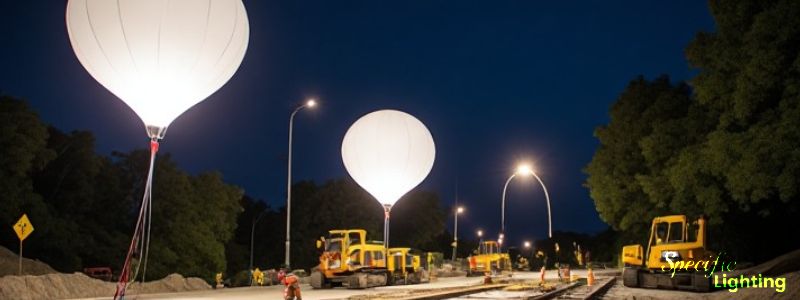
Balloon lighting offers a practical way to illuminate large areas with soft, evenly distributed light. By combining an inflatable, helium-filled balloon with an integrated LED lighting system, it creates a lighting solution that can be adapted to film sets, construction sites, industrial maintenance projects, outdoor events, and other demanding environments. Unlike conventional floodlights that concentrate light into a relatively narrow beam, a well-designed balloon light can spread illumination over a broader area while reducing harsh shadows and glare.
However, not every project has the same lighting requirements. A film crew may need a large, soft light source with precise color control, while a construction contractor may prioritize high light output, long operating hours, and reliable performance at night. Some applications require a spherical balloon, while others benefit from an elongated capsule shape or a completely customized design. Power requirements can also vary, from battery-powered systems for mobile operations to AC-powered configurations for extended use.
That is where custom balloon lighting comes into its own. Instead of forcing every application into a standard product, manufacturers can tailor the balloon shape, dimensions, LED configuration, power supply, mounting system, and control options to the actual working environment. The result is a lighting system designed around the project rather than the other way around.
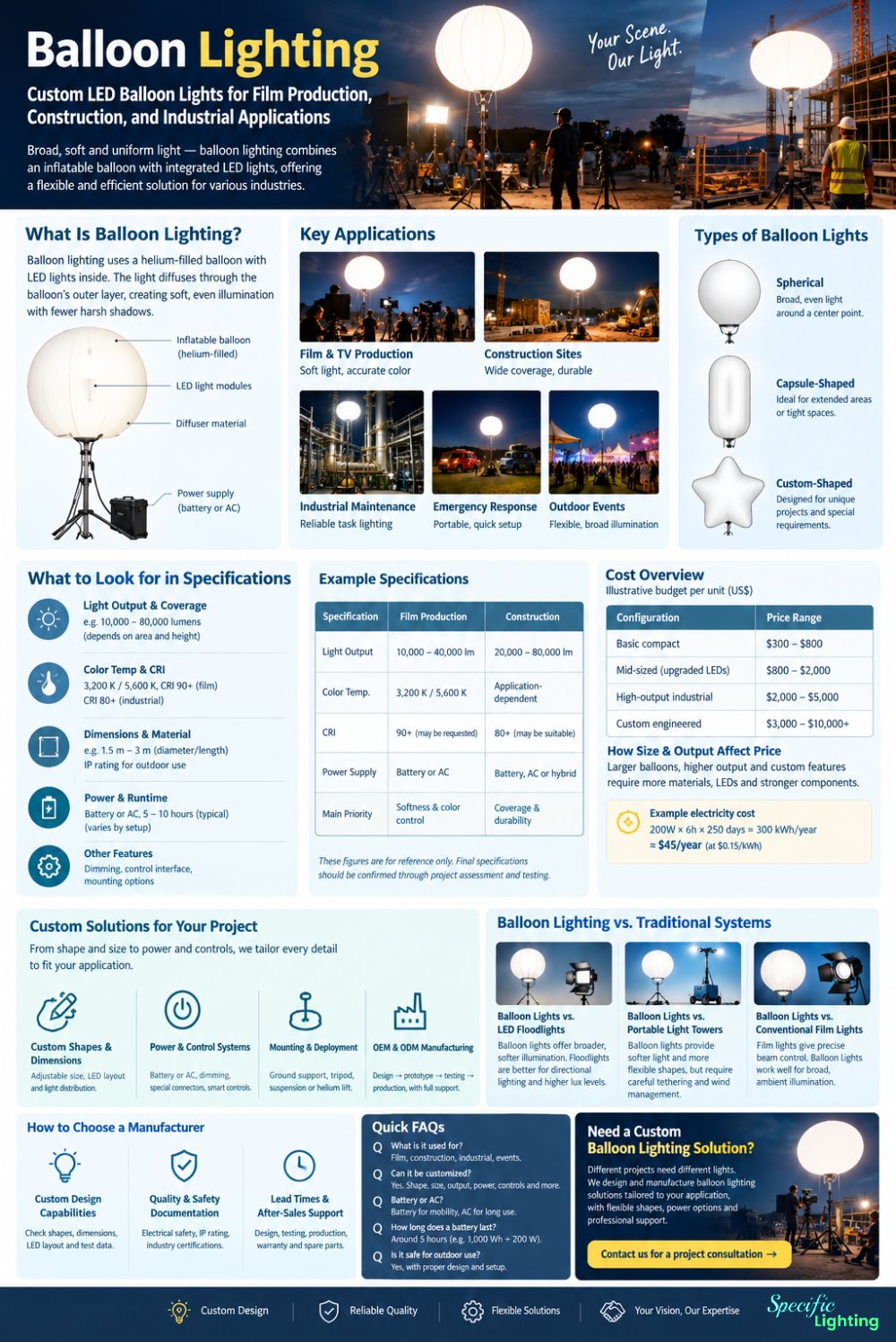
What Is Balloon Lighting and How Does It Work?
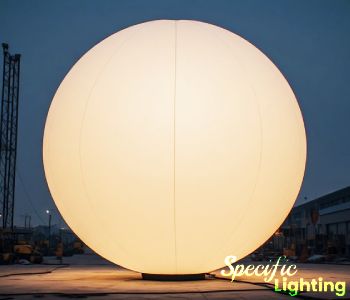 Balloon lighting is an inflatable lighting system that combines a balloon-shaped enclosure with an integrated light source. In the configuration discussed here, the balloon contains LED lighting components and uses helium to provide lift when the design requires an elevated light source. The balloon can be spherical, capsule-shaped, elongated, or manufactured in a custom geometry to suit a particular application.
The basic idea is straightforward. LEDs generate light inside the balloon, and the balloon’s translucent outer material diffuses that light before it reaches the surrounding area. Instead of seeing individual bright LED points or a concentrated beam, people working nearby receive a broader, softer source of illumination.
The actual performance depends on the complete system, including the LED arrangement, diffuser material, balloon dimensions, light output, and distance from the illuminated surface. Helium provides buoyancy, but it does not automatically make a lighting system safe to deploy at any height or in any weather. The balloon’s weight, tethering arrangement, wind exposure, and support equipment must all be considered during design.
How Does an LED Balloon Light Produce Soft Illumination?
LEDs are efficient light sources that can be arranged around the inside of an inflatable enclosure. When the light passes through a suitable diffuser, it spreads across a larger apparent surface area. This helps reduce the harshness associated with exposed point sources and conventional directional lighting.
For example, a small LED assembly concentrated in one location may create a bright patch on the balloon surface. Distributing the LEDs around the interior can help produce more uniform illumination. The appropriate arrangement depends on the balloon’s shape, the required brightness, and the optical properties of its outer material.
For film production, the goal may be to create soft light across a wide scene without introducing distracting shadows. For construction work, the objective may be to illuminate a work zone evenly enough for workers to see tools, equipment, and surface conditions clearly. These are different targets, so the LED layout and diffuser should be selected accordingly.
What Are the Main Components of a Balloon Lighting System?
A balloon lighting system generally includes the inflatable enclosure, LED modules, power supply, electrical connections, and a method of positioning or securing the equipment. Depending on the design, it may also include a dimming controller, a carrying case, inflation equipment, mounting accessories, and monitoring features.
The enclosure determines the overall shape and plays a major role in light diffusion. The LED assembly determines the light output, color characteristics, and electrical demand. The power system determines whether the light can operate independently or requires a continuous AC connection.
For helium-supported designs, the lifting capacity must account for the complete suspended assembly, including the balloon material, lighting components, wiring, and accessories. If the system is not intended to float freely, a supported or ground-mounted configuration may be more appropriate. A custom design should establish these requirements before the physical dimensions are finalized.
Applications of Balloon Lighting
Balloon lighting can serve a range of applications because its shape, light output, and power system can be adjusted. The same basic technology can support a compact mobile setup or a larger lighting installation for an extensive work area. The best configuration depends on what people need to see, how long the light must operate, and where the equipment will be positioned.
| Application | Main lighting priority | Potential design direction |
|---|---|---|
| Film and television | Soft light and color consistency | Large diffuser with adjustable output |
| Construction sites | Broad coverage and dependable operation | High-output system with suitable anchoring |
| Industrial maintenance | Visibility around equipment | Custom shape and adjustable positioning |
| Emergency response | Rapid deployment and mobility | Battery-powered configuration |
| Outdoor events | Broad, comfortable illumination | Custom dimensions and controlled deployment |
Film and Television Production
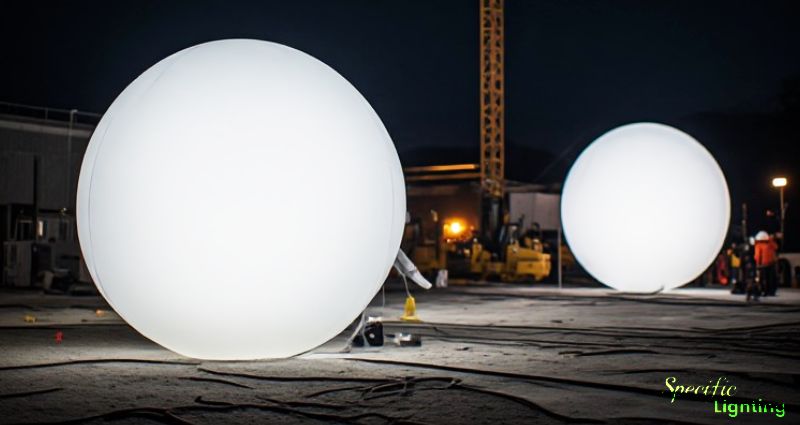
Film crews often need to illuminate a scene without making the lighting equipment itself too obvious. Hard light can create sharp shadows, pronounced highlights, and an appearance that does not fit the intended visual style. Balloon lighting provides another option by creating a large, diffused source that can illuminate actors, sets, and surrounding areas.
A balloon light suspended above or positioned beside a set can provide broad ambient illumination. The cinematography team can then use smaller lights to add highlights, shape faces, or create specific visual effects. This approach can be useful for night scenes, outdoor productions, commercial shoots, and large interior sets.
Color performance also matters. A production team may request a color temperature of 3,200 K for a tungsten-style setup or 5,600 K for a daylight-oriented setup. These values are common reference points rather than universal requirements. A custom system may offer a fixed color temperature or an adjustable range, depending on the LED modules and control electronics.
Color rendering should also be specified. A high color-rendering index, such as CRI 90 or above, can be a useful target for productions where accurate skin tones and set colors matter. However, CRI alone does not fully describe the spectral quality of a film light. Teams may also request TLCI measurements, flicker testing at intended frame rates, and confirmation of performance when dimmed.
For example, a production company filming a nighttime street scene might request a spherical balloon with a diameter of 2 m, adjustable output, daylight color temperature, and an AC power option for long shooting days. Another crew may prefer a smaller battery-powered unit for locations where cable runs would interfere with camera movement. These are starting specifications for a design discussion, not guaranteed off-the-shelf configurations.
Construction Sites
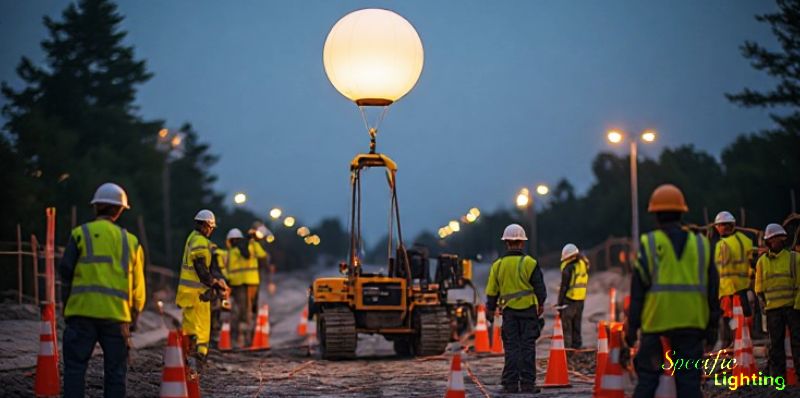
Construction projects often continue after sunset, particularly when road closures, equipment availability, or project schedules limit the working window. In these situations, workers need sufficient illumination across the work area without excessive glare or deep shadows.
Balloon lighting can provide broad illumination for roadwork, bridge maintenance, infrastructure projects, excavation areas, and temporary construction zones. Compared with a narrow beam, a large diffused source may help reduce harsh contrasts across the illuminated scene. The actual result depends on mounting height, output, distance, and the surrounding environment.
For a small work zone, a contractor might begin by evaluating a system delivering around 20,000 to 50,000 lumens. A larger area or a site with demanding visibility requirements may need multiple units or a higher total output. These figures are preliminary planning examples, not a substitute for a lighting layout or site-specific lux calculations.
Construction buyers should evaluate the light level at the working surface rather than relying on lumens alone. Lumens describe the total light emitted by a source, while lux describes the light reaching a given area. A fixture producing 40,000 lumens will not necessarily provide the same illumination across every site because mounting height, balloon size, light distribution, and distance all affect the result.
Outdoor deployment also requires attention to wind and weather. A helium-supported balloon presents an exposed surface to the wind, and the resulting forces can increase rapidly as wind speed rises. Anchoring, tethering, operating limits, electrical protection, and the manufacturer’s instructions must therefore be considered together. A balloon light should not be deployed outdoors merely because its enclosure is inflatable.
Industrial Maintenance and Temporary Work Areas
Industrial maintenance projects can involve equipment inspections, shutdowns, repairs, and work in areas where permanent lighting is insufficient. A portable balloon lighting system can provide temporary illumination without requiring a complete lighting installation.
A capsule-shaped balloon may suit a long maintenance corridor or an extended section of equipment. A spherical design may be more suitable when broad illumination is required around a central work area. Custom shapes can also be considered when the available installation space is restricted or when existing machinery limits where the light can be positioned.
Industrial buyers should consider more than light output. The design may need a suitable ingress protection rating, temperature tolerance, durable materials, protected electrical connections, and mounting hardware compatible with the worksite. Environments involving combustible dust, flammable gases, or other hazardous-area classifications require specifically approved equipment. A conventional balloon light should not be assumed suitable for hazardous locations without documented compliance.
Emergency Response and Outdoor Events
Emergency response teams may need temporary illumination at remote locations, damaged infrastructure, or work areas without dependable mains electricity. A battery-powered balloon light can reduce reliance on nearby outlets and help crews position the lighting where it is needed.
Runtime is a major factor. A system drawing 200 W and operating for 4 hours consumes 800 Wh of electrical energy before accounting for conversion losses and reserve capacity. The required battery size will depend on usable capacity, temperature, battery chemistry, and the system’s discharge limits. Buyers should request a realistic runtime estimate based on the actual operating conditions.
Outdoor events and temporary venues present a different set of requirements. Organizers may value a distinctive illuminated balloon shape, broad coverage, manageable noise levels, and convenient transportation. In these cases, the system’s appearance can be part of the design, while electrical safety and secure positioning remain necessary.
Types of Balloon Lighting Systems
The balloon’s shape affects how the system looks, how its internal components can be arranged, and how the light reaches the surrounding area. Shape selection should therefore begin with the intended application rather than appearance alone.
Spherical Balloon Lights
Spherical balloon lights are suitable for applications that need a broad light source around a central position. Their relatively symmetrical geometry can support a balanced LED layout and provide illumination across several directions.
For film sets, a spherical design can be useful when a large, soft source is required above or beside the scene. At construction sites, it may serve as part of a temporary area-lighting arrangement. The final performance will depend on the diffuser, LED placement, output, and distance from the work surface.
A 1.5 m diameter sphere has a projected frontal area of approximately 1.77 m², while a 2 m sphere has a projected frontal area of approximately 3.14 m². The larger sphere offers more room for internal components and a larger potential diffusing surface, but it also requires more attention to transportation, structural support, and wind loading. The balloon’s volume and surface area should be evaluated alongside its lighting performance.
Capsule-Shaped Balloon Lights
Capsule-shaped balloon lights have an elongated profile that can suit long work areas or lighting arrangements where the source needs to extend along a particular direction. Depending on the design, LEDs can be distributed along the length of the enclosure to create a continuous illuminated surface.
For example, a project may require a capsule approximately 3 m long and 1 m in diameter. That configuration could be considered for an extended maintenance area or a film set where the available mounting space favors an elongated source. Whether it provides the desired light distribution must be confirmed through optical design and testing.
The design also affects buoyancy and mechanical stability. An elongated balloon may respond differently to crosswinds than a spherical one, and its internal frame or suspension points may need a different arrangement. Custom dimensions should be assessed as a complete system rather than treated as a simple change to the outer cover.
Custom-Shaped Balloon Lights
Not every application fits a sphere or capsule. Some projects require a specific profile because of installation constraints, equipment geometry, transportation limits, or desired lighting coverage.
A custom balloon might use a flattened form, an elongated asymmetric shape, or a design developed around a particular mounting arrangement. The manufacturer must determine whether the proposed geometry can be inflated reliably, diffuse light evenly, support the lighting components, and remain stable during operation.
Custom shapes can also introduce engineering trade-offs. Narrow sections may create uneven illumination, while larger dimensions may increase wind exposure and the amount of helium needed. A prototype can help verify the appearance, inflation behavior, light distribution, and practical handling before the design moves into production.
Balloon Lighting Specifications – What Should Buyers Look For?
A useful specification sheet should describe the complete lighting system, not just the balloon diameter or LED wattage. Buyers need to understand the expected illumination, electrical requirements, operating conditions, and installation method before comparing quotations.
Light Output, Illuminance, and Coverage
Light output is commonly measured in lumens, while illuminance is measured in lux. These two values describe different things, and both can be useful when specifying balloon lighting.
For a simplified example, 20,000 lumens distributed uniformly over 100 m² would correspond to an average of 200 lux before accounting for optical losses, nonuniform distribution, obstructions, and other real-world factors. Actual illuminance can differ substantially, so the calculation should be treated as an initial estimate rather than a guaranteed result.
The required level depends on the task. A film scene may prioritize the ability to control the look of the light, while detailed industrial work may need higher illumination on specific surfaces. Construction areas also have different requirements depending on whether workers are moving equipment, handling materials, or performing detailed tasks.
A manufacturer can use the target area, mounting height, working distance, and desired lux level to estimate the number and output of the required fixtures. For complex installations, a photometric layout using an appropriate lighting simulation can help compare configurations before purchasing.
Color Temperature, Color Rendering, and Flicker Performance
Color temperature affects the appearance of the light. A value near 3,200 K is commonly associated with warm, tungsten-style lighting, while 5,600 K is often used for daylight-oriented film setups. Industrial applications may use other values depending on the visual task and existing lighting.
Color rendering is another consideration. CRI 80 may be acceptable for some general work lighting, while CRI 90 or higher may be requested for film production, inspection, or tasks involving color judgment. The actual requirement should be stated in the project specification rather than assumed from the product category.
For video work, buyers should ask about flicker performance at the intended frame rates, shutter settings, and dimming levels. A light that appears stable to the naked eye may still create visible banding or flicker in recorded footage. Test results under the intended operating conditions are more useful than a broad claim that the light is flicker-free.
Balloon Dimensions, Materials, and Environmental Protection
Balloon dimensions affect the illuminated surface, internal component layout, transport requirements, and mechanical loading. A larger balloon can provide more room for diffusing light, but it may also require more lifting capacity, stronger attachment points, and more space during setup.
The outer material should be selected according to the expected environment. Relevant properties may include light transmission, diffusion, tear resistance, seam strength, cleanability, and resistance to environmental exposure. A material that performs well in a controlled studio may not be appropriate for a construction site.
The ingress protection rating should also match the application. IP ratings describe specific levels of protection against solid objects and water under defined test conditions. Buyers should verify the rating of the complete relevant assembly, including connectors and power equipment, rather than relying solely on the balloon material’s characteristics.
Power Supply, Runtime, and Electrical Requirements
The two main power configurations are battery-powered and AC-powered systems. Battery power can make deployment easier in remote locations, while AC power may suit long operating periods where a reliable electrical supply is available.
The required battery capacity can be estimated from power consumption and runtime. A 200 W light operating for 5 hours uses approximately 1,000 Wh of energy. Allowing for conversion losses and reserve capacity, the battery would need a rated capacity greater than 1,000 Wh to deliver that operating period reliably.
AC systems require the correct input voltage, current capacity, cable arrangement, and electrical protection for the deployment environment. Buyers should also confirm whether dimming affects power consumption and whether the system supports backup power or alternative input configurations.
Sample Specification Comparison
The following table shows example design targets for different applications. These figures are illustrative starting points for consultation, not specifications of an existing standard product.
| Specification | Film production | Construction work |
|---|---|---|
| Example light output | 10,000 to 40,000 lm | 20,000 to 80,000 lm |
| Color temperature | 3,200 K or 5,600 K | Application-dependent |
| Color rendering | CRI 90+ may be requested | CRI 80+ may be suitable |
| Power configuration | AC or battery | AC, battery, or hybrid |
| Main design focus | Softness and color control | Coverage and durability |
| Shape options | Sphere or custom | Sphere, capsule, or custom |
Actual requirements should be determined through testing, site assessment, and applicable lighting standards. A higher lumen rating does not automatically mean a better solution if the light distribution, color quality, or deployment method is unsuitable.
Custom Balloon Lighting Solutions for Different Projects
Customization is where balloon lighting becomes particularly useful. Instead of selecting from a limited range of fixed sizes and power options, buyers can work with a manufacturer to develop a configuration around their project’s specific constraints.
Custom Shapes, Sizes, and Internal LED Layouts
The first design decision is the required illuminated area and the space available for installation. A compact spherical light may suit a mobile film crew, while a larger capsule may be better suited to an extended work zone. Custom dimensions can be developed around transportation limits, mounting height, and the distance between the light and the target area.
The internal LED arrangement should be designed alongside the enclosure. More LEDs do not necessarily produce a better result if they create uneven brightness or excessive heat. The objective is to achieve the required light output and distribution while maintaining manageable power consumption and suitable thermal performance.
A practical design process may begin with a target lumen range, balloon dimensions, color temperature, and operating distance. A prototype or test assembly can then be used to evaluate illumination, appearance, and handling before finalizing the design.
Customized Power and Control Systems
Power requirements often determine whether a balloon lighting system is practical for a particular job. A film crew working in a remote location may favor a battery-powered system with adjustable output, while a construction project operating for 10 hours per shift may benefit from an AC-powered configuration.
Dimming controls can help users adjust the output to match changing conditions. Film productions may also request separate control channels or compatible dimming interfaces, while industrial users may prefer straightforward controls that can be operated while wearing work gloves.
The manufacturer should confirm the available control functions, power input, connectors, and expected runtime during the quotation stage. If a project requires a hybrid configuration, the system design should establish how the power sources interact and whether switching can occur safely.
Customized Mounting, Tethering, and Deployment
The method of positioning the light can be just as significant as the light itself. A balloon may be ground-supported, mounted on a suitable structure, suspended from an approved rigging arrangement, or designed to use helium buoyancy with a controlled tethering system.
Each method creates different mechanical requirements. A tethered helium balloon needs sufficient lifting capacity for its suspended mass and must remain controllable under expected wind conditions. A ground-supported system avoids relying on buoyancy for positioning but may require a mast, frame, tripod, or other support structure.
Custom mounting options can include tailored attachment points, cable routing, transport cases, and interfaces with existing equipment. The correct choice depends on the site, available space, operating height, and applicable safety procedures.
OEM and ODM Balloon Lighting Manufacturing
Businesses developing their own product range may need an OEM or ODM manufacturing partner. OEM arrangements generally involve manufacturing to the buyer’s defined design or specifications, while ODM arrangements may involve the manufacturer contributing more of the product design.
For custom balloon lighting, the development process can include requirement gathering, preliminary design, prototype fabrication, performance testing, design revisions, and production planning. The exact stages depend on project complexity and the amount of existing engineering work.
A straightforward configuration may require fewer development steps than a new balloon geometry with specialized electrical controls. Buyers should clarify prototype fees, engineering charges, minimum order quantities, tooling requirements, and production lead times before approving the project.
How Much Does Balloon Lighting Cost?
Balloon lighting prices vary according to the light output, balloon dimensions, LED quality, power supply, enclosure materials, control functions, and degree of customization. A simple configuration and a fully engineered industrial system can have very different costs, so a single price range cannot accurately represent every product.
For initial budgeting, buyers can use illustrative planning ranges, provided they understand that these are not verified market quotations or offers for a specific configuration.
Estimated Balloon Lighting Price Ranges
The following figures are indicative budgeting examples in US$, not confirmed supplier prices. They are intended to show how product complexity may affect a project’s preliminary budget. Actual prices should be obtained from a manufacturer based on a defined specification.
| Configuration | Illustrative budget per unit |
|---|---|
| Basic compact LED balloon light | US$300 to US$800 |
| Mid-sized system with upgraded LEDs | US$800 to US$2,000 |
| High-output industrial configuration | US$2,000 to US$5,000 |
| Custom-engineered system with specialized features | US$3,000 to US$10,000+ |
These ranges may not cover every market or product category. They should not be used as a substitute for supplier quotations, particularly where helium handling, specialized mounting, certification, custom tooling, or complex control electronics are involved. Some designs may fall outside these ranges.
How Balloon Size and Light Output Affect Cost
Larger balloon lights may require more material, additional structural support, a more extensive LED assembly, and greater lifting capacity. They can also require more development work to maintain uniform illumination across the expanded surface.
Light output is another cost factor. Increasing output may require additional LEDs, more powerful drivers, improved heat management, and a larger power supply. However, price does not always increase in direct proportion to lumens because component efficiency and the overall system design also matter.
For example, a project requiring 20,000 lumens may be achievable with a relatively compact design, depending on the target illuminance and coverage. A requirement for 60,000 lumens across a large area may call for a larger system or multiple fixtures. Before comparing prices, buyers should confirm whether the quoted lumen figures are measured output values and whether the same test conditions are used.
Battery-Powered vs. AC-Powered Balloon Lighting Costs
Battery-powered systems typically require a battery pack, charging equipment, battery management electronics, and potentially additional protection and monitoring features. These components can increase the initial purchase price, but they may reduce the need for temporary electrical infrastructure at remote sites.
AC-powered systems may have a lower initial cost when the installation can use an existing, suitable electrical supply. They can also be convenient for long shifts, although cable routing, outlet availability, and electrical protection must be included in the deployment plan.
Consider a 200 W system operating for 6 hours per day over 250 working days. Its annual energy consumption would be approximately 300 kWh. At an illustrative electricity rate of US$0.15 per kWh, the annual electricity cost would be US$45. This calculation covers energy consumption only and excludes the purchase price, installation, maintenance, and any battery replacement.
For battery systems, the calculation is different because the buyer must consider battery purchase and replacement costs, charging efficiency, usable capacity, and the number of operating cycles. The lower-energy-cost option is not automatically the lowest-cost option overall.
Custom Engineering, Prototypes, and Bulk Orders
A custom balloon shape, specialized mounting system, or unique control interface may require engineering work before manufacturing begins. Depending on the project, the quotation may include design fees, prototype costs, tooling, testing, certification, and production setup.
For example, a buyer ordering 100 units should not assume the unit price will simply equal the price of one unit multiplied by 100. Larger production volumes may reduce per-unit manufacturing costs, but engineering, tooling, quality control, packaging, and logistics can affect the final quotation.
A clear quotation should separate recurring unit costs from one-time development expenses where possible. Buyers should also ask about minimum order quantities, prototype approval, payment terms, warranty coverage, replacement parts, packaging, shipping, and any applicable import duties.
The most useful way to compare two quotations is to ensure that they cover the same specifications. A US$1,000 unit with a different lumen output, battery capacity, or protection rating cannot be compared fairly with a US$1,000 unit that has a different configuration.
How to Request an Accurate Balloon Lighting Quote
A detailed request helps the manufacturer recommend a suitable configuration and avoid unnecessary design revisions. Start by describing the application, the size of the area to be illuminated, the expected operating hours, and whether the system will be used indoors or outdoors.
Next, provide any known requirements for balloon dimensions, shape, lumen output, color temperature, battery runtime, AC input, mounting arrangement, and environmental protection. If some specifications are unknown, it is perfectly reasonable to explain the working conditions and ask the manufacturer to propose suitable options.
A good quotation should identify the proposed configuration, included accessories, electrical specifications, estimated lead time, and any assumptions that affect the price. For custom projects, it should also explain how prototypes and design changes will be handled.
Balloon Lighting vs. Traditional Lighting Systems
Balloon lighting is not intended to replace every floodlight, light tower, or film fixture. It offers a different approach to illumination, and its suitability depends on the working environment and the desired lighting effect.
Balloon Lights vs. LED Floodlights
LED floodlights can deliver concentrated illumination across a defined area and are widely used for general industrial and outdoor lighting. They may be suitable when high-intensity directional light is needed or when equipment must be mounted on an existing structure.
Balloon lights are designed to create a larger diffusing surface, which can help soften shadows and reduce the harsh appearance of exposed point sources. They may be useful when the quality and spread of the light matter as much as the total output.
A contractor should compare the actual lux distribution, glare, installation height, and total system cost rather than assuming one technology will always outperform the other.
Balloon Lights vs. Portable Light Towers
Portable light towers can illuminate substantial outdoor areas and may be appropriate for roadwork, construction projects, and large work zones. They often use elevated fixtures mounted on a mast and may provide high output over a wide area.
Balloon lighting can be considered when a softer source or a more compact lighting arrangement is preferred. Depending on the configuration, it may also offer flexibility in shape and positioning. However, a helium-supported balloon has its own requirements for tethering, lifting capacity, and wind management, which should be compared with the deployment requirements of a conventional light tower.
Balloon Lights vs. Conventional Film Lighting
Traditional film fixtures provide a wide range of beam shapes, modifiers, and control options. They remain useful when a director of photography needs a tightly controlled beam, a particular optical effect, or a highly specific lighting ratio.
Balloon lights offer another tool for creating broad, diffused illumination across a scene. A production may combine a balloon light with smaller fixtures rather than choosing one system exclusively. The most suitable arrangement depends on the scene, available rigging, camera requirements, and desired visual result.
How to Choose a Balloon Lighting Manufacturer
Selecting a manufacturer involves more than comparing prices or browsing product photographs. The supplier should be able to explain how the proposed system will meet the project’s lighting, electrical, structural, and environmental requirements.
Evaluate Custom Design and Engineering Capabilities
Ask whether the manufacturer can develop spherical, capsule-shaped, and other custom enclosures. Find out whether the LED layout, power system, dimensions, and mounting arrangement can be adjusted to suit your application.
It is also useful to understand how the company validates a new design. Depending on the product, relevant checks may include light-output measurements, color performance, electrical testing, thermal evaluation, inflation tests, and mechanical assessment of attachment points.
A supplier should be able to distinguish between tested specifications, design estimates, and features that are still under development. That clarity makes it easier to establish realistic expectations before placing an order.
Review Quality Control and Safety Documentation
Ask for the technical datasheet and any applicable test reports or certificates. Depending on the intended market and product configuration, documentation may address electrical safety, electromagnetic compatibility, ingress protection, and relevant workplace requirements.
For outdoor systems, request clear guidance on permitted wind conditions, anchoring, tethering, and operating procedures. For hazardous industrial environments, verify that the exact equipment configuration has the required approval before considering deployment.
The documentation should match the supplied product. A certificate covering a different model or a different electrical configuration may not establish compliance for the unit being purchased.
Compare Lead Times, Support, and Total Ownership Costs
Lead time can depend on whether the product is a standard configuration or requires new engineering, tooling, or prototype approval. Ask for a realistic production schedule and clarify which project milestones could affect delivery.
After-sales support also deserves attention. Check whether replacement LED modules, power supplies, cables, and other components will be available, and ask what the warranty covers. For businesses purchasing several units, consistent replacement parts and technical support can make future maintenance easier.
Finally, compare the total cost of ownership rather than the purchase price alone. Energy use, battery replacement, transportation, setup time, servicing, and expected product life can all affect the cost of operating the system over several years.
Frequently Asked Questions About Balloon Lighting
What Is Balloon Lighting Used For?
Balloon lighting is used for applications that benefit from broad, diffused illumination. Common examples include film and television production, nighttime construction, industrial maintenance, temporary work areas, emergency response, and outdoor events. The appropriate design depends on the required light output, coverage, operating environment, and deployment method.
Can Balloon Lights Be Customized for Different Applications?
Yes. A custom system can be developed around the required shape, dimensions, LED arrangement, light output, color temperature, power supply, and mounting configuration. Customization may also include control interfaces, connectors, accessories, and branding. The feasible configuration depends on engineering constraints and the intended operating conditions.
Are Balloon Lights Available in Spherical and Capsule Shapes?
Yes. Spherical and capsule-shaped designs are both possible, and other geometries may be developed for specialized projects. The final shape should be evaluated for illumination uniformity, structural performance, inflation behavior, transportation, and wind exposure.
Is Battery-Powered or AC-Powered Balloon Lighting Better?
Battery power generally suits mobile operations or locations without convenient access to electricity. AC power can be more practical for long operating periods when a suitable supply is available. The decision should account for power consumption, expected runtime, charging arrangements, cable management, and total ownership costs.
How Much Does a Balloon Light Cost?
The price depends on size, output, LED quality, power configuration, enclosure materials, accessories, and customization. Illustrative budgeting ranges may run from several hundred US dollars for basic configurations to several thousand dollars for high-output or custom-engineered systems. A manufacturer quotation is needed to establish the actual price for a defined specification.
Can Balloon Lighting Be Used Outdoors?
Outdoor use is possible when the equipment is designed for the conditions and deployed according to its operating instructions. Buyers should verify weather resistance, electrical protection, anchoring, tethering, and wind limits. Helium-supported designs require particular attention to buoyancy and wind forces, and should not be operated beyond the manufacturer’s specified conditions.
How Long Can a Battery-Powered Balloon Light Operate?
Runtime depends on power consumption and usable battery capacity. As a simplified example, a 1,000 Wh battery could theoretically supply a 200 W load for 5 hours. Actual runtime will usually be lower after accounting for conversion losses, reserve capacity, battery condition, and environmental factors. Manufacturers should provide an estimate for the complete system under the intended operating conditions.
How Can I Get a Custom Balloon Lighting Quote?
Share your application, target illuminated area, operating hours, preferred balloon shape, desired light output, and power requirements. If you have a target budget or reference design, include that information as well. A manufacturer can use these details to recommend a configuration and prepare a project-specific quotation.
A Balloon Lighting Solution Built Around Your Needs
Every lighting project comes with its own set of constraints, whether it is a film crew working against a tight shooting schedule, a construction contractor illuminating a nighttime work zone, or an industrial team operating in a location without permanent lighting. A standard product may be a suitable starting point, but the right combination of balloon shape, LED performance, power supply, and deployment equipment can make a substantial difference to how well the system performs.
Our strength is customization. We work toward developing balloon lighting solutions around each customer’s application, with options for spherical, capsule-shaped, and other customized designs, as well as battery-powered and AC-powered configurations. If you are planning a new lighting project, upgrading an existing system, or exploring a design that does not fit standard product specifications, contact us for a consultation. Share your operating environment, lighting targets, dimensions, and budget expectations, and we can discuss a practical, project-specific solution tailored to your needs.