When choosing LED lighting for a chemical plant, steel mill, fertilizer factory, or other harsh industrial environment, the product specifications deserve a closer look. A light may be advertised as corrosion-resistant, chemical-resistant, or suitable for high temperatures, but what do those claims actually mean? Can it withstand chlorine gas (Cl₂), ammonia (NH₃), and temperatures of 200°C (392°F) or even 300°C (572°F)?
The answer depends on the complete lighting system, including its housing, lens, seals, LED module, driver, wiring, and mounting components. A fixture that performs well in a humid chemical processing room may not be suitable for a furnace area, while a high-temperature light may not withstand aggressive gases.
For industrial buyers, the goal is to turn broad product claims into measurable requirements. Understanding corrosion test standards, material compatibility, temperature ratings, enclosure protection, and electrical certifications makes it easier to compare products and avoid costly mistakes. Here is what to look for when reviewing the specifications of corrosion-resistant and heat-proof LED lighting.
Corrosion-Resistance Specifications for Industrial LED Lighting
Corrosion resistance is not represented by one universal rating. The right approach is to identify the chemicals present, determine their concentrations and exposure conditions, and verify the compatibility of the complete fixture.
Chemical Compatibility With Chlorine, Ammonia, and Other Gases
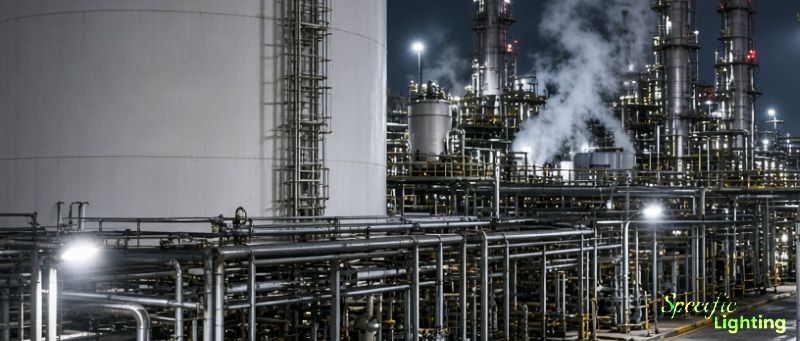
Chlorine (Cl₂), ammonia (NH₃), hydrogen sulfide (H₂S), and sulfur dioxide (SO₂) can affect materials in different ways. Their effects depend on concentration, temperature, moisture, exposure duration, and the materials involved.
For example, a fixture exposed to chlorine in a humid treatment area may face different corrosion conditions from one installed in a dry process enclosure. Likewise, ammonia compatibility should not be assumed based on a manufacturer’s general statement about chemical resistance.
When reviewing a product datasheet, ask whether compatibility information covers the actual gas, concentration, temperature, and expected exposure duration. If several gases are present together, confirm whether the manufacturer has assessed the combined conditions.
A general chemical-resistant label is not a substitute for gas-specific compatibility data. This is particularly relevant when the lighting system will be installed close to chemical dosing equipment, process piping, or gas-handling machinery.
IEC 60068-2-60 – Mixed-Gas Corrosion Testing
IEC 60068-2-60 is a recognized environmental testing standard that describes methods for evaluating equipment and components under controlled flowing mixed-gas corrosion conditions.
The standard includes different test methods with specified environmental conditions. It can be useful when evaluating electrical and electronic components exposed to corrosive atmospheres, but the test method, gas mixture, duration, and results must be reviewed carefully.
Passing a mixed-gas test does not automatically demonstrate resistance to every concentration of chlorine or ammonia. Nor does it prove that the complete luminaire can operate continuously at 200°C (392°F) or 300°C (572°F).
Buyers should request the actual test report and confirm which components were tested. A report covering an LED package or circuit board does not necessarily establish the corrosion performance of the housing, seals, fasteners, and cable entries.
Material Specifications for the Housing and Internal Components
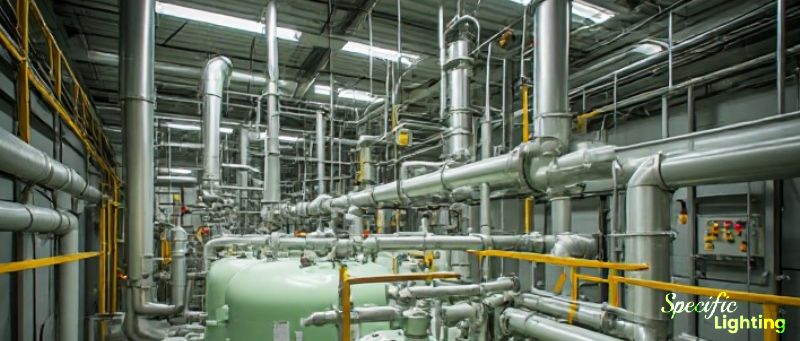
Housing material is an important part of corrosion resistance, but it is only one part of the picture. Suitable engineered polymers, glass, corrosion-resistant metals, and protective coatings may all be used in industrial lighting, depending on the application.
For example, a fiberglass-reinforced polyester (GRP) housing may be suitable for certain corrosive environments. Stainless steel may offer useful corrosion resistance in some applications, although performance depends on the exact grade and exposure conditions. Glass may provide good chemical compatibility with selected substances, but the mounting arrangement and seals still need to withstand the operating environment.
The same attention should be given to smaller components. Screws, cable glands, electrical contacts, connectors, gaskets, and protective coatings can become weak points if their materials are unsuitable.
A useful supplier datasheet should identify the main construction materials and provide compatibility information for the chemicals specified by the buyer.
Can IP66 or IP69K Prove Corrosion Resistance?
No. IP ratings describe protection against dust and water ingress under defined test conditions. They do not directly measure resistance to chlorine, ammonia, or other corrosive gases.
IP66 indicates a dust-tight enclosure with protection against powerful water jets under the applicable test conditions. IP69K addresses specified high-pressure, high-temperature water-jet exposure. Neither rating guarantees chemical compatibility.
NEMA 4X is another enclosure classification worth considering in relevant markets. It includes corrosion-resistance requirements within its defined test framework, but it still does not establish compatibility with every industrial gas or continuous operation at extreme temperatures.
| Rating or standard | Main purpose | What it does not prove |
|---|---|---|
| IP66 | Dust protection and powerful water-jet resistance | Resistance to corrosive gases |
| IP69K | Protection against specified high-pressure, high-temperature water jets | Suitability for 300°C ambient temperatures |
| NEMA 4X | Enclosure protection that includes corrosion resistance | Compatibility with every chemical |
| IEC 60068-2-60 | Controlled mixed-gas corrosion testing | Universal chemical resistance or high-temperature operation |
The best specification combines the appropriate enclosure rating with chemical compatibility evidence and a separate temperature rating.
Heat-Resistance Specifications – From 100°C to 300°C
High-temperature LED lighting requires careful attention to the conditions surrounding the fixture. A product rated for a certain surface temperature or short-term heat exposure may not be suitable for continuous operation in an atmosphere at the same temperature.
Before selecting a product, establish whether the required temperature refers to ambient air, the fixture surface, radiant heat from nearby equipment, or a short-term peak.
Understanding the Operating Temperature Range
The following table converts common industrial temperature requirements into Fahrenheit and provides a general indication of the engineering considerations involved.
| Temperature in °C | Temperature in °F | Specification considerations |
|---|---|---|
| 100°C | 212°F | Elevated-temperature design and component verification |
| 150°C | 302°F | Greater demands on seals, wiring, and electronics |
| 200°C | 392°F | Specialized thermal management may be required |
| 250°C | 482°F | Verify continuous operation and thermal isolation |
| 300°C | 572°F | Highly demanding conditions requiring specific engineering evidence |
These figures are application targets, not claims that every temperature range is readily available in commercial LED fixtures.
Many industrial LED products are designed for much lower ambient temperatures. As the required operating temperature rises, the range of suitable products becomes narrower and the need for detailed engineering documentation increases.
Continuous Operating Temperature vs. Maximum Exposure Temperature
This distinction is one of the first things buyers should check.
A continuous operating temperature is the ambient condition under which the fixture is designed to function over an extended period, within the manufacturer’s stated limits. A maximum exposure temperature may refer to a temporary condition that the product can tolerate for a specified duration without unacceptable damage.
For example, a fixture may tolerate a brief exposure to a hot process area but require a much lower ambient temperature during normal operation. Those two conditions should never be treated as equivalent.
Ask the manufacturer to state the maximum continuous ambient temperature, any permitted peak temperature, the duration of peak exposure, and the applicable restrictions.
LED Junction Temperature and Component Limits
LED chips generate heat during operation. The junction temperature is the temperature at the semiconductor junction, and it is a key parameter in LED performance and lifetime.
However, a fixture’s maximum ambient temperature cannot be inferred from the LED chip’s junction-temperature limit alone. The driver, capacitors, wiring, seals, connectors, and other components may have lower temperature limits.
A well-designed high-temperature lighting system must manage heat throughout the complete assembly. Buyers should request the manufacturer’s operating limits for the system rather than relying on a single component specification.
Thermal Management and Remote Driver Design
Thermal management methods may include heat sinks, thermal barriers, remote drivers, specialized mounting arrangements, or active cooling where appropriate.
Remote driver placement can be useful when the lighting head must operate near a hot process while the electronics can be installed in a cooler location. However, the arrangement must account for cable length, voltage drop, connector ratings, and the manufacturer’s permitted configuration.
At 250°C (482°F) or 300°C (572°F), the supplier should clearly explain how the system handles the thermal load. If the proposed fixture relies on cooling equipment, the quotation should also identify the cooling requirements, maintenance needs, and consequences of cooling failure.
A housing rated for 300°C does not automatically mean the complete LED light can operate continuously at 300°C. The LED module, driver, wiring, seals, and other components must all be considered.
Electrical and Safety Specifications for Harsh-Environment Lighting
Environmental resistance is only part of the specification. The lighting system must also meet the electrical and safety requirements of the installation.
Voltage, Power Consumption, and Electrical Connections
Industrial LED lights may be available in different input-voltage configurations, such as 100 to 277 V AC or 200 to 480 V AC, depending on the product. These are examples of possible product ranges, not universal requirements.
The buyer should specify the available supply voltage, frequency, phase configuration where relevant, grounding requirements, and any control or dimming functions needed.
Power consumption should be assessed alongside the required light output. A 100 W fixture does not necessarily deliver the same illumination as another 100 W fixture, since efficacy, optics, and installation geometry affect the result.
Electrical connections also need to suit the environmental conditions. Cable jackets, glands, connectors, and terminal components should have documented temperature and chemical-resistance ratings appropriate to their location.
Hazardous-Area Certifications
Some chemical and petrochemical facilities contain potentially explosive gas or dust atmospheres. In these areas, lighting equipment may need to meet specific hazardous-area requirements.
Depending on the jurisdiction and installation, relevant schemes may include ATEX, IECEx, UL, or other applicable certifications. Buyers should confirm the area classification and check the actual product marking, gas group, temperature class, and protection method.
Corrosion resistance does not automatically provide explosion protection. Similarly, a fixture carrying hazardous-area certification is not automatically suitable for extreme heat or every corrosive chemical.
The supplier should provide the applicable certificate and confirm that the proposed configuration is covered by it. Changes to the driver arrangement, enclosure, cable entries, or other components may affect the certification scope.
Electrical and Environmental Documentation
A complete product specification should provide enough information for engineers to assess the fixture without relying on general marketing language.
Useful documents include the product datasheet, installation instructions, electrical ratings, material specifications, relevant test reports, warranty terms, and applicable certificates.
For combined chemical and thermal exposure, ask the supplier to identify any restrictions on simultaneous exposure. Testing for corrosion at room temperature and testing for heat resistance separately do not automatically demonstrate performance under both conditions together.
Lighting Design Specifications
A fixture can withstand harsh conditions and still be unsuitable if it does not provide enough light. Lighting design should therefore be part of the purchasing specification from the beginning.
How Many Lumens Do You Need?
Lumens measure the total visible light output from a source. Lux measures the amount of light reaching a surface, expressed as lumens per square meter.
The required illuminance depends on the task, visual detail, safety requirements, and applicable workplace lighting guidance. A general access corridor may need less light than a detailed inspection station or control panel area.
The following figures are illustrative planning targets rather than universal compliance requirements.
| Application | Illustrative illuminance target |
|---|---|
| Basic access and circulation areas | 50 to 100 lux |
| General industrial work areas | 150 to 300 lux |
| Assembly and routine inspection | 300 to 500 lux |
| Fine inspection and detailed tasks | 500 to 1,000 lux |
The appropriate target should be confirmed against the applicable lighting standard and the work being performed. Glare, shadows, contrast, uniformity, and emergency lighting requirements may also influence the design.
Calculating the Required Light Output
Suppose an industrial room covers 100 m² and requires an average maintained illuminance of 200 lux.
The theoretical light reaching the working plane would be:
100 m² × 200 lux = 20,000 lumens.
That figure does not mean the installation needs exactly 20,000 lumens of rated fixture output. Some light will be lost because of mounting height, beam distribution, surface reflectance, dirt accumulation, and other factors.
For an initial design, an engineer may use a utilization factor and a maintenance factor:
Required installed lumens = Area × Target lux ÷ (Utilization factor × Maintenance factor).
If the utilization factor is 0.70 and the maintenance factor is 0.80, the estimated installed output becomes:
20,000 ÷ (0.70 × 0.80) = approximately 35,714 lumens.
The assumptions should be refined using photometric data and the actual room geometry. This calculation is a planning tool, not a substitute for a lighting layout.
Wattage, Efficacy, and Energy Consumption
Luminous efficacy describes how efficiently a fixture converts electrical power into visible light, usually expressed in lumens per watt (lm/W).
For illustration, a 100 W fixture rated at 150 lm/W would produce 15,000 lumens under the conditions stated by its manufacturer. A different 100 W fixture rated at 120 lm/W would produce 12,000 lumens.
These figures illustrate the calculation, not the guaranteed performance of a particular product. High-temperature operation, optical losses, and the fixture’s design may affect actual performance.
Energy costs can also be estimated before purchase. Consider 20 fixtures rated at 100 W each, operating 16 hours per day for 300 days per year.
| Parameter | Example |
|---|---|
| Number of fixtures | 20 |
| Power per fixture | 100 W |
| Total connected load | 2 kW |
| Annual operating hours | 4,800 hours |
| Annual electricity consumption | 9,600 kWh |
| Electricity rate | US$0.12/kWh |
| Estimated annual electricity cost | US$1,152 |
The calculation is 2 kW × 4,800 hours = 9,600 kWh. At US$0.12 per kWh, the annual electricity cost is US$1,152, excluding demand charges and other utility fees.
For industrial facilities operating lighting 24 hours a day, annual consumption can be substantially higher. The correct design should balance illumination, power consumption, fixture count, and maintenance requirements.
Beam Angle, Mounting Height, and Lighting Uniformity
Beam angle determines how light is distributed from the fixture. A narrow beam concentrates illumination over a smaller area, while a wider beam covers a broader area but may provide less illuminance at a particular point.
Mounting height also affects the result. High-bay installations may require different optical distributions from low-mounted inspection lights. Equipment, pipework, platforms, and structural beams can create shadows that need to be addressed in the layout.
A lighting plan should therefore include mounting positions, beam angles, expected lux levels, and uniformity. For demanding facilities, ask the supplier for an IES or LDT photometric file so the design can be evaluated using lighting software.
Specify the Right Lighting Before You Buy
Corrosion-resistant and heat-proof LED lighting should be selected using verified specifications rather than broad marketing claims. Chemical compatibility, continuous temperature ratings, enclosure protection, electrical safety, photometric performance, and maintenance requirements all influence whether a product is suitable for a particular facility.
For applications involving chlorine, ammonia, or other corrosive gases alongside temperatures from 100°C (212°F) to 300°C (572°F), the most useful starting point is a clear description of the real operating conditions. That information allows suppliers to assess available products, identify design limitations, and determine whether specialized thermal management or a custom configuration is needed.
If you are planning a harsh-environment lighting project, contact us for a technical consultation. Share your temperature range, chemical exposure conditions, required illumination, installation details, and estimated quantity, and our team can help you review suitable specifications, explore customization options, and request a quotation tailored to your application.