
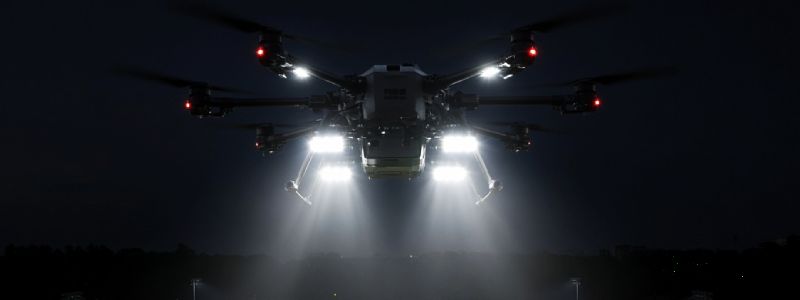
Drone lighting is changing the way people illuminate large outdoor areas, especially when traditional lighting equipment is difficult to position, too slow to set up, or simply unable to reach the right spot. By attaching high-power LED floodlights to the underside of a drone, operators can direct bright, adjustable light onto construction sites, sports fields, film locations, emergency scenes, and other large areas that need reliable illumination after dark.
For businesses and project managers, the appeal goes beyond having a powerful light in the air. A drone lighting system can move with the work, illuminate hard-to-reach locations, and provide temporary lighting without installing permanent poles or moving heavy equipment around the site. Depending on the application, it can complement existing floodlights, replace some temporary lighting arrangements, or provide an additional layer of visibility when conditions change.
However, not every drone light is suitable for every job. Brightness, beam angle, mounting weight, flight time, power supply, and operating cost all affect the final result. A system designed for filming a small outdoor scene will have different requirements from one intended to illuminate a construction site covering several thousand square meters.
Understanding these differences makes it much easier to choose equipment that performs well in real working conditions, rather than buying a product based on wattage or advertised brightness alone.
What Is Drone Lighting?
Drone lighting refers to a lighting system mounted on an unmanned aerial vehicle (UAV), usually beneath the aircraft, to illuminate an area from above. Most systems designed for large-area illumination use high-power LED floodlights because LEDs provide strong light output, relatively low power consumption, and a compact form that works well with aerial platforms.
Unlike a conventional floodlight fixed to a wall, tripod, or lighting tower, a drone-mounted light can change its position and height during operation. The operator can move the illuminated area, adjust the angle, or reposition the drone when workers, cameras, vehicles, or emergency teams move to another location.
Drone lighting can be configured in several ways. Some systems use a battery-powered light attached directly to the drone, while others rely on a tether that supplies power from a ground station. The first option offers greater freedom of movement, whereas the second can support longer lighting sessions when the aircraft and tether system are designed for continuous operation.
How Drone-Mounted LED Floodlights Work
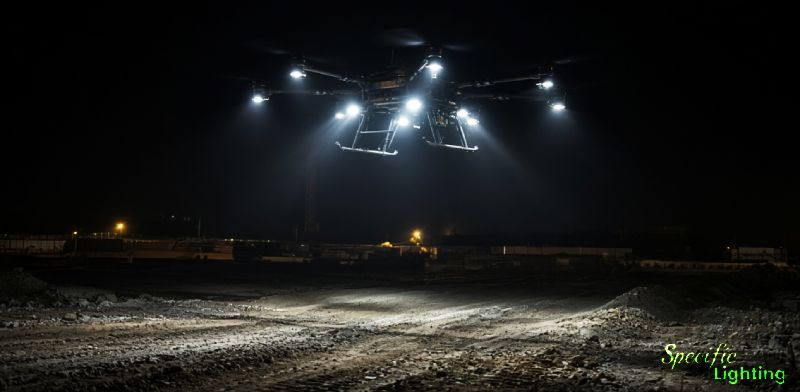
A drone lighting system combines an aerial platform, a lighting payload, a power source, a mounting mechanism, and a control system. The drone lifts the light to the required position, while the LED module converts electrical energy into visible light. Depending on the equipment, the operator may be able to adjust brightness, switch lighting modes, or change the direction of the beam remotely.
The operating height and beam angle determine how the light spreads across the ground. A narrow beam concentrates more light within a smaller area, while a wide beam covers a larger area but generally produces lower illuminance at the same distance and output.
For example, a light positioned 20 meters above the ground with a 60-degree beam angle illuminates a circular area approximately 23 meters in diameter under an idealized geometric model. Increasing the height to 30 meters expands the diameter to about 35 meters, but the illuminated area grows by more than twice as much. Without increasing the light output, the average illuminance therefore falls.
These figures describe the beam geometry rather than a guarantee of usable lighting. The actual result depends on the optical design, beam distribution, atmospheric conditions, and the amount of light reaching the target surface.
Key Components of a Drone Lighting System
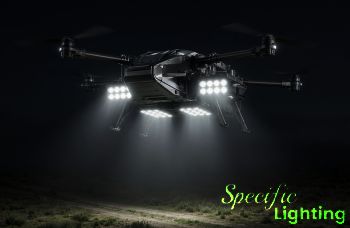 The LED lighting module is responsible for brightness, beam distribution, color characteristics, and thermal management. High-power LEDs can generate considerable heat, so the housing must dissipate it effectively to maintain performance and protect the electronics.
The mounting system connects the light to the drone and helps keep it secure during flight. Its weight, dimensions, and position affect payload capacity, balance, and flight efficiency. A mounting arrangement designed for one drone model may not be suitable for another, even if the two aircraft appear similar in size.
Power can come from a dedicated battery, the drone’s electrical system where compatible, or an external source connected through a purpose-designed tether. A controller or compatible flight interface may provide dimming and switching functions. For professional applications, buyers should also consider wiring protection, weather resistance, thermal monitoring, and the availability of replacement parts.
Drone Lighting vs. Traditional Floodlights
Traditional floodlights remain a practical choice when a location needs consistent illumination from a fixed position. They can operate for long periods without consuming flight time, and permanently installed fixtures may be more economical for sites that use the same lighting arrangement every night.
Drone lighting has a different advantage – mobility. Instead of relocating a tower or setting up several temporary fixtures, an operator can move an aerial light to a new working area. This can be particularly useful for temporary operations, remote locations, and situations where the required lighting position changes frequently.
| Feature | Drone lighting | Traditional floodlighting |
|---|---|---|
| Positioning | Adjustable in the air | Fixed or manually repositioned |
| Setup | Requires drone preparation and flight checks | Depends on mounting and power arrangements |
| Coverage | Flexible, with changing height and angle | Depends on fixture placement |
| Operating duration | Limited by flight time unless externally powered | Can run continuously with a suitable power supply |
| Best fit | Temporary, mobile, or hard-to-reach lighting | Fixed sites and long-duration illumination |
In practice, the two approaches can work together. Ground-mounted floodlights may illuminate the general work area, while a drone provides additional light over a particular task or location.
What Are the Main Applications of Drone Lighting?
The value of drone lighting becomes easier to understand when looking at the jobs it can support. Its strongest applications usually involve large or changing work areas, difficult access, temporary lighting requirements, or a need to move illumination without moving heavy ground equipment.
Construction Sites
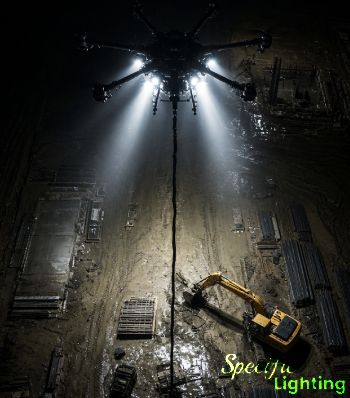 Construction projects frequently continue after sunset to meet deadlines, accommodate traffic restrictions, or complete work during cooler hours. Poor lighting can make it harder to inspect surfaces, identify obstacles, coordinate machinery, and carry out detailed work safely.
A drone-mounted floodlight can provide temporary illumination over excavation areas, roadworks, material storage zones, and sections of a site that are not adequately covered by existing fixtures. When the work moves, the light can be repositioned without requiring a lighting tower to be dismantled and transported.
For example, a contractor working across a 2,000-square-meter site might divide the area into several working zones rather than trying to illuminate the entire site uniformly with one aerial light. The number of fixtures required depends on their measured output, beam distribution, mounting height, and the illuminance target for each task. A drone light can supplement ground lighting, but it should not automatically be treated as a replacement for lighting required by local workplace standards.
Film Production and Video Shooting
Filmmakers often need to light outdoor locations where installing stands, running cables, or placing large fixtures is difficult. A drone-mounted LED floodlight can provide elevated fill light, illuminate backgrounds, or add directional lighting to a wide scene.
The main advantage is positioning flexibility. Instead of placing every light at ground level, the production team can experiment with different angles and heights to shape shadows and separate subjects from the background.
Brightness is only part of the decision, though. Color temperature, color rendering, flicker performance, and controllability also affect image quality. A light with a color temperature of 5,600 K, for instance, is commonly used to approximate daylight-balanced lighting, although the appropriate setting depends on the camera, surrounding light, and creative direction.
For video work, buyers should ask whether the light supports smooth dimming and whether its driver performs well at the intended camera frame rate and shutter settings. A system that looks bright to the naked eye may still produce unwanted flicker or uneven exposure on camera.
Sports Fields and Outdoor Events
Outdoor sports events may require additional lighting for training, temporary competitions, maintenance, or event preparation. Drone lighting can help illuminate selected areas where fixed lighting is unavailable or where installing temporary towers would be inconvenient.
A football training area, for example, may require different lighting coverage from a small running track or a temporary outdoor event space. The target illuminance also changes with the activity. Casual training, detailed technical work, and televised competition do not necessarily have the same lighting requirements.
For this reason, sports applications should start with a lighting plan rather than a wattage estimate. A lighting designer should consider the field dimensions, mounting height, uniformity, glare, spill light, and any relevant sport-specific standards. Drone-mounted lights are often more appropriate for temporary or supplementary illumination than as an automatic substitute for a purpose-built sports lighting installation.
Emergency Response and Disaster Relief
Emergency teams may need to illuminate road accidents, damaged infrastructure, flood-affected areas, temporary treatment zones, or locations where normal power has been interrupted. In these situations, moving lighting equipment into position can be difficult, especially when roads are blocked or the terrain is unstable.
A drone lighting system can provide an aerial view of the work area and help direct light toward teams operating below. This may be particularly useful during initial assessments or when ground equipment cannot reach a suitable position quickly.
Battery-powered systems offer mobility, while tethered systems may provide longer illumination periods when a suitable ground power source is available. The choice depends on deployment time, the size of the illuminated area, weather, and the duration of the operation.
Emergency use also requires careful coordination. Bright aerial lighting can create glare for drivers, aircraft operators, rescue personnel, or people looking upward. Operators should coordinate with the incident commander and follow applicable aviation requirements rather than deploying the drone independently of the wider response plan.
Search and Rescue
Search and rescue operations often take place in areas with uneven ground, limited road access, or poor visibility. An aerial lighting payload can illuminate selected terrain, access routes, or areas where ground teams are working.
A broad floodlight can support general scene illumination, while a narrower beam may be more useful when the operator needs to concentrate light on a specific location. Some applications may benefit from using a visible-light camera alongside the lighting payload, allowing the team to assess the scene while adjusting the light.
The payload should be chosen around the mission rather than brightness alone. A heavier light may reduce flight time, while a very wide beam may spread its output too thinly across a large search area. Wind, terrain, temperature, and the need to keep the aircraft within permitted operating conditions also influence performance.
Roadworks and Infrastructure Maintenance
Road construction, bridge inspection support, rail maintenance, and utility work can involve temporary operations spread across long distances. Moving conventional lights along the work zone takes time, and fixed fixtures may not reach the exact point where a crew needs extra visibility.
Drone lighting offers a way to reposition illumination as teams progress along a route. For example, a maintenance crew could use an aerial light to supplement lighting around a temporary inspection area before moving it to the next section.
Roadside applications require particular attention to glare and light spill. The light should support the work without distracting road users or creating unnecessary illumination beyond the site. Operators must also account for overhead cables, structures, vehicle movements, and local flight restrictions.
Industrial and Remote Worksites
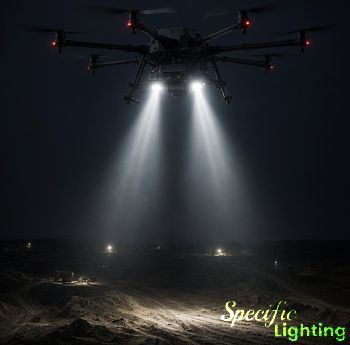 Remote industrial facilities, temporary power projects, mining support operations, and large outdoor storage areas may lack permanent lighting in certain sections. A drone-mounted LED floodlight can help provide temporary illumination when work needs to take place away from existing fixtures.
However, not every industrial environment is suitable for standard drone equipment. Sites with combustible dust, flammable gases, or other hazardous conditions may require specifically approved equipment and operating procedures. Ordinary drone lights should not be assumed to be safe for hazardous areas merely because the LED housing is weather-resistant.
For these projects, the procurement process should involve the site’s safety team and verify whether the aircraft, lighting payload, batteries, and operating procedures meet the applicable requirements.
What Are the Benefits of Using Drone Lighting?
Drone lighting provides the greatest value when mobility and positioning matter as much as brightness. It is not always cheaper than conventional lighting, but it can simplify certain jobs and reduce the need to move ground equipment repeatedly.
Flexible Positioning and Wider Coverage
An aerial light can be raised or repositioned to change the angle at which a scene is illuminated. This can help reduce shadows cast by equipment, vehicles, or temporary structures, depending on the lighting arrangement.
Raising the light also changes the size of the illuminated area. A higher position generally produces a wider footprint with a given beam angle, although the light reaching each square meter decreases unless the system provides enough output to compensate.
For this reason, the best mounting height is not necessarily the highest permitted altitude. The operator needs to balance coverage, illuminance, glare, flight stability, and the aircraft’s approved operating limits.
Access to Difficult Locations
Some work areas are difficult to reach with a vehicle or lighting tower. Steep slopes, uneven ground, waterlogged terrain, temporary road closures, and dense equipment layouts can make ground-based positioning awkward.
A drone can approach a suitable lighting position without requiring a vehicle to travel directly to that spot. This does not remove the need for safe access around the ground station or for suitable flight planning, but it may reduce the amount of equipment that needs to be moved around the site.
Faster Repositioning During Changing Work
On a construction site, the area requiring the most light can change several times during a shift. A drone-mounted fixture can move with the crew, subject to safe flight conditions and the operator’s approved procedures.
This flexibility may reduce repositioning work compared with repeatedly moving a large lighting tower. Actual time savings depend on the site layout, drone preparation time, battery changes, required checks, and the number of moves per shift.
Reduced Need for Permanent Infrastructure
Temporary projects do not always justify installing permanent poles, wiring, or fixed fixtures. A drone lighting system may offer a more flexible option for short-term work or locations that change frequently.
However, buyers should compare the complete operating arrangement, not just the price of the LED module. The drone, batteries, charging equipment, controllers, spare parts, maintenance, and trained operators all contribute to the cost. For a site requiring lighting every night for several months, conventional lighting may still be more economical.
What Types of Drone Lighting Systems Are Available?
Different projects call for different power arrangements and beam designs. Choosing the right system means looking at how long the light needs to operate, how far the drone must travel, and whether the illumination should cover a broad area or concentrate on one task.
Battery-Powered Drone Lighting Systems
Battery-powered systems use an onboard battery to power the LED payload. Depending on the design, the lighting battery may be separate from the drone’s flight battery or integrated into a compatible power arrangement.
These systems are useful when the light needs to move freely between locations. Film crews, emergency teams, and mobile maintenance workers may prefer this setup because there is no power tether restricting movement.
The main trade-off is operating duration. The drone must also carry the lighting payload, so adding a heavy battery can affect flight time and handling. Buyers should request runtime figures at several brightness settings rather than relying on a single maximum-runtime claim.
For example, if a lighting system draws 200 W and uses a 400 Wh battery, its theoretical runtime is two hours. In practice, usable runtime will be lower because of conversion losses, battery limits, and the power required by supporting electronics. The drone’s flight time may be shorter still, depending on the aircraft and total payload.
Tethered Drone Lighting Systems
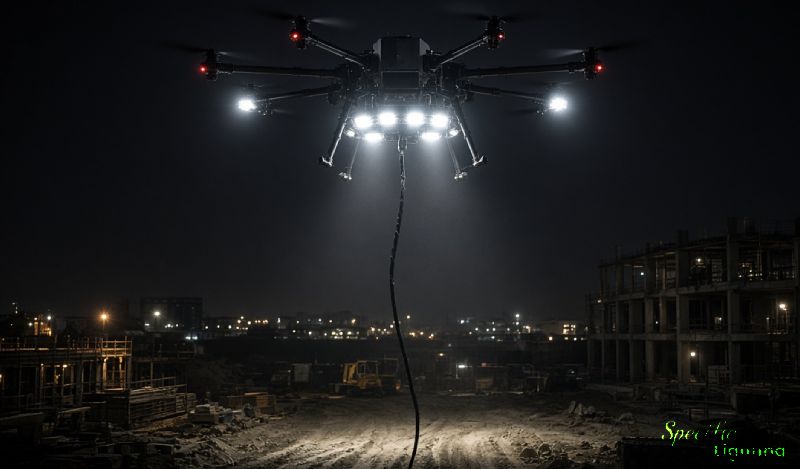
Tethered drone lighting systems use a cable connected to a ground power unit or another approved power arrangement. The tether may supply electrical power to the aircraft, the light, or both, depending on the system architecture.
Their main advantage is the ability to support extended operation without relying solely on the energy stored in an onboard lighting battery. This can make tethered systems attractive for construction sites, emergency staging areas, security support, and other applications that require relatively stationary illumination.
However, tethered equipment introduces additional considerations. Cable length limits positioning, while wind, obstacles, cable management, ground power availability, and the tether’s electrical specifications all affect deployment. A tethered drone also needs to be designed and approved for tethered operation. Attaching a cable to an ordinary drone does not automatically make it suitable for continuous flight.
High-Power LED Floodlights and Adjustable Searchlights
Floodlights are designed to spread light over a relatively broad area. They are often suitable for illuminating work zones, open ground, outdoor filming locations, and temporary activity areas.
Searchlights and spotlights use narrower beams to concentrate illumination on a more specific target. They may be useful for locating objects or directing light toward a particular part of a scene, although the most suitable beam depends on the mission.
| Lighting type | Typical purpose | Main consideration |
|---|---|---|
| Wide-beam LED floodlight | General scene illumination | Coverage and uniformity |
| Medium-beam LED light | Work areas and selected zones | Balance between reach and coverage |
| Narrow-beam spotlight | Focused illumination | Intensity on the target |
| Multi-light configuration | Multiple directions or beam patterns | Payload weight and power demand |
These categories describe optical functions rather than fixed product specifications. Two lights with the same wattage can have very different beam patterns and useful ground illumination.
Integrated Lighting Systems vs. Retrofit LED Payloads
An integrated system is designed around a particular drone platform or product family. It may offer a compatible mount, power interface, control software, and tested operating configuration.
A retrofit payload is added to an existing drone. It can be an attractive option for organizations that already own suitable aircraft, but compatibility needs to be checked carefully. The light’s weight, dimensions, center of gravity, electrical demand, and mounting arrangement all affect whether the combination is suitable.
Before purchasing a retrofit payload, confirm the drone manufacturer’s payload restrictions and any requirements for approved accessories. A physically compatible mount does not guarantee that the aircraft can carry the light safely or maintain the expected flight performance.
How to Choose the Right Drone Lighting System
The right drone lighting system should match the job’s actual lighting requirements. A high wattage figure might look impressive on a specification sheet, but it does not tell you how evenly a site will be illuminated or whether enough light will reach the working surface.
How Many Lumens Do You Need for Drone Lighting?
Lumens measure the total visible light output of a source. They are useful for comparing lighting products, but they do not directly tell you how bright the ground will appear at a particular distance.
A 20,000-lumen light with a wide beam may distribute its output across a large area, while a light with the same output and a narrower beam concentrates more light in a smaller footprint. The appropriate output depends on the target area, height, beam pattern, ambient light, and required illuminance.
For preliminary planning, consider an illustrative 500-square-meter work area with an average target illuminance of 50 lux. The area would require 25,000 lumens actually arriving at the target surface, before accounting for uneven distribution and other losses. If only 30% of the fixture’s emitted light contributes to useful illumination across the target, the theoretical source output would be approximately 83,000 lumens.
That 30% figure is only an example, not a standard efficiency value. Real optical performance varies by product, mounting position, and site conditions. A photometric report or lighting simulation can provide a more reliable estimate than a general lumen calculation.
What Wattage Is Best for a Drone-Mounted LED Floodlight?
Wattage indicates electrical power consumption, not brightness by itself. Two LED modules consuming 150 W can produce different amounts of light because of differences in LED efficiency, optics, temperature management, and driver performance.
For a drone-mounted light, electrical power must also be considered alongside payload weight and thermal management. A higher-power light may provide more output, but it may require a larger heat sink, heavier power supply, or larger battery. All of these can affect flight performance.
As an initial comparison, a buyer might evaluate lighting payloads in the 50 W, 100 W, 200 W, and 300 W classes. These are convenient comparison points rather than universal recommendations. A compact light in the 50 W class could suit a smaller scene, while a 200 W or 300 W payload may be worth evaluating for broader or more demanding applications, provided the aircraft can support it.
The final decision should be based on verified lumen output, beam distribution, illuminance measurements, and total payload mass rather than wattage alone.
How to Choose the Right Beam Angle and Lighting Coverage
Beam angle describes how widely a fixture spreads its light. A wider beam generally illuminates a larger footprint, while a narrower beam concentrates more of the output into a smaller area.
For an idealized circular beam, the footprint diameter can be estimated using:
D = 2H tan(θ/2)
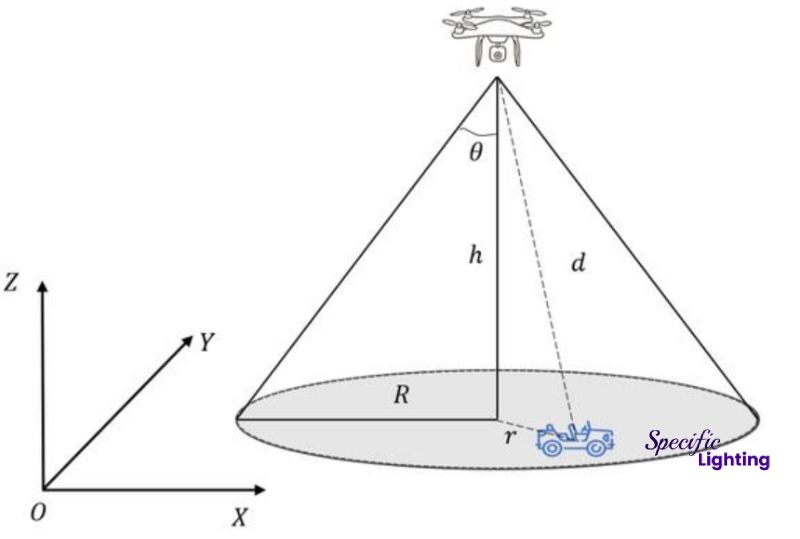
Here, (D) is the approximate beam diameter, (H) is the height above the target, and θ is the beam angle.
The following examples show how height and beam angle affect the geometric footprint.
| Height above ground | 30° beam | 60° beam | 90° beam |
|---|---|---|---|
| 10 m | 5.4 m | 11.5 m | 20 m |
| 20 m | 10.7 m | 23.1 m | 40 m |
| 30 m | 16.1 m | 34.6 m | 60 m |
These figures are theoretical approximations. They do not account for the fixture’s actual beam profile, the edge of the beam becoming dimmer, or the amount of light reflected from the ground. The 90-degree column, in particular, represents idealized geometry rather than a recommendation to fly at any specified height.
A large site may need several overlapping lighting zones to avoid dark gaps. For professional use, ask the supplier for an intensity distribution file, such as an IES or EULUMDAT file where available, and use it to model the proposed arrangement.
How to Evaluate Lux and Lighting Uniformity
Lux measures illuminance, meaning the amount of light arriving at a surface per unit area. It is often more useful than lumens when evaluating whether a work area receives enough light.
For example, 50 lux means that an average of 50 lumens per square meter reaches the measured surface. It does not mean that every point receives exactly 50 lux. Some parts of the area may be brighter than others, particularly when the light is positioned high above the ground or the beam is uneven.
The following figures are illustrative planning examples, not universal legal or industry requirements.
| Example task | Illustrative illuminance range |
|---|---|
| General outdoor movement and orientation | 10 to 30 lux |
| Basic outdoor work areas | 30 to 100 lux |
| More detailed temporary work | 100 to 200 lux |
| Detailed inspection or precision tasks | 200 to 500 lux or more |
Actual requirements depend on the task, jurisdiction, applicable standards, and working conditions. Film production and sports lighting may also have requirements for uniformity, glare, and camera exposure that cannot be represented by a single lux value.
For a work area, it is useful to check both average illuminance and minimum illuminance. A site averaging 100 lux may still contain dark corners if most of the light falls into one concentrated patch. Uniformity measurements help reveal these differences.
Choosing the Right Color Temperature and Color Rendering
Color temperature affects the visual appearance of white light. Lower values generally look warmer, while higher values tend to look cooler or more blue-white.
For example, 3,000 K can provide a warm appearance, around 4,000 K offers a more neutral white, and 5,600 K is commonly used for daylight-balanced production lighting. None of these values is automatically best for every project.
Color rendering also matters. The color rendering index, or CRI, describes how accurately a light source renders a range of colors compared with a reference source. A high CRI can be useful for filming, inspection, and applications where color identification matters. A CRI of 80 or above may be adequate for many general lighting uses, while some professional video and color-critical applications may call for a CRI of 90 or above. CRI should be assessed alongside other color metrics and actual camera tests.
For video production, ask about flicker performance, dimming behavior, and compatibility with the intended camera settings. For construction and emergency operations, reliable visibility and suitable color rendering may matter more than achieving a particular creative look.
How Payload Weight Affects Drone Performance
Every lighting component adds weight. The total payload includes the LED module, mount, wiring, controller, and any dedicated battery carried by the drone.
A light advertised as weighing 1 kg may not represent the complete installed payload if its power supply and mounting hardware are sold separately. Ask for the fully configured weight before comparing products.
A heavier payload usually increases power demand and may reduce endurance. It can also affect acceleration, handling, and the aircraft’s ability to operate in wind. The exact effect depends on the drone’s design, battery, environmental conditions, and flight profile, so there is no reliable universal rule for converting payload weight directly into flight minutes.
Buyers should request test data for the actual drone and light combination, including payload mass, operating brightness, ambient temperature, wind conditions, and the reserve requirements used in the test. Keep within the aircraft manufacturer’s approved payload and flight limits.
Battery Life and Continuous Lighting Requirements
Battery capacity is normally measured in watt-hours (Wh), while the lighting module’s electrical demand is measured in watts (W). A simple estimate divides battery energy by power consumption:
t = E/P
Here, (t) is theoretical operating time in hours, (E) is usable energy in watt-hours, and (P) is power consumption in watts.
For a 500 Wh battery powering a 200 W light, the theoretical runtime is 2.5 hours. If only 80% of the nominal battery capacity is available for the intended operating range, usable energy falls to 400 Wh and the theoretical runtime becomes two hours.
Even this estimate excludes other electrical loads and may not account for temperature, battery aging, or power conversion losses. It also does not establish how long the drone can remain airborne. If the drone and light share a battery, the flight controller, motors, and other electronics draw additional power.
For longer projects, calculate the complete operating cycle, including flight, battery changes, charging, inspections, and cooling periods. Tethered systems may be worth evaluating where extended stationary operation is the main requirement.
Weather Resistance and Operating Conditions
Outdoor lighting equipment may encounter dust, rain, humidity, temperature changes, and vibration. The enclosure’s IP rating helps describe its resistance to the entry of solid objects and water under specified test conditions.
For example, an IP54 rating indicates a defined level of dust protection and protection against water splashes. IP65 indicates dust-tight construction and protection against water jets under the relevant test conditions. Neither rating automatically makes the complete drone suitable for flight in heavy rain or strong winds.
The lighting payload, aircraft, battery, connectors, and controller may have different operating limits. Always check the rating and operating instructions for the complete configuration, not just the LED housing. Thermal performance matters too, since high-power LEDs can become hot during prolonged operation, particularly in enclosed housings or warm weather.
Remote Control and Integration
Some lighting systems provide basic on-and-off control, while others offer dimming, multiple operating modes, beam adjustment, or integration with compatible drone controllers.
Remote dimming can be useful when the operator needs to reduce glare, balance several lights, or adapt illumination for a camera. If the light is intended for repeated commercial use, the control interface should be straightforward and reliable.
Before purchasing, confirm which functions work with the chosen aircraft and controller. Do not assume that every drone supports third-party payload control, even if the lighting unit has a wireless interface or a compatible-looking connector.
How Much Does a Drone Lighting System Cost?
Drone lighting costs vary substantially depending on whether the purchase includes only an LED payload or a complete operational system. A bare light module may look inexpensive, but it cannot be compared directly with a package containing a compatible drone, flight batteries, a ground station, and a tethered power unit.
The best way to budget is to separate the lighting payload, aircraft, power system, accessories, training, and ongoing operating expenses. Requesting quotations based on the same technical specification makes supplier comparisons much more meaningful.
Typical Drone Lighting Price Ranges
The figures below are illustrative budgeting allowances in US$, not verified market averages or quotations for specific products. Actual prices can fall outside these ranges, particularly for specialized industrial equipment, customized payloads, or complete professional systems.
| Equipment category | Illustrative budget range |
|---|---|
| Basic LED lighting payload | US$200 to US$800 |
| Higher-output professional LED payload | US$800 to US$3,000 |
| Specialized lighting payload with advanced controls | US$2,000 to US$6,000+ |
| Compatible commercial drone platform | US$1,500 to US$8,000+ |
| Complete battery-powered lighting setup | US$2,000 to US$12,000+ |
| Professional tethered drone lighting setup | US$8,000 to US$30,000+ |
These categories overlap because products differ in output, aircraft compatibility, control functions, and included accessories. Some commercial drones are far more expensive than the illustrative range, and specialized tethered platforms can also exceed it. The cost of the lighting payload alone should never be mistaken for the total cost of a ready-to-use system.
For an accurate budget, ask suppliers to identify what is included, what must be purchased separately, and which performance figures are backed by test data.
How Brightness and Power Output Affect Cost
Higher-output lighting systems may require more powerful LED modules, larger heat sinks, more advanced optics, and greater electrical capacity. These additions can increase both purchase price and total payload weight.
However, price does not rise in a simple straight line with wattage. A 200 W fixture with efficient optics and a well-designed thermal system may deliver more useful ground illumination than a less expensive product with similar power consumption but a poorly controlled beam.
When comparing a 100 W, 200 W, and 300 W payload, request lumen output, beam angle, intensity distribution, complete weight, power requirements, and measured illuminance at the intended operating height. If two products provide comparable coverage and illuminance, the less expensive or lighter option may be the better purchase.
Battery-Powered vs. Tethered System Costs
Battery-powered systems typically require flight batteries, charging equipment, and potentially separate batteries for the lighting payload. The operating budget should include replacement batteries over the equipment’s service life.
Tethered systems can cost more upfront because they may include a compatible aircraft, tether, ground power equipment, cable management, and specialized controls. In return, they can reduce reliance on frequent onboard battery changes during stationary lighting operations.
A simple comparison should account for the length of each lighting session. If a site needs only 20 minutes of additional light at a time, a mobile battery-powered setup may be more practical. If it needs several hours of near-continuous illumination from a fixed position, a tethered configuration may deserve closer evaluation.
The lower purchase price does not necessarily indicate the lower lifetime cost. Consider battery replacement, charging downtime, operator time, maintenance, and the availability of spare parts when comparing the two approaches.
Additional Equipment and Operating Expenses
The total budget may include mounting hardware, spare batteries, chargers, controllers, replacement cables, protective cases, maintenance tools, transport, software, and training. Some projects also require site-specific permissions, insurance, or specialist operating procedures.
For example, a hypothetical battery-powered setup might have a US$5,000 purchase price, US$600 in accessories, and US$400 in initial training. Its initial investment would be US$6,000 before insurance, maintenance, and future battery replacement.
If annual maintenance and battery replacement average US$800 and the equipment is used for three years, the three-year cost would be US$8,400, excluding electricity, operator labor, financing, and resale value. These figures are an example of how to structure a budget, not a claim about typical maintenance costs.
A useful purchasing comparison should separate the one-time investment from recurring expenses. This helps organizations avoid underestimating the cost of keeping a system operational.
How to Calculate the Total Cost of Ownership
Total cost of ownership, or TCO, includes the initial purchase and the expenses required to operate the equipment over a chosen period.
A simplified calculation is:
TCO = Purchase Cost + Operating Cost + Maintenance Cost
For a more complete estimate, include training, battery replacement, repairs, insurance, charging, software, and end-of-life disposal, then subtract any expected resale value.
Suppose a system costs US$8,000 upfront and incurs US$1,500 in annual operating and maintenance costs. Over three years, its estimated total cost would be US$12,500 before resale value or financing costs.
If the equipment is used for 250 hours per year, that represents 750 operating hours over three years. Dividing US$12,500 by 750 gives an approximate equipment cost of US$16.67 per operating hour. If operator labor, transportation, and other project expenses are added, the actual cost per hour will be higher.
This calculation helps compare ownership with rental or outsourced lighting services. It also makes it easier to assess whether the equipment will receive enough use to justify its purchase price.
Is Buying a Drone Lighting System Better Than Renting?
Buying may make sense for organizations that use aerial lighting frequently, need consistent access to their own equipment, or require a customized configuration. Ownership can also make scheduling easier when several projects need lighting support.
Rental may be more suitable for a one-off event, a short construction project, or an organization that wants to test the technology before committing to a purchase. The rental provider may also supply trained operators, maintenance support, and compatible equipment.
For example, if buying a complete setup costs US$10,000 and renting a comparable system costs US$500 per day, the simple purchase-price break-even point is 20 rental days. This calculation does not include ownership costs, rental delivery charges, labor, maintenance, or the residual value of the equipment.
The real break-even point may therefore be higher or lower. Compare equivalent services and equipment, including whether the rental rate covers the operator, batteries, transport, and any required permits.
Drone Lighting Safety and Operational Requirements
A drone-mounted floodlight combines electrical equipment, an aircraft, and a powerful light source. Safe operation therefore involves more than selecting a suitable LED module. The aircraft, payload, power system, operating environment, and people on the ground all need to be considered together.
Payload Limits and Flight Performance
The drone must remain within its manufacturer’s approved payload and operating limits. Adding a light, mount, battery, and wiring changes the aircraft’s total mass and can affect its balance and flight characteristics.
Before operation, verify the complete payload weight and the approved mounting arrangement. Test the configuration according to the manufacturer’s instructions, and avoid assuming that a drone can safely carry a light simply because it can lift the payload briefly.
Wind, temperature, battery condition, and altitude can also affect performance. A lighting setup that works well in calm conditions may not be suitable when wind increases or the drone must operate near structures.
Night Flight and Local Regulations
Rules for night operations vary by country and operating category. Depending on the jurisdiction, a commercial operation may require specific equipment, pilot qualifications, permissions, airspace checks, or operating procedures.
In the United States, operators should check the applicable Federal Aviation Administration requirements, including the rules governing the relevant drone operation and night flight. Other countries have their own aviation authorities and procedures. Permission to fly a drone at night should not be assumed simply because the light makes the aircraft easier to see.
The lighting payload itself can also affect visibility. An extremely bright downward-facing floodlight does not necessarily provide adequate aircraft visibility from every direction, so the drone may require separate compliant lighting.
Glare, Light Spill, and Electrical Safety
A powerful light can create glare for drivers, workers, pilots, and nearby residents. Position the fixture so that the beam illuminates the intended work area without shining unnecessarily into people’s eyes or beyond the site boundary.
For battery-powered systems, inspect connectors, cables, and batteries before use. Follow the manufacturer’s charging, storage, and temperature instructions. For tethered systems, verify the cable rating, grounding arrangements where applicable, power supply, cable management, and emergency procedures.
Industrial environments may require additional controls, particularly where flammable gases, vapors, or combustible dust are present. Standard consumer or commercial drone lighting equipment should not be used in hazardous locations unless the complete equipment and operation are suitable for that environment.
Frequently Asked Questions About Drone Lighting
How Bright Can a Drone-Mounted LED Floodlight Be?
Brightness varies by product, with commercial payloads available in a wide range of power and lumen-output classes. Wattage alone is not enough to determine how much light reaches the ground, since beam angle, mounting height, optical efficiency, and the target area all affect the result.
For a reliable comparison, request measured lumen output and illuminance data at a stated distance or height. These figures provide a more useful basis for choosing equipment than wattage alone.
How Large an Area Can Drone Lighting Illuminate?
The coverage area depends on beam angle, flight height, light output, and the minimum illuminance required for the task. A wide beam at a greater height can cover a larger footprint, but the light becomes more spread out.
For example, an idealized 60-degree beam at 20 meters produces a geometric footprint about 23 meters in diameter. That does not mean the entire footprint will receive sufficient illumination for detailed work. Photometric data and on-site measurements are needed to establish the usable coverage.
How Long Can a Drone Lighting System Operate?
Operating time depends on the drone, payload weight, battery capacity, lighting power, and environmental conditions. A battery that theoretically supplies a 200 W light for two hours may deliver less usable time once conversion losses and other electrical loads are included.
For continuous or extended lighting, a purpose-built tethered system may be a better fit. The manufacturer’s tested endurance figures should be checked against the complete payload configuration and intended operating conditions.
Can Drone Lighting Be Used in Rain?
That depends on the rating and operating limits of the entire system. An LED module with a suitable IP rating does not automatically make the drone, battery, connectors, or flight controller safe to operate in rain.
Check the manufacturer’s restrictions for the aircraft and lighting payload separately. Never exceed the approved weather limits of the complete configuration.
Is Drone Lighting Suitable for Professional Filming?
Yes, it can be useful for illuminating outdoor scenes, adding elevated fill light, and reaching positions that are difficult to access with ground equipment. The best systems for filming offer appropriate brightness, color control, smooth dimming, and good flicker performance.
Before a shoot, test the lighting with the actual camera, frame rate, shutter settings, and surrounding light. A test can reveal exposure or flicker issues that may not be obvious when viewing the light directly.
Should I Buy a Battery-Powered or Tethered System?
A battery-powered system is generally better suited to mobile work where the lighting position changes frequently. A tethered system may suit applications that require extended illumination from a relatively stable position.
Compare the complete purchase cost, expected operating duration, power availability, payload requirements, and site layout. If you are unsure, a small-scale test or rental can help establish which configuration works better before a larger investment.
Find the Right Drone Lighting Solution for Your Project
Drone lighting offers a flexible way to illuminate construction sites, filming locations, sports areas, emergency scenes, and other large outdoor environments. The best system is not necessarily the one with the highest wattage or the lowest price. It is the one that delivers suitable ground illuminance, practical coverage, reliable operating time, and compatibility with the intended drone.
Before choosing a product, establish the target area, required lux level, beam angle, mounting height, total payload weight, and expected operating duration. Compare the full system cost, including power equipment, accessories, maintenance, and operator requirements, rather than looking at the LED payload price alone.
If you are looking for a drone-mounted LED floodlight for a specific application, contact us for a consultation. Share your project area, required lighting performance, preferred drone platform, and expected operating hours, and our team can help you evaluate suitable lighting configurations, discuss customization options, and identify a practical solution for your project.