
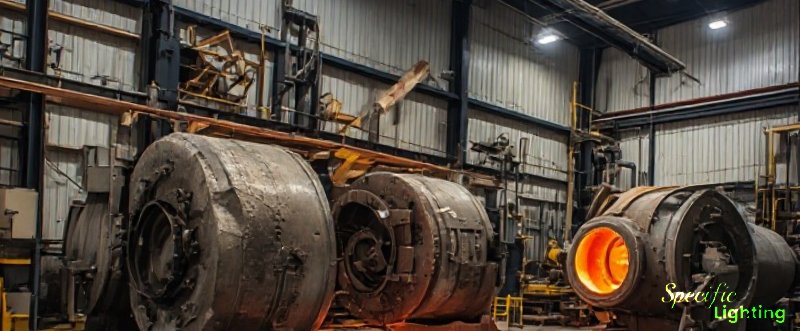
Foundries are demanding places for lighting. Between furnaces, molten metal, casting equipment, dust, fumes, vibration, and long operating hours, a lighting fixture can face conditions that would be unusual in a normal warehouse or commercial building. A fixture may be mounted several metres above the production floor, exposed to heat every day, and expected to keep working for years without becoming a regular maintenance headache.
That makes high-temperature lighting more than a matter of choosing a bright LED. The fixture has to suit the actual environment around it, while the lighting layout needs to deliver enough illumination to the places where people work, inspect castings, operate machinery, and move through the facility.
The temperature rating, thermal management, housing materials, IP protection, optics, mounting height, beam angle, glare, colour rendering, electrical components, and maintenance conditions all have a part to play. A good foundry lighting system is designed around the process, not simply around the light fixture.
For facilities planning a new installation or replacing older metal-halide, fluorescent, or other industrial lighting, this approach can also make a noticeable difference to operating costs. A facility running 100 fixtures for 12 hours a day, 300 days per year can easily accumulate hundreds of thousands of fixture-hours over the life of an installation. Even a relatively modest reduction in power consumption can therefore become meaningful over several years.
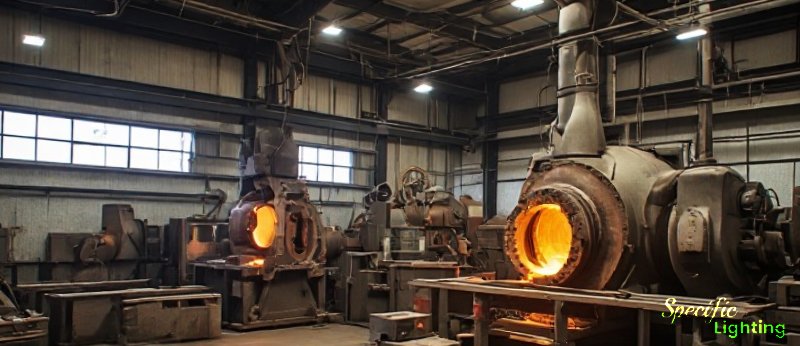
What Makes Our Lights Survive in Foundries and Metal Casting?
The phrase “high-temperature lighting” only has real value when it is supported by engineering details. In a foundry environment, durability comes from the way the complete luminaire is designed and matched to its installation conditions.
A good fixture should be selected according to its rated ambient temperature, thermal behaviour, environmental protection, mechanical construction, and electrical components. These characteristics should then be considered alongside the actual location where the fixture will be installed.
Designed Around High Ambient Temperatures
LED lighting is generally efficient, but LEDs and their electronic components still produce heat. If that heat cannot move away from the components effectively, operating temperatures can rise and affect performance and service life.
Thermal management is therefore a major consideration for high-temperature industrial lighting. The housing, heat sink, LED board, driver, and surrounding air all form part of the thermal system.
Suppose a fixture is specified for an ambient temperature of 70°C. That does not mean it should be installed in a location that routinely reaches 70°C and then treated as though it has unlimited thermal headroom. The actual temperature rating needs to be considered alongside the fixture’s operating conditions, installation orientation, and manufacturer’s specifications.
The difference becomes particularly relevant in foundries because the surrounding air temperature and radiant heat can vary throughout the production process.
Managing Radiant Heat
A furnace may operate at temperatures far above the maximum temperature that a lighting fixture can tolerate. Fortunately, the fixture does not necessarily experience the furnace’s actual process temperature.
Distance, shielding, ventilation, mounting height, and the direction of the hot surface all affect the thermal environment around the luminaire.
Imagine a furnace operating at several hundred degrees Celsius with a fixture mounted 6 metres away. The fixture is not suddenly a several-hundred-degree component. What matters is the temperature at the fixture’s actual mounting location, including the effect of radiant heat.
This distinction is useful when designing a lighting system because it can allow fixtures to be positioned far enough away from the hottest sources while still providing the required illumination.
The goal is not to put the light as close to the furnace as possible. The goal is to put useful light where it is needed while controlling the fixture’s thermal exposure.
Thermal Management Is More Than a Heat Sink
A large heat sink is helpful, but thermal management involves more than the amount of aluminium visible on the outside of a fixture.
Heat needs to travel away from the LED and driver efficiently. Housing design, thermal interfaces, component placement, airflow, mounting orientation, and ambient conditions all influence the result.
Dust accumulation can also change thermal performance. A layer of contamination on a heat-dissipating surface may reduce the ability of the fixture to release heat, depending on the design and environment.
For this reason, a high-temperature luminaire should be evaluated as a complete system rather than by looking at one component specification in isolation.
Heat-Resistant Housing and Materials
The materials used in the housing, lens, seals, wiring, and connectors need to match the intended environment.
Aluminium housings, for example, can provide structural strength while also helping transfer heat away from internal components. Lens materials need to maintain their optical and physical properties within the specified temperature range.
Seals and gaskets deserve attention as well. A fixture installed in a hot, dusty environment may experience years of thermal cycling, where the temperature rises and falls repeatedly during production and shutdown periods.
The long-term performance of the complete enclosure depends on how these materials behave under those conditions.
Protection Against Dust and Contamination
Foundry environments can produce significant amounts of dust and airborne particulate matter. Depending on the process, there may also be smoke, fumes, oil, moisture, sand, and other contaminants.
This is where enclosure protection becomes useful.
An IP65-rated enclosure, for example, is designed to provide protection against dust ingress and water jets under the relevant test conditions. Higher levels of protection may be appropriate in some applications, depending on the environment and cleaning regime.
However, an IP rating should not be treated as a universal measure of foundry suitability. It says something specific about enclosure protection, but it does not by itself describe temperature performance, chemical resistance, impact resistance, optical performance, or vibration tolerance.
Resistance to Vibration and Impact
Heavy industrial equipment can generate substantial vibration. Cranes, conveyors, presses, grinders, fans, pumps, and other machinery can all contribute to mechanical stress.
The fixture itself needs suitable construction, but so does the mounting system. A durable luminaire installed with unsuitable brackets or fasteners can still become a maintenance problem.
Where there is a realistic risk of mechanical impact, the fixture’s IK rating may also be relevant. As with IP ratings, the rating should be checked against the actual conditions and the relevant standard rather than treated as a general statement that the fixture is “indestructible.”
Understanding Temperature Ratings Before Choosing a Fixture
Temperature ratings are among the first specifications to examine when selecting lighting for a foundry.
The important figure is the temperature around the fixture during operation. The temperature of molten metal or the furnace process itself is not necessarily the temperature that the luminaire experiences.
A lighting survey should therefore consider the expected ambient temperature at each proposed mounting location.
Measure the Environment, Not Just the Furnace
A simple temperature measurement at the working floor may not tell you enough.
Hot air can rise, production equipment can create local heat zones, and radiant heat can affect fixtures from below or from the side. A fixture mounted at 10 metres may experience different conditions from one mounted at 4 metres.
If the production process runs in cycles, temperatures may also change throughout the day.
A useful design process considers the highest realistic operating condition rather than relying only on an average temperature.
Different Zones Need Different Ratings
A large facility may contain several thermal zones.
A furnace area could require a fixture rated for high ambient temperatures, while a warehouse section may operate at ordinary industrial temperatures. An inspection room may have completely different environmental requirements.
There is little value in specifying the most extreme temperature rating for every fixture if only a small percentage of the building actually needs it. Conversely, using a standard fixture in a high-temperature zone simply because it costs less initially can create problems later.
Zone-based specification can make the lighting system both more appropriate and more economical.
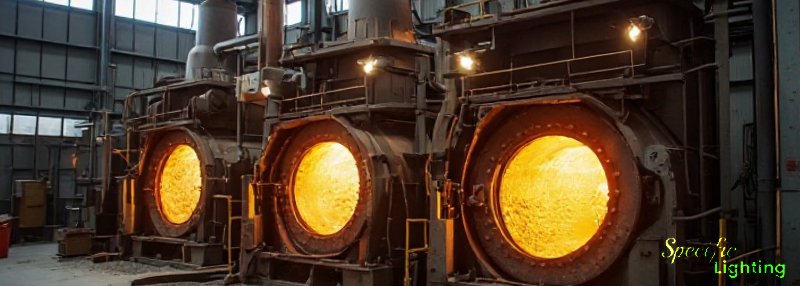
Lighting Design and Layout for Foundries
Choosing the fixture is only half the job. The other half is deciding where the fixtures should go.
A lighting system can use high-quality fixtures and still deliver poor results if spacing, mounting height, beam angle, and orientation are wrong.
For industrial facilities, lighting design is normally based on the visual tasks taking place in each area. EN 12464-1 provides workplace lighting guidance covering maintained illuminance, uniformity, glare, and colour rendering for different activities. Foundry references based on this standard commonly show values around 200 lux for furnace and casting areas, around 300 lux for some casting or moulding activities, and around 500 lux or higher for certain inspection tasks. Actual requirements should be checked against the current standard and the specific workplace.
| Area / Factor | Main Recommendation / Reference |
|---|---|
| General production & furnace areas | Around 200 lux |
| Casting & moulding | Around 200–300 lux |
| Finishing / grinding | Around 300 lux+ |
| Inspection & quality control | Around 500–750 lux |
| Lumen calculation | Example: 2,000 m² + 25,000 lm fixtures = ~37 fixtures |
| Design standard | Check current EN 12464-1 requirements for the specific workplace task) |
How Many Lux Does a Foundry Need?
Lux describes illuminance, or how much light reaches a surface.
A useful starting point for a foundry might look something like this: general furnace and production areas may be designed around 200 lux, casting or moulding work may fall around 200 to 300 lux, finishing tasks can require around 300 lux or more, while inspection and quality-control areas may be designed at 500 lux or higher depending on the visual task.
Published foundry lighting guidance gives examples ranging from approximately 100 lux for circulation areas to 200 lux for furnace and casting zones and 500 to 750 lux for inspection and quality control. These figures are design references rather than a substitute for the applicable workplace standard or a project-specific lighting calculation.
The distinction is important because simply aiming for 500 lux everywhere may waste energy, while aiming for 100 lux everywhere may leave detailed work poorly illuminated.
A Simple Lighting Calculation
The basic lumen method can provide an initial estimate of fixture quantity.
A simplified calculation can be expressed as:
Number of fixtures = (Target lux × Area) ÷ (Fixture lumens × Utilisation factor × Maintenance factor)
Imagine a 2,000 m² production area with a target of 200 lux. If each fixture produces 25,000 lumens, the utilisation factor is estimated at 0.55, and the maintenance factor is 0.80, the calculation becomes:
2,000 × 200 = 400,000 lumens required at the working plane.
Each fixture contributes approximately:
25,000 × 0.55 × 0.80 = 11,000 effective lumens.
That gives:
400,000 ÷ 11,000 = approximately 36.4 fixtures.
The initial estimate would therefore be around 37 fixtures, before checking the result with proper photometric software.
This is why a lumen count alone should not determine the final layout. The actual fixture distribution, ceiling height, beam angle, room geometry, equipment obstructions, reflectance, and uniformity all need to be checked.
Mounting Height Changes Everything
A 25,000-lumen fixture mounted at 5 metres behaves very differently from the same fixture mounted at 12 metres.
At greater heights, the light has farther to travel and the beam needs to distribute the available output appropriately across the working area.
For example, if a facility has a 12-metre ceiling, installing fixtures with a very wide beam may produce excessive light directly beneath the fixture but insufficient intensity farther away. A narrower or medium distribution may provide a better result.
On the other hand, a low-bay area may benefit from wider distribution.
The right answer depends on the photometric data rather than a general rule.
Fixture Spacing Matters
Suppose a 60-metre-long production area uses 6 rows of fixtures. If 10 fixtures are installed along each row, the total would be 60 fixtures.
Changing the layout to 8 fixtures per row would reduce the total to 48 fixtures, but it would also increase spacing. Whether that saves money or creates dark areas depends on the fixture output and optical distribution.
This is where a lighting simulation becomes valuable. A good design can test different fixture counts and spacing arrangements before installation.
Avoid Bright Spots and Dark Areas
Industrial lighting should not be judged only by the maximum lux directly beneath a fixture.
Uniformity matters because workers move through the space and may need to transition between workstations. Large differences between bright and dark areas can make the visual environment less comfortable and may reduce visibility in locations where work is taking place.
A lighting calculation should therefore look at average illumination, minimum illumination, and uniformity.
A published foundry case study, for example, reported an average illuminance of 367 lux and a uniformity value of 0.48 for a designed LED installation.
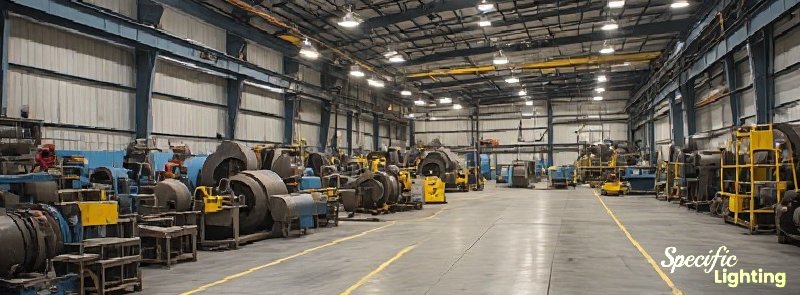
Designing Lighting for Different Foundry Areas
Different parts of a foundry support different activities, so the lighting design should reflect those differences.
Furnace and Melting Areas
Furnace zones need enough illumination for operators to see equipment, controls, platforms, access areas, and the surrounding work environment without unnecessarily exposing the fixtures to extreme heat.
A design value around 200 lux is commonly referenced for furnace work areas, although the actual requirement depends on the task and applicable standard.
The fixture position should also be considered carefully. If moving the fixture 1 or 2 metres farther away from a major heat source significantly reduces thermal exposure while maintaining the required illumination, that can be a worthwhile design adjustment.
Pouring and Casting Areas
Casting areas can require around 200 to 300 lux depending on the specific activity and workplace requirements. Published guidance for foundries lists 300 lux for some casting-bay applications.
The lighting should cover the casting process and the surrounding movement areas. Multiple fixtures can sometimes provide better visibility than a single very powerful source because light arriving from different directions can reduce harsh shadows.
Moulding and Core-Making Areas
Moulding and core-making tasks can require more visual attention than general circulation.
Published EN 12464-1-based foundry references commonly use around 200 to 300 lux for these activities, with colour rendering and glare limits also considered.
The actual design should take into account whether the work is automated, semi-automated, or performed manually.
Fettling, Grinding and Finishing Areas
Finishing operations often involve workers examining and modifying casting surfaces.
Around 300 lux is a useful reference point for some finishing environments, although the required level depends on the exact task.
Here, shadow management can be especially useful. A light positioned directly behind the worker may illuminate the general area but leave the working surface in shadow.
Inspection and Quality-Control Areas
Inspection is where lighting requirements can rise significantly.
Published foundry lighting guidance gives 500 to 750 lux as a reference range for some inspection and quality-control applications.
Colour rendering can also matter. If inspectors need to identify surface colour, oxidation, coating differences, or subtle visual defects, a higher colour-rendering light source may be appropriate.
A 500-lux general production area and a 750-lux inspection station should not necessarily use identical lighting.
Points to Note When Installing High-Temperature Lights
Installation conditions can affect performance just as much as fixture selection.
Confirm the Temperature Rating
Before installation, confirm the maximum expected ambient temperature at the mounting position.
If the fixture is rated to 70°C ambient, the installation should be assessed to ensure the actual operating conditions stay within that specification.
Where temperatures are uncertain, measurement during normal production can provide better information than assumptions based on the general room temperature.
Consider Radiant Heat
A fixture may be exposed to radiant heat even when the surrounding air temperature appears acceptable.
The distance from hot surfaces, angle of exposure, shielding, and mounting direction should therefore be considered.
In some installations, moving the fixture a few metres away from a heat source can make a significant difference to its thermal environment.
Leave Room for Heat Dissipation
A fixture needs an appropriate path for heat to escape.
Do not cover ventilation or heat-dissipation surfaces unless the fixture has specifically been designed for enclosed installation.
Likewise, installing a heat-dissipating housing directly against another surface can change its operating conditions.
Choose Suitable Mounting Hardware
Mounting hardware needs to account for fixture weight and environmental conditions.
If a 10 kg fixture is suspended 10 metres above the floor, the mounting system should not be treated as an afterthought. Vibration, structural loading, corrosion, and access for maintenance all need to be considered.
Protect Cables and Connections
A high-temperature luminaire does not automatically make every cable and connector suitable for high-temperature conditions.
Cable insulation, glands, connectors, junction boxes, and conduit should be specified for the environment in which they are installed.
Cables should also be routed away from unnecessary heat exposure and protected against mechanical damage.
Cost of a Foundry Lighting Upgrade
The cost of upgrading lighting in a foundry can vary quite a bit depending on the size of the facility, fixture specifications, mounting height, electrical work, access requirements, controls, and the number of fixtures needed. A high-temperature lighting project should therefore be evaluated as a complete installation rather than simply comparing the purchase price of individual fixtures.
| Item | Example |
|---|---|
| Foundry area | 2,000 m² |
| LED fixtures | 40 |
| Initial project cost | $26,000 |
| Annual energy savings | 36,000 kWh |
| Annual energy cost savings | $6,480 |
| Energy-only payback | ~4 years |
| Example maintenance cost | $300/fixture |
| TCO evaluation period | 5–10 years |
As a practical example, imagine a 2,000 m² foundry production area that requires approximately 40 high-temperature LED fixtures. If each fixture costs an average of $350, the fixture cost would be:
40 × $350 = $14,000
Installation can add another significant portion to the budget, particularly when fixtures are mounted 8 to 12 meters above the production floor. For this example, suppose wiring modifications, lifting equipment, labor, commissioning, and other installation work add approximately $12,000. The estimated initial project cost would then be around $26,000.
The next step is to look at energy consumption. Assume the existing lighting system uses 400 W per fixture, while the new LED fixtures use 150 W and provide the illumination required for the redesigned space.
With 40 fixtures operating 12 hours per day and 300 days per year, the existing system would consume:
400 W × 40 fixtures × 12 hours × 300 days = 57,600 kWh per year
The new LED system would consume:
150 W × 40 fixtures × 12 hours × 300 days = 21,600 kWh per year
That represents a theoretical reduction of 36,000 kWh per year.
If the facility pays an average electricity rate of $0.18 per kWh, the estimated annual energy saving would be:
36,000 kWh × $0.18 = $6,480 per year
Based on energy savings alone, a $26,000 project would have a simple payback period of approximately 4 years:
$26,000 ÷ $6,480 = approximately 4.0 years
This is a simplified example rather than a guaranteed project return. Actual costs and savings will depend on the electricity tariff, operating schedule, fixture performance, number of fixtures, installation conditions, controls, and the existing lighting system. Maintenance savings and avoided replacement costs could also shorten the overall payback period, while financing, taxes, changes in electricity prices, and other project expenses could affect the result.
The main point is that a foundry lighting upgrade can be evaluated using real operating numbers rather than simply describing LED lighting as “energy efficient.” Looking at fixture cost, annual energy consumption, maintenance, and expected service life gives facility owners a much clearer picture of the investment.
Maintenance Costs Can Change the Equation
Energy consumption is only one part of the cost of operating industrial lighting. In a foundry, maintenance can become a sizeable expense because fixtures are often installed above machinery, production lines, furnaces, and other difficult-to-access areas.
Consider a fixture mounted 10 meters above the production floor. Replacing a failed unit may require two technicians, a lifting platform, electrical isolation, and one to two hours of work. If labor and access equipment together cost around $300 per fixture replacement, replacing 20 fixtures could represent approximately $6,000 in maintenance-related expenses.
That figure does not include production disruption or the time required to arrange access equipment. In a busy facility, even a relatively simple lighting repair can involve scheduling around production activities.
A durable lighting system can therefore provide value beyond lower electricity consumption. If fixtures have a long service life and are properly matched to the temperature, dust, vibration, and operating conditions of the facility, the frequency of replacement may be reduced.
Cleaning is another factor worth considering. A dusty foundry may require periodic cleaning of fixtures and lenses to maintain useful light output. A well-sealed enclosure can help protect internal components from contamination, while an appropriate lens and fixture design can make routine cleaning more manageable.
The goal is not simply to buy a fixture that lasts a long time on paper. The fixture needs to remain suitable for the actual conditions in which it operates.
Total Cost of Ownership Matters More Than the Purchase Price
A $250 fixture and a $400 fixture should not automatically be viewed as a simple $150 price difference. Their energy consumption, output, temperature rating, service life, maintenance requirements, and installation costs may be very different.
For example, suppose a lower-priced fixture costs $250 and consumes 180 W, while another fixture costs $400 and consumes 120 W. Now assume a facility operates 100 fixtures for 4,000 hours per year.
The annual energy difference would be:
60 W × 100 fixtures × 4,000 hours = 24,000 kWh per year
At an electricity rate of $0.18 per kWh, that represents approximately:
24,000 × $0.18 = $4,320 per year
The initial fixture cost difference for 100 units would be:
($400 − $250) × 100 = $15,000
If the more efficient system provides comparable lighting performance and installation requirements, the energy difference alone could theoretically recover that additional $15,000 in approximately 3.5 years.
Of course, the real comparison should go further. If the higher-priced fixture also has a temperature rating better suited to the installation, requires fewer replacements, or reduces maintenance access, its total operating cost could be lower over the same period.
This is why a 5-year or 10-year total cost of ownership calculation can be more useful than looking only at the initial fixture price. For a foundry operating thousands of hours each year, small differences in wattage, maintenance frequency, and service life can add up quickly.
Lighting That Keeps Working When the Environment Gets Hot
Good foundry lighting is therefore about finding the right balance between thermal performance, lighting quality, reliability, energy consumption, installation cost, and long-term maintenance.
If you are planning a new foundry lighting installation, upgrading an existing system, or dealing with recurring lighting failures in a high-temperature area, our team can help assess your application and develop a suitable lighting approach. Share your facility dimensions, mounting height, approximate operating temperature, existing fixture information, operating hours, or photos of the installation area with us, and we can help evaluate the appropriate high-temperature lighting solution and lighting layout for your foundry or metal-casting facility.