
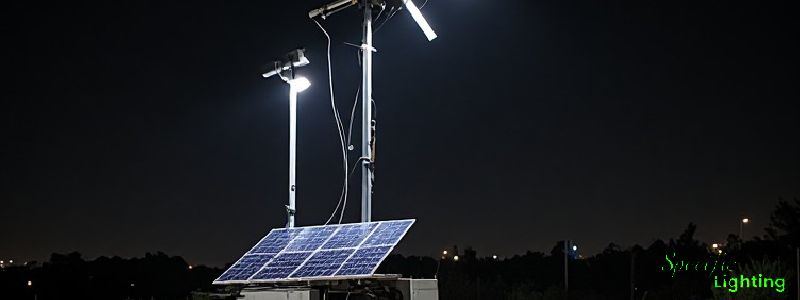
A solar light tower offers a practical way to bring bright, reliable lighting to places where grid power is unavailable, expensive to install, or simply inconvenient. By combining solar panels, battery storage, LED floodlights, and a mobile mast, these systems can illuminate construction sites, sports fields, roads, mining operations, outdoor events, and emergency response areas without relying on diesel fuel every night.
For businesses and public organizations, the appeal goes beyond clean energy. A well-designed solar light tower can reduce fuel expenses, simplify equipment deployment, cut routine maintenance, and provide flexible lighting wherever work needs to happen. However, not every model delivers the same performance. Battery capacity, actual light output, solar charging capability, and overnight runtime can make a substantial difference to both operating costs and day-to-day reliability.
Whether you’re comparing equipment prices, looking for a high-output lighting solution, or exploring funding for a school sports field upgrade, understanding these details will help you make a more informed decision. Let’s look at how solar light towers work, what they cost, which specifications deserve attention, and how to find a system that fits your project.
What Is a Solar Light Tower?
A solar light tower is a mobile or relocatable lighting system that uses solar energy to power LED floodlights. Most units combine photovoltaic panels, a rechargeable battery bank, a telescopic mast, a lighting head, and a supporting trailer or portable base. Some models also include automatic controls, remote monitoring, and a backup generator for situations where sunlight alone cannot meet the energy demand.
Unlike conventional diesel light towers, solar-powered models do not need to burn fuel while producing light. Once the battery has been charged, the LEDs can operate after sunset using stored electricity. During daylight hours, the solar panels replenish the battery, preparing the system for its next operating period.
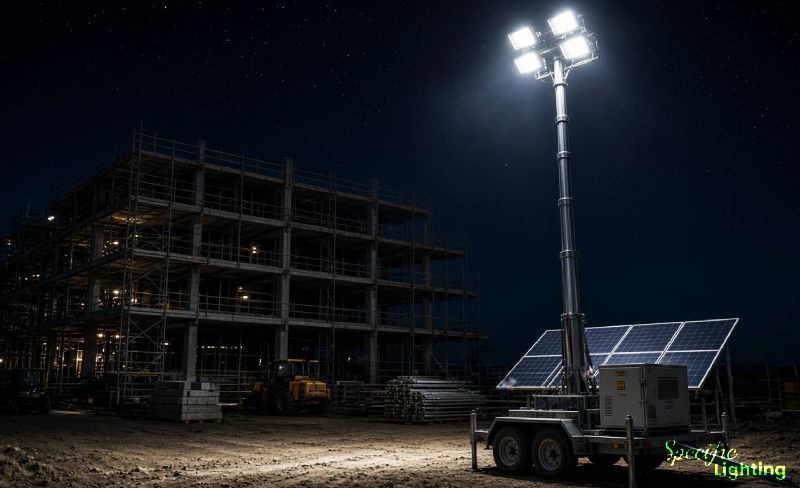
How Does a Mobile Solar Light Tower Work?
The process is straightforward. Solar panels convert sunlight into electricity, and a charge controller regulates the energy entering the battery. After sunset, the battery supplies electricity to the LED floodlights, which distribute light across the designated work area. Depending on the model, an automatic photocell or programmable controller can switch the lights on and off without requiring someone to operate the system manually.
Battery storage is what makes nighttime operation possible. A tower with a 5 kWh battery, for example, does not necessarily provide 5 kWh of usable energy to its lights because battery management limits, conversion losses, and other electrical loads must be considered. If the system has 4 kWh of usable energy and the lighting load averages 400 watts, its theoretical runtime is 10 hours before accounting for additional losses.
Real-world performance also depends on weather, panel orientation, seasonal daylight, temperature, and lighting settings. A system that performs well during long summer days may need more solar capacity, a larger battery, or backup power during a cloudy winter period.
Solar-Only vs. Hybrid Solar Light Towers
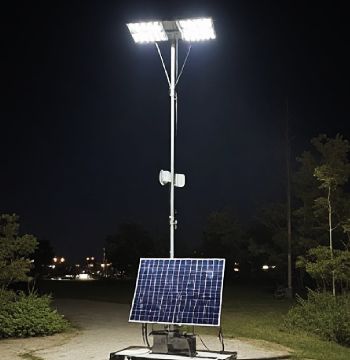 Solar-only towers rely on solar charging and stored battery energy. They suit applications where daily operating hours are predictable and the equipment can receive enough sunlight to recharge. With no routine fuel consumption, these systems can be attractive for temporary work zones, school facilities, recreational areas, and outdoor events.
Hybrid models combine solar and battery power with another energy source, commonly a diesel generator or an alternative backup supply. When the battery reaches a predefined level or solar charging cannot keep up with demand, the backup system can support continued operation or recharge the battery, depending on the design.
For example, a construction contractor operating 10 to 12 hours every night may prefer a hybrid configuration if the project runs through winter or experiences several consecutive cloudy days. A school using portable towers for occasional evening practices may find a solar-only system more suitable.
The right choice depends on the required runtime and local weather, not simply whether a system is advertised as solar-powered.
Solar Light Tower Specifications – What Should You Look For?
A solar light tower can look impressive in a product photo, but the numbers on its specification sheet tell you much more about how it will perform on site. Before comparing manufacturers, focus on six areas – lighting output, solar charging capacity, battery storage, operating runtime, mast height, and durability.
| Specification | Example / Typical Range | What to Check |
|---|---|---|
| LED light output | 30,000–130,000 lumens | Higher lumens do not guarantee better ground illumination |
| Example work area | 1,000 m² at 20 lux | Requires 20,000 lumens reaching the surface before losses and uneven distribution |
| Solar panel capacity | 1,200 W (1.2 kW) | Check rated wattage and real-world charging performance |
| Peak sun hours | 4 hours/day | Actual sunlight varies by location and season |
| Estimated daily solar production | 3.6 kWh/day | Based on 1.2 kW × 4 peak sun hours × 75% performance factor |
| Battery voltage | 48 V | Compare voltage alongside amp-hour and kWh ratings |
| Battery capacity example | 48 V × 200 Ah = 9.6 kWh | This is nominal capacity, not necessarily usable energy |
| Battery cycle life example | 3,000 cycles | Verify test conditions, depth of discharge, and warranty |
| Battery runtime example | 8 kWh usable capacity ÷ 500 W load = 16 hours | Actual runtime will be lower after losses and reserve requirements |
| Lighting energy consumption | 600 W × 10 hours = 6 kWh | Estimate consumption using the actual lighting load |
| Dimming example | 360 W × 10 hours = 3.6 kWh | Reduces energy consumption by 40% compared with a 600 W load |
| Consecutive cloudy-day autonomy | 2–3 days as a design target | Confirm usable battery capacity and backup arrangements |
| Mast height | Approximately 6–9 m | Check operating height, stability, and light distribution |
| Weather protection | IP65 as an example | Verify the rating of each relevant component |
| Wind resistance | Manufacturer-specific | Confirm permitted wind speeds for both deployed and stowed configurations |
LED Light Output – Lumens, Lux, and Lighting Coverage
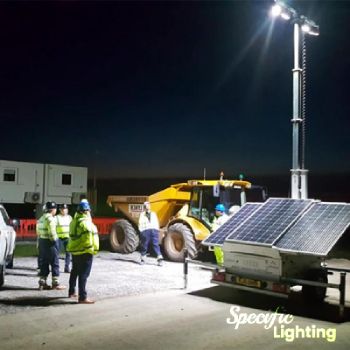 Lumens measure the total visible light produced by a light source, while lux measures how much light reaches a particular surface. The distinction matters because a tower producing 100,000 lumens does not automatically deliver 100 lux across an entire work area. Beam shape, mast height, aiming angle, fixture efficiency, and the distance between towers all influence the result.
Commercial mobile solar light towers may offer approximately 30,000–130,000 lumens, while some larger or specialized systems advertise higher outputs. For example, published manufacturer specifications include systems rated at 64,000 lumens and others rated at 128,000 lumens. These are useful reference points, but the figures alone do not establish which system performs better in a particular location.
For a simplified lighting example, imagine a 1,000-square-meter work area that needs an average maintained illuminance of 20 lux. The area would require 20,000 lumens reaching the working surface, before accounting for uneven distribution, dirt, depreciation, and light falling outside the target area. Since not all emitted light reaches the intended surface, the installed lighting output would need to be higher.
Actual designs should use photometric files and lighting calculations rather than a simple lumen-to-area formula. For a construction site, the lighting designer should account for vehicle routes, equipment movement, pedestrian access, work surfaces, and shadows. For a sports field, uniformity and glare control matter just as much as average illuminance.
Solar Panel Capacity and Daily Energy Production
Solar panel capacity is measured in watts. A tower with a 1,200 W solar array can theoretically produce 1.2 kWh of energy per hour at rated output, but outdoor conditions rarely remain at the laboratory conditions used for panel ratings.
A useful preliminary estimate is:
Daily solar energy = panel capacity × peak sun hours × system performance factor.
Suppose a tower has a 1,200 W array, receives an average of 4 peak sun hours daily, and achieves a planning performance factor of 75%. Its estimated daily energy production would be:
1.2 kW × 4 hours × 0.75 = 3.6 kWh per day.
This is a planning calculation, not a guaranteed output. Shading, panel temperature, orientation, dirt, seasonal daylight, and controller losses can change the result. A location receiving 2 peak sun hours would produce considerably less energy than one receiving 5 peak sun hours with the same equipment.
Buyers should also check whether panels are fixed, adjustable, or extendable. Adjustable panels can help optimize the angle toward the sun, while extendable arrays may provide additional charging capacity when deployed. The trade-off is that larger or moving panels may increase the tower’s footprint, setup time, mechanical complexity, and wind exposure.
Battery Capacity, Chemistry, and Cycle Life
Battery capacity is usually expressed in kilowatt-hours (kWh) or amp-hours (Ah). Kilowatt-hours are especially useful when comparing systems because amp-hours alone do not tell you how much energy a battery stores without also knowing its voltage.
For example, a nominal 48 V battery rated at 200 Ah stores approximately 9.6 kWh of nominal energy:
48 V × 200 Ah ÷ 1,000 = 9.6 kWh.
Usable energy may be lower, depending on the battery chemistry, allowed depth of discharge, reserve settings, and conversion losses. A system should not be selected based solely on the largest advertised battery number.
Lithium iron phosphate batteries are widely used in energy-storage applications because they can offer long cycle life, good thermal stability, and useful energy density. Lead-acid batteries remain available in some equipment and can have a lower upfront cost, although their usable capacity, weight, and replacement requirements may differ.
Ask manufacturers to specify the battery’s usable kWh, rated cycle life, test conditions, warranty period, and expected replacement criteria. A claim of 3,000 cycles, for instance, needs context – the depth of discharge, operating temperature, and end-of-life capacity used in the test all affect its meaning.
Nightly Runtime and Battery Autonomy
Runtime tells you how long a tower can operate on stored energy. Autonomy describes how long the system can continue operating without adequate solar recharge, which is particularly relevant during cloudy weather.
A simple estimate is:
Runtime = usable battery energy ÷ average electrical load.
If a battery provides 8 kWh of usable energy and the lights consume an average of 500 W, theoretical runtime is 16 hours. After allowing for inverter or controller losses and reserve capacity, actual runtime will be lower.
Dimming can make a noticeable difference. A 600 W lighting load operating for 10 hours consumes 6 kWh before losses. Reducing the average load to 360 W through suitable dimming brings consumption down to 3.6 kWh over the same period. The lighting level must still meet the project’s safety and visibility requirements, so dimming should be based on the actual task and lighting design.
For projects requiring two or three consecutive nights of operation with little sunlight, ask the supplier to show how the battery and charging system support that requirement. A headline runtime measured under favorable conditions is not a substitute for a documented operating profile.
Mast Height, Beam Distribution, and Weather Resistance
Many commercial mobile towers use masts around 6–9 meters high, although the available range varies by model. Greater height can help spread light across a wider area and reduce some harsh shadows, but it does not automatically improve every lighting arrangement. The fixture optics and aiming angles still need to match the site.
Check whether the mast is manually raised, electrically operated, or hydraulically extended. Also confirm the time required for deployment, the number of people needed for setup, and the procedure for securing the unit before use. For frequent relocation, a simpler setup process can save time across hundreds of deployments.
Weather protection deserves equal attention. An IP65-rated enclosure, for example, is designed to resist dust ingress and water jets under specified test conditions. It does not mean the entire tower is waterproof under every circumstance, nor does it automatically establish suitability for flooding or submersion.
Ask for the manufacturer’s operating and stowed wind ratings, the required stabilizer setup, and any restrictions on mast deployment during high winds. Towing weight, trailer dimensions, braking arrangements, and local road requirements should also be checked before ordering.
What Is the Highest-Spec Solar Light Tower Available?
There is no single specification that determines the highest-performing solar light tower. One model may offer higher light output, another may store more energy, and a third may be better suited to several cloudy nights or rapid relocation. The best comparison looks at the complete system and the conditions under which the published figures were measured.
Comparing High-Output Models
Published product specifications provide useful examples of the range available. Solight lists solar tower configurations with 64,000 lumens and larger systems rated at 128,000 lumens. Progress Solar Solutions describes its HELIOS-2 configuration as delivering 69,000 lumens, with an option to add another light for a stated total of 86,000 lumens. Other manufacturers publish configurations with different mast heights, solar arrays, battery chemistries, and runtime claims.
These figures are manufacturer-published specifications, not an independent ranking of the entire market. Product configurations can change, and a high lumen rating does not tell you how much light reaches the ground.
For a demanding project, compare at least four performance measures. First, examine delivered lumens and photometric distribution. Second, compare usable battery energy and verified runtime at the intended lighting setting. Third, evaluate daily solar energy production under the project’s local weather conditions. Finally, check the mast, wind ratings, and deployment arrangements.
A tower with a 2,500 W solar array and a 20.5 kWh battery, for example, has a different energy profile from one with a 1,200 W array and a 10.2 kWh battery. Yet the larger system is not automatically the better purchase if the smaller one already meets the lighting requirements and the site cannot make use of the additional capacity.
How to Identify a High-Performance System
A strong specification sheet should state the LED power in watts, total light output in lumens, battery capacity in usable kWh, solar array rating in watts, and expected runtime at a defined load. It should also explain the environmental assumptions behind the performance claims.
Ask whether the manufacturer can supply an IES or LDT photometric file for lighting-design software. This lets a designer estimate illuminance and uniformity across a specific layout. For a school field, roadwork zone, or large industrial yard, that information is far more useful than relying on a headline brightness figure.
Warranty coverage is another differentiator. Check whether the battery, solar panels, mast, trailer, and lighting fixtures have separate warranty terms. A supplier offering local technical support and replacement parts may reduce downtime, especially when the tower supports overnight operations.
Solar Light Tower Applications Across Different Industries
Solar light towers are used in many settings, but each application has its own demands. The equipment suitable for a small outdoor event may not deliver enough coverage for a large construction project or a sports facility. Matching the configuration to the work is the best way to avoid paying for capacity you do not need.
Construction Sites and Roadwork
Construction contractors often need lighting in areas without grid power, particularly during early starts, night shifts, road repairs, and temporary infrastructure projects. A mobile solar tower can be repositioned as the work progresses, avoiding some of the cabling and fuel logistics associated with conventional lighting setups.
For example, a contractor working across a 2,000-square-meter site might start by using several towers around access roads and material storage areas, then move them as the work zone changes. The final number of towers should be determined by a lighting plan that accounts for required lux levels, overlapping coverage, and shadowed areas.
Roadwork needs particular care because glare can affect drivers and workers. Towers should be positioned to illuminate the work area without shining directly into traffic or obscuring warning signs. The lighting layout should follow the project’s applicable work-zone and safety requirements.
School, College, and Sports Field Lighting
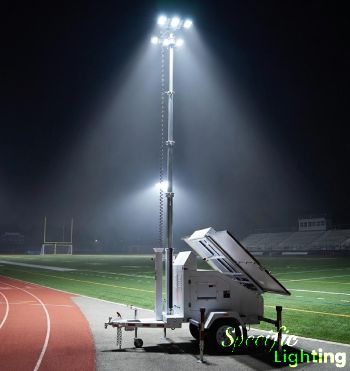 Schools, colleges, parks departments, and community sports organizations may use mobile solar light towers for practice sessions, temporary events, overflow parking, and areas where permanent lighting is unavailable. Portable systems can also provide supplemental illumination during maintenance or renovations.
However, mobile towers are not always a substitute for a permanent sports lighting installation. A competition field may require carefully controlled light distribution, consistent illumination across the playing surface, and limits on glare and light spill beyond the property. The required performance varies by sport, level of play, venue rules, and governing-body guidance.
Consider a hypothetical school that needs temporary lighting for a 60 m by 40 m practice area. The area covers 2,400 square meters. If the design target were an average of 50 lux, the working surface would need to receive 120,000 lumens before accounting for uneven distribution and other design factors. That does not mean a tower rated at 120,000 lumens will meet the target, because some of its light will fall outside the playing area and illuminance will vary across the field.
A qualified lighting designer should calculate the number and position of towers, confirm uniformity, and assess glare and spill light. Where regular evening sports use is planned, it is worth comparing mobile towers against permanent LED floodlights and solar-plus-storage installations.
Mining, Industrial Sites, and Remote Operations
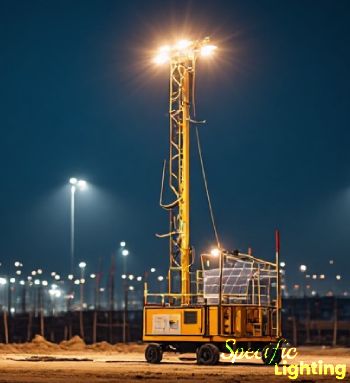 Mining sites and remote industrial facilities may have large outdoor work areas and limited access to grid electricity. Solar towers can reduce routine fuel deliveries and provide localized lighting near workshops, storage areas, temporary roads, and equipment yards.
The operating environment may be rough, so buyers should evaluate structural strength, dust protection, battery temperature limits, and the availability of service support. If the equipment must operate throughout long winter nights or under repeated cloudy conditions, a hybrid configuration may provide more predictable coverage than a solar-only unit.
For hazardous industrial areas, verify the applicable electrical and site certifications before deploying any equipment. A general-purpose solar light tower should not be assumed suitable for an explosive atmosphere or a specialized hazardous location without the required certification.
Emergency Response and Outdoor Events
Emergency response teams may need temporary lighting after severe weather, during recovery work, or around relief distribution points. Solar towers can be useful where fuel deliveries are difficult or generator noise is undesirable. Battery autonomy, quick deployment, and the ability to charge from an alternative power source can all influence their suitability.
Outdoor events present a different set of priorities. Organizers may value quiet operation, reduced local exhaust emissions, automatic switching, and the ability to move equipment between entrances, parking areas, and service zones. Crowd movement, trip hazards, cable-free layouts, and glare control should all be included in the site plan.
In both cases, backup arrangements matter. A solar tower should not be treated as a guaranteed emergency power source unless its capacity and operating conditions have been assessed for the specific task.
How Much Does a Solar Light Tower Cost?
Price is usually one of the first questions buyers ask, and the answer varies considerably by equipment size, battery capacity, lighting performance, mobility, and control features. A compact portable tower and a heavy-duty trailer-mounted unit designed for demanding industrial applications can have very different price tags.
As an initial US-market budgeting guide, buyers might investigate the following broad planning ranges. These are indicative estimates rather than verified quotations for specific models, and actual supplier prices can fall outside them.
| Solar light tower type | Indicative equipment budget |
|---|---|
| Compact portable solar lighting unit | US$1,000–US$4,000 |
| Small mobile solar light tower | US$3,000–US$8,000 |
| Trailer-mounted commercial solar light tower | US$6,000–US$18,000 |
| High-capacity industrial or extended-runtime model | US$15,000–US$35,000+ |
| Customized hybrid or specialist configuration | US$20,000–US$50,000+ |
These categories overlap because manufacturers use different designs and performance specifications. Some lower-priced products marketed as light towers may be portable solar lamps with limited coverage, rather than complete commercial towers with telescopic masts and large battery banks. Buyers should compare complete systems on a like-for-like basis.
What Affects the Purchase Price?
Battery storage is one of the main cost drivers. A larger battery generally supports longer operating periods, but the battery chemistry, usable capacity, cycle-life rating, temperature protection, and battery management system all influence cost. Lithium iron phosphate (LiFePO4) batteries are commonly considered for applications requiring frequent cycling and long service life, although the actual warranty and performance specifications matter more than the chemistry label alone.
Solar panel capacity also affects the purchase price. A larger array can recover more energy during suitable daylight conditions, helping the tower recharge between operating periods. However, the panels need to be matched to the battery and lighting load. Adding panels to an undersized battery or pairing a large battery with insufficient charging capacity may not deliver the expected benefit.
The mast, trailer, and structural components contribute to the final price as well. A unit designed for frequent towing, rough ground, and repeated deployment may need stronger frames, stabilizers, weather-resistant electrical enclosures, and additional safety features. Remote monitoring, automatic dimming, GPS tracking, and customized lighting configurations can add further costs.
Before accepting a quote, check whether it includes freight, commissioning, accessories, batteries, warranties, and any required site preparation. A US$12,000 equipment price may not represent the full amount payable if delivery, specialized transport, or additional electrical equipment is billed separately.
Solar Light Tower Purchase vs. Rental Costs
Buying is not always the most economical choice, particularly for short projects. Rental gives contractors access to equipment without tying up as much capital, while the rental provider may handle maintenance and replacement if a unit develops a fault.
For planning purposes, a commercial mobile tower might rent for approximately US$150–US$500 per week or US$500–US$1,500 per month, depending on location, capacity, rental duration, and service terms. These figures are illustrative rather than confirmed market rates. Delivery, pickup, insurance, damage charges, and minimum rental periods can change the total considerably.
Suppose a tower costs US$12,000 to purchase and the equivalent rental costs US$900 per month. Ignoring maintenance, financing, and resale value, the simple purchase-price equivalent is about 13.3 months of rental.
That does not automatically make buying the better deal. A contractor using the tower for two months may prefer renting, while a business expecting to use it for several years may benefit from ownership. The most useful comparison includes actual utilization, maintenance, battery replacement, financing, resale value, and the cost of keeping equipment idle between projects.
Operating Costs and Long-Term Savings
Solar towers avoid routine diesel consumption, but they are not entirely maintenance-free. Batteries eventually degrade, solar panels need cleaning, mechanical components require inspection, and electronic controls may need servicing. Owners should account for these costs instead of treating solar operation as free electricity.
Consider a simplified diesel-versus-solar example. Assume a diesel light tower consumes 0.6 liters of fuel per hour, operates 10 hours per night for 250 nights annually, and diesel costs US$4 per liter. Annual fuel consumption would be 1,500 liters, costing US$6,000.
If the solar alternative avoids most of that fuel use, the potential gross fuel saving is approximately US$6,000 per year. If the solar tower costs US$6,000 more upfront than the comparable diesel model, the additional purchase price would equal one year of fuel savings under these assumptions.
However, this calculation excludes differences in maintenance, rental rates, battery replacement, financing, and backup energy. It also assumes the diesel unit actually consumes 0.6 liters per hour under the stated operating conditions. Real equipment can vary considerably.
For a fair comparison, use supplier fuel-consumption data, local fuel prices, annual operating hours, and realistic maintenance estimates. The more hours a tower operates, the more valuable a carefully calculated lifetime cost comparison becomes.
Grants and Funding for Solar Light Towers
For schools, colleges, local governments, and community sports organizations, funding can make a solar lighting project easier to justify. However, finding a grant that specifically pays for a mobile solar light tower can be trickier than finding funding for a broader energy-efficiency or renewable-energy upgrade.
The key is to match the proposed equipment to the funding program’s actual objectives. A grant supporting energy improvements at public schools may have different rules from a program funding permanent solar installations, transportation electrification, or community infrastructure.
Grants for School and College Sports Field Lighting
Public school districts and colleges can investigate education-facility funding, state energy programs, municipal capital budgets, utility incentives, and community recreation grants. Depending on the program, funding might support energy assessments, lighting improvements, renewable-energy systems, or broader facility upgrades.
One federal program worth researching is the U.S. Department of Energy’s Renew America’s Schools initiative. The program was established with US$500 million to support energy improvements at K–12 public school facilities. Its published funding history includes awards for energy upgrades across hundreds of school facilities. However, that does not mean a school can automatically apply for a new mobile solar tower under the program. Applicants need to check the latest funding announcements, eligibility rules, and whether the proposed equipment qualifies.
Schools can begin their research at the U.S. Department of Energy’s Renew America’s Schools page.
For a permanent athletic field upgrade, a school might propose replacing inefficient floodlights with LED fixtures, improving lighting controls, or incorporating solar generation and battery storage into a broader facility project. A mobile solar light tower could potentially be considered where the funding rules allow it and the project objectives support temporary or relocatable lighting.
Private colleges and universities should also review their own sustainability budgets, facilities renewal plans, and applicable state or local incentives. Their eligibility may differ from that of public K–12 school districts.
State, Local, and Community Energy Funding
The U.S. Department of Energy’s Office of State and Community Energy Programs provides information about programs supporting states, local governments, Tribal Nations, public schools, and community organizations. Depending on the program and current funding availability, opportunities may include technical assistance, energy planning, or support for qualifying energy improvements.
The DOE State and Community Energy Programs website is a useful starting point for finding relevant programs and state-level resources.
Municipalities can also investigate energy-efficiency and conservation funding, state energy-office initiatives, and utility-sponsored incentives. Some programs focus on permanent improvements to buildings or electrical infrastructure, so mobile equipment may not qualify. A grant administrator can clarify whether the funding can cover equipment purchases, transportation, installation, and battery storage.
Rural communities may want to review USDA Rural Development for programs that support eligible community facilities or energy projects. Again, eligibility depends on the specific program, the applicant, and the proposed use of the equipment.
How to Prepare a Strong Funding Application
A convincing funding proposal should explain the problem the project solves and provide measurable information about the expected benefits. For a school, that might include the current lighting arrangement, the hours of evening use, the size of the area being illuminated, and the reason a mobile solution is preferable to a permanent installation.
Include a supplier quotation, equipment specifications, a proposed lighting layout, and a realistic operating-cost comparison. If the proposal claims fuel savings, show the assumed diesel consumption, annual operating hours, fuel price, and calculation. If it claims energy savings, explain which existing energy costs will actually be avoided.
A project budget of US$25,000, for example, should clearly separate the tower purchase price from delivery, site preparation, accessories, and ongoing maintenance. If the project includes multiple towers, show the quantity and cost of each unit rather than presenting only a single total.
Always confirm that a grant is open and that mobile solar lighting is an eligible expense before making a purchase commitment. Funding rules can change, and some grants require approval before equipment is ordered.
How to Choose the Right Solar Light Tower
Before requesting quotations, establish how much area needs lighting, how bright the working surfaces must be, and how many hours the lights will operate each night. These three details provide a much better starting point than simply asking for the brightest available model.
Match the Lighting Design to the Site
Start by identifying the work area and its required illuminance. A small maintenance zone, a large construction yard, and a school playing field will have different lighting needs. Consider access roads, equipment movement, pedestrian routes, shadows, and nearby properties that could be affected by glare or light spill.
For example, a site with a 1,500-square-meter work area and a target average of 20 lux needs 30,000 lumens reaching the working surface. Actual fixture output will need to be higher because of distribution losses and the requirement to maintain reasonably consistent illumination. A photometric design can estimate the number of towers, their positions, and the expected light levels.
Size the Battery for Nighttime Operation
Calculate the average lighting load and multiply it by the expected operating hours. If a system draws 400 W for 10 hours, the lights consume 4 kWh before accounting for losses. The battery must provide enough usable energy for that demand while retaining the appropriate reserve.
Then consider the solar recharge window. If the tower uses 4 kWh every night but only replenishes 3 kWh on an average day, the energy deficit will accumulate. A larger battery may delay the problem, but it will not solve an ongoing shortage of solar generation.
In that situation, the design may need more panel capacity, a lower average lighting load where safe, a different operating schedule, or hybrid backup.
Compare Suppliers and After-Sales Support
Request a complete datasheet, warranty terms, battery specifications, and an explanation of the stated runtime. Ask whether the quoted configuration is a standard model or a custom design. If you are buying several units, clarify spare-parts availability and the process for arranging repairs.
For larger projects, request a lighting simulation or a demonstration under representative conditions. A supplier that can explain how the equipment meets your site requirements gives you a stronger basis for comparison than one that only provides a lumen rating and a price.
Frequently Asked Questions About Solar Light Towers
How many hours can a solar light tower run at night?
Runtime varies by battery capacity and lighting load. A tower with 8 kWh of usable battery energy supplying a 400 W load has a theoretical runtime of 20 hours before losses and reserve requirements. The actual runtime may be shorter, so request figures at the intended brightness setting.
Can a solar light tower work during several cloudy days?
Yes, provided the stored energy and available charging capacity are sufficient. A system designed for two or three nights without meaningful solar recharge needs enough usable battery capacity to cover the expected load. Hybrid backup can help when weather conditions remain poor for longer than anticipated.
Are solar light towers suitable for school sports fields?
They can be useful for practice areas, temporary events, and supplemental lighting. Competition fields may require a professionally designed lighting layout that meets the relevant sport’s illuminance, uniformity, and glare requirements. A mobile tower should not be assumed to replace a permanent sports lighting system without an assessment.
What is the difference between lumens and lux?
Lumens describe the total visible light emitted by a source, while lux measures the light arriving at a surface. A high-lumen tower can still deliver uneven illumination if its fixtures are poorly positioned or aimed. For site planning, lux levels and uniformity are often more useful than lumens alone.
How long does a solar light tower last?
Service life depends on the chassis, mast, lighting fixtures, battery, environment, and maintenance. LEDs and structural components may last many years, while batteries can require replacement earlier. Ask the supplier for component-specific warranties and realistic battery replacement assumptions rather than relying on a single lifespan figure for the entire tower.
Is buying better than renting a solar light tower?
Buying may suit organizations with frequent, long-term requirements, while renting can make more sense for short projects or occasional events. Compare total rental payments with the purchase price, expected maintenance, battery replacement, financing, and resale value over the same period.
What size solar panel does a solar light tower need?
The required solar panel capacity depends on the lighting load, daily operating hours, local sunlight, and battery charging needs. For example, a 1,200 W solar array receiving four peak sun hours per day and operating at an estimated 75% system efficiency could generate around 3.6 kWh daily. Actual production varies with weather, shading, panel angle, and season.
How much does a solar light tower cost?
The purchase price depends on lighting output, battery capacity, solar panel size, mast height, mobility features, and backup options. Basic models generally cost less than high-output units designed for extended overnight operation. When comparing quotes, check whether delivery, setup, warranties, maintenance, and battery replacement are included.
Do solar light towers need a backup generator?
Not always. A properly sized solar array and battery system may cover normal operating requirements without a generator. However, hybrid models with generator or alternative charging options can provide extra reliability at sites with limited sunlight, unusually high lighting demands, or long periods of continuous operation.
How long does it take to recharge a solar light tower?
Charging time depends on the battery’s remaining capacity, solar array output, sunlight availability, and charging efficiency. A tower with a large battery may recharge in a day under favorable conditions but take longer during cloudy weather or winter. Ask the manufacturer for estimated charging times under realistic local conditions.
Can solar light towers be used in winter?
Yes, many solar light towers can operate during winter, but shorter daylight hours, snow-covered panels, and reduced sunlight can limit energy production. Cold temperatures can also affect battery performance, depending on the battery chemistry and built-in thermal protection. For winter projects, check cold-weather operating limits and whether the system offers sufficient battery storage or backup charging.
Are solar light towers easy to transport and set up?
Many mobile units are designed for transport between construction sites, events, and temporary work areas. Setup requirements vary by model and may include positioning the trailer, stabilizing the chassis, raising the mast, and aiming the lights. Check the tower’s transport dimensions, weight, towing requirements, and deployment procedure before choosing a model.
What maintenance does a solar light tower require?
Routine maintenance typically includes cleaning solar panels, checking electrical connections, inspecting cables and lighting fixtures, testing battery performance, and examining the mast and stabilizers. The required schedule depends on the operating environment and manufacturer’s instructions. Dusty construction sites, coastal conditions, and severe weather may call for more frequent inspections.
Find a Solar Light Tower That Fits Your Project
Choosing a solar light tower is about more than finding a model with impressive brightness figures. The best fit combines suitable lighting coverage, enough battery storage, reliable solar charging, safe deployment, and a realistic total cost of ownership. For schools and public facilities, checking grant eligibility early can also help shape a project budget and determine whether mobile lighting or a permanent installation is the better route.
If you’re comparing solar light towers for construction, sports facilities, industrial sites, outdoor events, or remote operations, contact our team for a project consultation. Share your lighting area, expected operating hours, location, and budget, and we can help you assess suitable configurations, review key specifications, and explore the practical considerations involved in choosing a solar-powered lighting solution.