In many industrial facilities, lighting has to deal with far more than dust and moisture. Chemical plants may contain chlorine (Cl₂), ammonia (NH₃), or other aggressive gases, while steel mills, furnaces, and thermal processing facilities can expose equipment to temperatures of 100°C to 300°C (212°F to 572°F). Under these conditions, ordinary industrial LED lights may suffer from corrosion, overheating, electrical failure, or a much shorter service life than expected.
Corrosion-resistant and high-temperature LED lighting is designed to address these demanding conditions. Depending on the product, it may use specialized housing materials, chemical-resistant seals, advanced thermal management, and high-temperature-rated electrical components. Some projects require protection against corrosive gases, others focus on extreme heat, and some need both in the same installation.
Finding the right solution takes more than choosing a light with a high wattage or an IP66 rating. Buyers need to consider the actual chemicals present, the temperature around the fixture, the required illumination, installation conditions, and the total cost over its working life. Let’s look at how these specialized lights work, where they are used, what they cost, and how to choose a suitable solution for your facility.
Why Do Standard LED Lights Fail in Harsh Industrial Environments?
LED technology is generally energy-efficient and long-lasting, but that does not make every LED fixture suitable for a harsh industrial environment. The complete lighting assembly has to survive the conditions surrounding it.
Corrosive Gases Can Damage the Housing and Electronics
Corrosion does not always begin with obvious rust. Depending on the gas and materials involved, degradation may affect coatings, metal contacts, seals, circuit boards, fasteners, and cable connections.
When moisture combines with corrosive contaminants, the risk can increase. Small amounts of chemical ingress may gradually affect electrical connections or damage internal components, even when the exterior of the fixture still looks acceptable.
This is one reason why an IP66 or IP67 rating should not be treated as proof of chemical resistance. IP ratings describe specified protection against dust and water ingress, not compatibility with every corrosive gas.
Excessive Heat Accelerates Component Aging
Heat is another common cause of premature LED failure. The LED chip generates heat during operation, and that heat needs to move away from the component through an appropriate thermal path.
As surrounding temperatures rise, the available temperature difference for heat dissipation decreases. Electronic drivers, capacitors, seals, connectors, and other components may also approach their operating limits.
An LED fixture that performs well at 25°C (77°F) may behave very differently in a room maintained at 100°C (212°F). At 200°C (392°F) or above, ordinary industrial lighting is generally unsuitable unless specifically engineered and rated for the exposure.
Combined Chemical Exposure and Heat Create Additional Challenges
Heat can change how materials behave, while chemical exposure can weaken materials or protective layers. When these conditions occur together, the fixture may face stresses that are not captured by separate room-temperature corrosion tests and ordinary operating-temperature tests.
A supplier should therefore be able to explain the limits of the proposed design under the expected combined conditions. If the manufacturer has only tested chemical compatibility at 25°C (77°F), for example, buyers should not assume the same performance at 150°C (302°F).
How Does Corrosion-Resistant and Heat-Proof LED Lighting Work?
The basic lighting process remains the same as in other LED systems – electrical energy is converted into light by semiconductor components. The difference lies in how the fixture protects those components from its surroundings and manages the heat generated during operation.
Chemical-Resistant Housing and Protective Materials
The housing provides the first layer of protection. Depending on the application, manufacturers may use suitable engineered polymers, glass, corrosion-resistant alloys, or coated metal components.
Each material has advantages and limitations. Some polymers offer good resistance to selected chemicals but may soften, deform, or age at elevated temperatures. Metals can provide mechanical strength and heat conduction, but their corrosion resistance depends on the specific alloy, gas, moisture level, and surface treatment.
Glass can offer good compatibility with many chemicals, although its mounting arrangement, seals, and resistance to thermal shock still need attention.
The best material is therefore not necessarily the most expensive one. It is the material supported by compatibility data for the actual environment.
Thermal Management and Heat Dissipation
Thermal management is a major part of high-temperature LED design. Heat must be transferred away from the LED module without allowing the junction temperature to exceed its specified limit.
A conventional heat sink may work well when surrounding air is relatively cool. However, its effectiveness can be reduced when the ambient temperature is already high. At that point, simply adding more aluminum fins may not solve the problem.
Specialized systems may use remote power supplies, thermal barriers, heat-resistant mounting arrangements, or active cooling where appropriate. In some installations, the practical solution is to place the lighting head near the process area while positioning the driver in a cooler, accessible location.
At 250°C (482°F) or 300°C (572°F), buyers should ask for a clear explanation of how the system keeps every component within its operating limits. A headline temperature figure without supporting thermal data is not enough.
Sealing Technology and Protection Against Gas Ingress
Seals, cable glands, connectors, and joints are common points where an enclosure can lose its protective performance.
The sealing materials must remain suitable at the expected temperature and in contact with the chemicals present. A gasket that performs well at room temperature may harden, soften, swell, or lose its sealing force under different operating conditions.
The same principle applies to cable entries and electrical connections. Even a well-designed housing can be let down by an incompatible cable jacket or connector.
For environments containing toxic or flammable gases, the enclosure design must also match the facility’s safety requirements. Gas resistance, gas-tightness, and explosion protection are different properties, and one should not be assumed from another.
Testing and Product Verification
Before purchasing a specialized fixture, ask the supplier what evidence supports its stated performance.
For high-temperature operation, useful documentation includes the rated ambient temperature, temperature test conditions, component operating limits, and any restrictions on continuous use. For chemical resistance, request material compatibility information and test data relevant to the gases and concentrations involved.
Where hazardous-area installation is required, check the relevant certification, equipment marking, and permitted operating conditions. A product designed for a harsh environment is not automatically approved for a classified hazardous location.
Applications of Corrosion-Resistant and Heat-Proof LED Lighting
These lighting solutions are used across several industrial sectors, although the required specification can vary widely from one facility to another.
Chemical Processing Plants
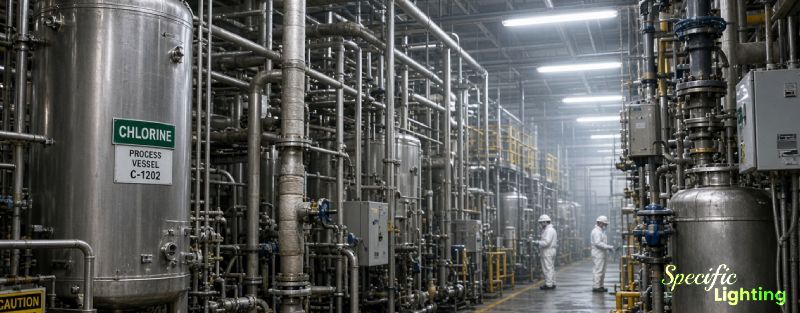
Chemical plants may expose lighting to chlorine, ammonia, hydrogen sulfide, sulfur dioxide, solvent vapors, or mixtures of process gases. Lights may also face humidity, cleaning chemicals, and restricted maintenance access.
Corrosion-resistant fixtures can be considered for designated process areas, pipe racks, chemical handling rooms, and equipment surroundings. The exact choice depends on the chemicals present, their concentrations, and whether exposure is continuous or intermittent.
Water and Wastewater Treatment Facilities
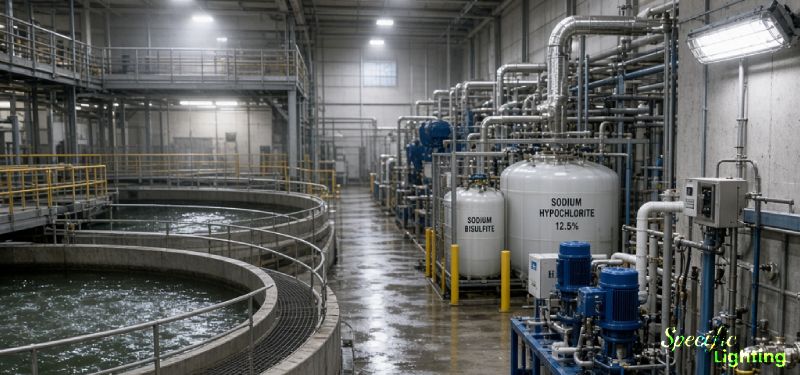
Water treatment plants often use chlorine-based disinfection systems, while wastewater facilities may contain hydrogen sulfide and other corrosive compounds.
Lighting near chemical dosing equipment, treatment tanks, and humid process areas may require corrosion-resistant materials and suitable ingress protection. However, chlorine gas, chlorine solutions, and other chlorine-based chemicals are not identical exposure conditions, so the compatibility assessment should reflect the actual process.
Steel Mills, Foundries, and Heat-Treatment Facilities
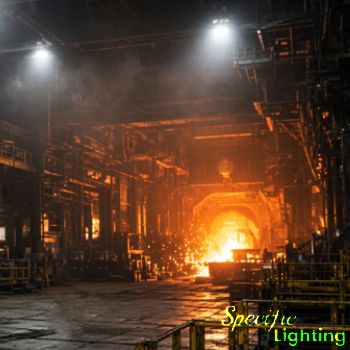 Steel production and metal processing can expose lighting to radiant heat, elevated ambient temperatures, dust, vibration, and industrial contaminants.
In these settings, the fixture may not need to operate inside a 300°C (572°F) atmosphere if it can be mounted in a cooler position with adequate illumination of the work area. That distinction can significantly expand the available product options.
For installations close to furnaces, engineers should evaluate the direct radiant heat reaching the fixture, not just the temperature shown by a nearby room sensor.
Glass Manufacturing, Kilns, and Industrial Ovens
Glass production and thermal processing facilities often have very hot equipment and limited opportunities for routine maintenance.
High-temperature lighting may be used to illuminate inspection points, furnace surroundings, and designated work areas. In many cases, the preferred design places the light outside the hottest zone and uses an appropriate optical arrangement to illuminate the target area.
This can reduce thermal stress on the fixture while keeping the workspace visible.
Fertilizer and Ammonia-Related Facilities
Ammonia production, fertilizer manufacturing, and chemical storage operations may require lighting that can tolerate specified ammonia exposure.
Material compatibility must be assessed for the expected concentration, temperature, humidity, and other chemicals present. If the installation is within a classified hazardous area, the fixture must also meet the relevant electrical safety requirements.
Petrochemical Plants and Refineries
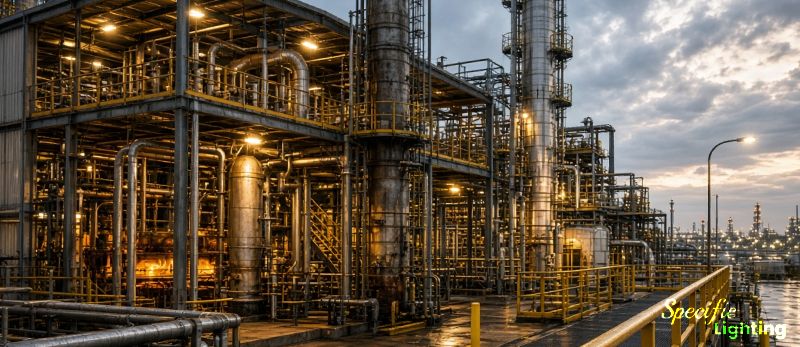
Petrochemical facilities may combine elevated temperatures, chemical vapors, outdoor weather, dust, and potentially hazardous atmospheres.
Different parts of the same plant can have very different requirements. A sheltered walkway may need corrosion-resistant outdoor lighting, while a process area near hot equipment may require additional thermal protection and specific hazardous-area certification.
A site-based specification is usually more useful than choosing one fixture model for the entire facility.
How to Choose the Right Corrosion-Resistant, High-Temperature LED Light
Selecting the right product starts with the actual operating conditions rather than the product name. A little preparation at the specification stage can prevent expensive replacements later.
Confirm the Maximum Operating Temperature
First, establish whether the quoted temperature refers to ambient air, the fixture surface, nearby process equipment, or a short-term peak.
| Temperature | Fahrenheit | Typical consideration |
|---|---|---|
| 100°C | 212°F | Specialized elevated-temperature design |
| 150°C | 302°F | More demanding thermal and component requirements |
| 200°C | 392°F | Requires clearly documented high-temperature suitability |
| 250°C | 482°F | May require remote electronics or special thermal engineering |
| 300°C | 572°F | Highly specialized design; verify continuous operation carefully |
These temperatures describe the application range under discussion, not a guarantee that standard products are available at every rating.
Ask whether the fixture can operate continuously at the stated ambient temperature, how long it can tolerate peak exposure, and what restrictions apply to the driver, cables, seals, and mounting arrangement.
Identify the Corrosive Gases and Their Concentrations
A useful specification identifies each gas by name and, where possible, includes concentration, moisture level, temperature, exposure duration, and any cleaning chemicals used nearby.
For example, a facility reporting chlorine exposure should explain whether the gas is continuously present, released only during certain operations, or associated with humid washdown conditions.
The same approach applies to ammonia and hydrogen sulfide. The supplier should confirm compatibility for the actual conditions instead of relying on a general statement that the fixture is suitable for chemical plants.
Check IP Rating, Corrosion Resistance, and Mechanical Protection
IP66 indicates protection against dust ingress and powerful water jets under specified test conditions. IP67 addresses temporary immersion under specified conditions. Neither rating establishes resistance to chlorine, ammonia, or high-temperature operation.
An IK rating, where provided, addresses mechanical impact protection. Corrosion resistance needs separate supporting information, and temperature suitability must be verified independently.
Verify Hazardous-Area Certifications
If the area contains potentially explosive gas or dust atmospheres, determine its classification and the applicable certification requirements.
Depending on the project and jurisdiction, these may involve ATEX, IECEx, UL, or other recognized certification schemes. The required protection method, gas group, temperature class, and equipment marking must match the installation.
Not every corrosive atmosphere is explosive, and corrosion-resistant construction alone does not make a fixture explosion-proof.
Evaluate Brightness, Beam Angle, and Mounting Height
A durable light still needs to illuminate the work area properly. Buyers should consider luminous flux, beam distribution, mounting height, glare, shadows, and the illumination level required for the task.
For an initial estimate, illuminance can be calculated using:
Lux = Lumens ÷ Area in square meters
For example, delivering 20,000 lumens across a 100 m² area gives a theoretical average of 200 lux before accounting for optical losses, mounting geometry, surface reflectance, and uneven light distribution.
Actual installations should use a photometric layout rather than relying solely on this simplified calculation.
Check Warranty and Maintenance Conditions
Ask whether the warranty covers operation at the specified temperature and chemical exposure. A standard warranty may exclude unusual environments or require the fixture to operate within a narrower temperature range.
Also check whether drivers, LED modules, seals, and other components can be replaced independently. In a facility where accessing a light requires scaffolding, a shutdown, or specialized protective equipment, maintainability can have a substantial effect on lifecycle costs.
How Much Does Corrosion-Resistant and Heat-Proof LED Lighting Cost?
Pricing varies considerably because these are specialized industrial products rather than a single standardized category. A chemically resistant fixture for a humid treatment room may cost far less than a custom system designed for continuous exposure to 250°C (482°F) or a certified hazardous location.
The following figures are illustrative planning allowances in US$, not verified supplier quotations or current market averages. They are intended to help buyers organize an initial budget. Actual prices depend on the product, project volume, certifications, testing, and delivery location.
Estimated Fixture and System Costs
| Product or project type | Illustrative budget per fixture or assembly |
|---|---|
| Standard industrial LED fixture | US$50 to US$200 |
| Corrosion-resistant industrial LED fixture | US$100 to US$500 |
| Specialized high-temperature LED fixture | US$300 to US$1,500 |
| Combined chemical- and heat-resistant custom assembly | US$800 to US$3,000+ |
| Certified or engineered solution for demanding installations | US$1,000 to US$5,000+ |
These categories overlap, and some specialized or certified systems can fall outside these ranges. A custom assembly may also include a remote driver, cooling equipment, protective enclosure, or additional accessories. The final quotation should state exactly what is included.
What Drives the Price Up?
The first factor is the operating temperature. As the specified temperature increases, manufacturers may need more specialized components, different materials, remote electronics, or additional thermal engineering.
Chemical compatibility is another cost driver. A fixture intended for a specific gas mixture may need materials and seals selected for that exposure, supported by additional testing. If the installation also requires hazardous-area certification, the design and documentation requirements may add further costs.
Optical performance and installation details matter as well. A 100 W fixture is not automatically cheaper or more suitable than a 60 W model if it needs a different housing, beam distribution, or thermal arrangement.
Finally, project quantity affects pricing. An order for 100 identical fixtures may have a different unit price from a one-off custom assembly requiring engineering work and specialized testing.
Example – Budgeting for a 20-Light Installation
Suppose a facility needs 20 corrosion-resistant fixtures, each priced at an illustrative US$250. The fixture purchase alone would be US$5,000.
If installation averages US$100 per fixture, installation adds US$2,000. If the project also allocates US$1,000 for engineering review, lighting calculations, and commissioning, the initial project budget becomes US$8,000.
| Cost item | Illustrative amount |
|---|---|
| 20 fixtures × US$250 | US$5,000 |
| Installation – 20 × US$100 | US$2,000 |
| Engineering and commissioning allowance | US$1,000 |
| Estimated project total | US$8,000 |
This example assumes a relatively straightforward installation. It excludes specialized wiring, hazardous-area installation costs, scaffolding, production downtime, taxes, and any custom cooling equipment. A project involving extreme heat or a classified hazardous area may require a substantially larger budget.
How to Calculate Energy Costs
Electricity consumption is another part of the total cost of ownership. The calculation is straightforward:
Annual energy use (kWh) = Fixture power (kW) × Operating hours per year
Consider 20 LED fixtures rated at 100 W each, operating 16 hours per day for 300 days per year.
The total connected load is 20 × 0.1 kW = 2 kW. Annual consumption is 2 kW × 16 hours × 300 days, or 9,600 kWh.
At an illustrative electricity rate of US$0.12 per kWh, annual energy costs would be US$1,152.
| Operating parameter | Example |
|---|---|
| Number of fixtures | 20 |
| Power per fixture | 100 W |
| Annual operating time | 4,800 hours |
| Annual electricity use | 9,600 kWh |
| Electricity rate | US$0.12/kWh |
| Annual electricity cost | US$1,152 |
For comparison, replacing those 100 W fixtures with 150 W fixtures under the same schedule would increase annual consumption to 14,400 kWh. At the same electricity rate, the annual bill would rise to US$1,728, a difference of US$576.
However, wattage alone does not determine the best choice. A 150 W fixture with better optical distribution may illuminate a large area with fewer units. Lighting calculations should compare the complete installation rather than individual wattage figures.
Calculate the Total Cost of Ownership
The purchase price is only one part of the financial picture. In a harsh industrial environment, maintenance labor, replacement frequency, access equipment, and production interruptions can add up quickly.
Consider a hypothetical installation of 20 fixtures. If replacing one fixture costs US$250 and requires US$150 in labor and access costs, each replacement costs US$400 before any production losses.
If the installation experiences five such replacements in a year, the direct replacement expense would be US$2,000. Reducing that number to one replacement would lower the annual direct expense to US$400, saving US$1,600 under these assumptions.
These figures are examples, not predicted failure rates. Actual maintenance costs should be estimated using site records, supplier warranty conditions, and the time required to access each fixture.
A more expensive fixture can make financial sense when its verified operating limits match the environment and it reduces maintenance requirements. However, a higher purchase price does not automatically mean a longer service life. Buyers should compare documented performance and realistic operating conditions.
Important Points When Installing and Using Harsh-Environment LED Lights
Even a well-designed fixture can fail early if it is installed outside its rated conditions. Installation planning should cover temperature, chemical exposure, electrical connections, and maintenance access.
Do Not Exceed the Rated Ambient Temperature
Confirm the maximum continuous operating temperature before installation. A fixture advertised as heat-resistant may have a rating of 100°C (212°F), but that does not make it suitable for a location reaching 200°C (392°F).
Also account for radiant heat from furnaces, hot pipes, and process equipment. A temperature sensor measuring the room air may not capture the full thermal load on a fixture facing a hot surface.
Where practical, relocating the light, adjusting its orientation, or using an approved thermal barrier may reduce exposure. Any modification must remain consistent with the manufacturer’s installation instructions and safety requirements.
Confirm Material Compatibility Before Exposure
Avoid assuming that a housing material, gasket, coating, or cable jacket is suitable simply because it is marketed as chemical-resistant.
Check the specific chemical, concentration, temperature, and moisture conditions. If the process includes multiple gases or cleaning agents, the supplier should assess the combination where relevant.
This is particularly useful when evaluating chlorine and ammonia applications, where the exact exposure conditions can differ substantially between facilities.
Plan Driver Placement and Electrical Connections
Remote driver placement can help protect electronics from high ambient temperatures, provided the overall system supports that configuration. The allowable cable length, voltage drop, driver location, and connector temperature ratings all need to be considered.
Electrical connections should use components rated for the actual operating environment. Cable glands and seals must maintain their specified performance, and installation work should be completed by appropriately qualified personnel.
Schedule Inspections Around Actual Conditions
A maintenance plan should reflect the severity of exposure, operating hours, and ease of access. For example, a facility might begin with monthly visual inspections and a more detailed quarterly review, then adjust the schedule based on observed degradation and manufacturer guidance.
Inspection intervals should not be treated as universal rules. A highly corrosive process area may need more frequent attention than a sheltered installation with occasional chemical exposure.
Look for changes in light output, damaged seals, unusual discoloration, loose connections, and evidence of overheating. Any abnormal condition should be assessed according to the site’s safety procedures.
Frequently Asked Questions About Corrosion-Resistant and Heat-Proof LED Lighting
Can LED Lights Operate at 100°C (212°F)?
Some specialized LED lighting systems are designed for elevated ambient temperatures, including applications around 100°C (212°F). However, the complete fixture must be rated for that condition. Check the LED module, driver, seals, cables, and any restrictions on continuous operation.
Are There LED Lights That Can Withstand 200°C (392°F) or 300°C (572°F)?
Specialized systems may be developed for demanding thermal environments, but continuous operation at 200°C (392°F) or 300°C (572°F) is far beyond the capability of ordinary industrial LED fixtures.
At these temperatures, the design may require remote electronics, thermal isolation, or a specialized cooling arrangement. Ask for documentation that clearly identifies the permitted operating conditions and the temperature of each relevant component.
Can LED Lights Resist Chlorine Gas (Cl₂)?
Some lighting assemblies can be designed for specified chlorine exposure. Suitability depends on gas concentration, humidity, temperature, exposure duration, and the materials used throughout the fixture.
A general corrosion-resistant label is not enough. Request chemical compatibility data for the actual operating conditions.
Can LED Lights Be Used in Ammonia (NH₃) Environments?
Yes, where the fixture materials and complete assembly are compatible with the ammonia exposure. The supplier should consider concentration, moisture, temperature, and any other process chemicals present.
If the location is also classified as hazardous, the fixture must meet the applicable electrical safety requirements.
Does an IP66 Rating Mean a Light Is Corrosion-Proof?
No. IP66 describes specified protection against dust and powerful water jets. It does not establish resistance to corrosive gases, chemical vapors, or extreme temperatures.
Chemical compatibility and temperature ratings should be checked separately.
How Long Do Corrosion-Resistant and High-Temperature LED Lights Last?
Service life depends on the LED components, driver design, thermal conditions, chemical exposure, operating hours, and maintenance practices.
A manufacturer may provide an LED lifetime rating such as L70, which indicates the point at which light output has declined to 70% of its initial value under specified conditions. It does not guarantee that the complete fixture will remain operational for that period in a harsh industrial environment.
Ask for lifetime information that reflects the intended application rather than relying on a headline number alone.
Can These LED Lights Be Customized for Specific Industrial Applications?
Depending on the manufacturer, customization may cover housing materials, mounting arrangements, optical distribution, cable connections, driver placement, and thermal management.
Projects involving combined chemical exposure and temperatures above 200°C (392°F) may require additional engineering assessment. Buyers should provide the operating conditions early so the supplier can determine whether an existing product is suitable or a custom design is needed.
Find the Right Lighting Solution for Your Industrial Environment
Corrosion-resistant and high-temperature LED lighting can help industrial facilities maintain reliable illumination in demanding environments, but the right solution depends on more than a single temperature rating or corrosion-resistant label. Chemical compatibility, thermal management, optical performance, enclosure protection, electrical safety, and maintenance costs all influence whether a fixture is suitable for long-term use.
For temperatures ranging from 100°C (212°F) to 300°C (572°F), the first step is to establish the actual exposure conditions and verify how the complete lighting system will operate within them. A well-matched design can also make budgeting easier by accounting for energy consumption, replacement labor, installation access, and expected maintenance needs.
If your facility operates in an environment containing chlorine, ammonia, other corrosive gases, or extreme heat, contact us for a technical consultation on your industrial LED lighting requirements. Share your operating temperature, chemical exposure conditions, installation location, and lighting needs, and our team can help assess suitable product configurations, discuss customization options, and prepare a quotation based on your project specifications.