Stadium lighting has come a long way from simply putting a few powerful floodlights around a sports field and switching them on after sunset. Today’s systems need to deliver consistent visibility, keep energy bills under control, work with modern broadcasting equipment, and avoid sending excessive light into nearby homes. For schools, colleges, sports clubs, municipalities, and professional stadium operators, getting the design right can make a noticeable difference to both the initial budget and the cost of running the facility for years to come.
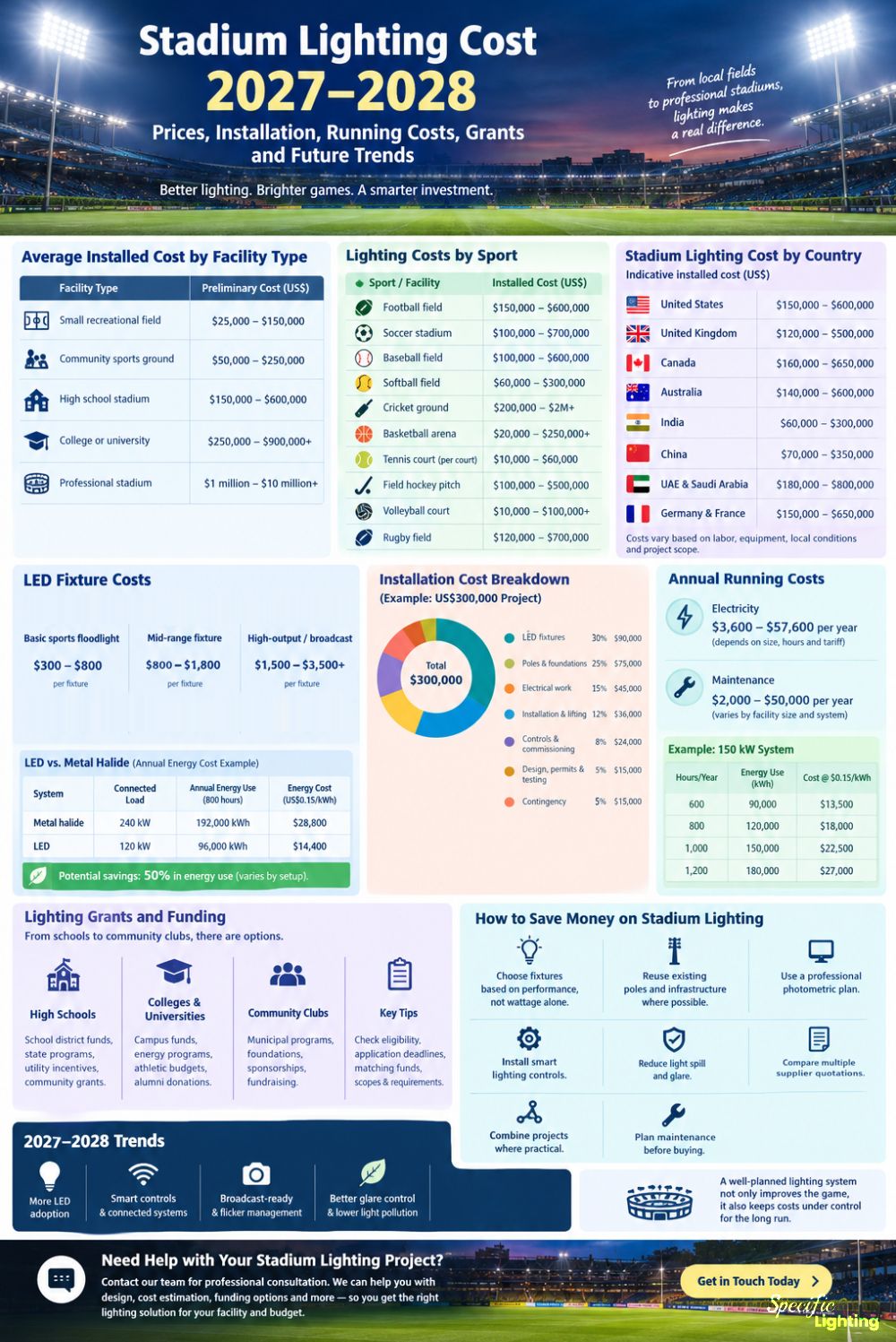
So, how much should you budget for stadium lighting in 2027–2028? A small community sports field might need an investment of US$25,000 to US$150,000, while a high school stadium could require US$150,000 to US$600,000. Larger collegiate venues and professional stadiums can cost considerably more, especially when they need broadcast-ready lighting, new high-mast poles, upgraded electrical infrastructure, or advanced control systems. These are preliminary budgeting ranges rather than guaranteed market prices, and the actual figure will depend on the sport, site conditions, lighting specifications, and local construction costs.
LED technology is expected to remain a major focus in the 2027–2028 stadium lighting market. However, buying the most powerful fixtures or choosing the lowest equipment quote does not automatically produce the best result. The real goal is to create a lighting system that meets the venue’s needs without spending more than necessary on equipment, installation, electricity, and maintenance.
From football and soccer to cricket, baseball, basketball, tennis, volleyball, and other popular sports, each facility presents a different set of challenges. This guide explores the costs involved, explains how to estimate a realistic budget, compares potential expenses across countries, and looks at grants and funding options that may help institutions make their projects more affordable.
How Much Does Stadium Lighting Cost in 2027–2028?
Stadium lighting costs vary widely because a community training ground and a professional stadium are not buying the same lighting system. One venue may need a straightforward LED upgrade using existing poles, while another may require dozens or hundreds of high-output floodlights, new foundations, extensive electrical work, and a lighting design suitable for televised matches.
For early planning, it helps to divide projects into several categories. Small recreational facilities generally have lower equipment and installation requirements. School and college stadiums tend to require more consistent lighting across larger playing areas, while professional venues may need additional vertical illumination, camera compatibility, redundant systems, and sophisticated lighting controls.
Average Stadium Lighting Installation Costs
A small recreational field with relatively basic lighting requirements may cost around US$25,000 to US$150,000 to light. The lower end of that range is more likely when the field is modest in size, existing infrastructure can be reused, and the installation does not require major civil engineering work. A project with new poles, long cable runs, or upgraded electrical equipment can quickly move toward the upper end.
A typical high school stadium may require approximately US$150,000 to US$600,000 for a complete new lighting installation. This range can cover a variety of outdoor sports facilities, but it should not be treated as a universal price for every school. A smaller field with local competition requirements may cost much less than a venue designed for large crowds, televised games, or multiple sports.
College and university facilities often need budgets of US$250,000 to US$900,000 or more. The cost depends on whether the project covers a single playing field, a larger competition venue, or several facilities under one contract. Universities may also have more demanding requirements for lighting controls, maintenance access, energy reporting, and compatibility with existing campus infrastructure.
At the professional level, the budget can reach several million dollars. A major stadium lighting project may cost US$1 million to US$10 million or more when it includes high-performance floodlights, new towers, major electrical upgrades, complex control systems, and broadcast-specific requirements. Large venues with unusual structures or extensive reconstruction work can exceed that range.
The figures below are broad planning estimates for 2027–2028, not supplier quotations. They are intended to help facility owners decide whether they are planning a relatively small upgrade or a major capital project.
| Facility type | Preliminary installed cost in US$ |
|---|---|
| Small recreational sports field | US$25,000–US$150,000 |
| Community sports ground | US$50,000–US$250,000 |
| High school stadium | US$150,000–US$600,000 |
| College or university facility | US$250,000–US$900,000+ |
| Professional stadium | US$1 million–US$10 million+ |
These ranges can overlap because facility size alone does not determine the budget. A small venue with strict competition requirements may need a more sophisticated system than a larger field used mainly for recreational practice. For that reason, the final design should be based on the required lighting performance rather than the name or capacity of the venue.
New Stadium Lighting vs. LED Retrofit Costs
A new installation usually involves more than purchasing lights. The project may require lighting poles, reinforced concrete foundations, underground cabling, electrical distribution equipment, protective devices, controls, engineering, and commissioning. If the site has never had permanent sports lighting, these additional costs can account for a substantial share of the total investment.
An LED retrofit can be more affordable when the existing poles, foundations, and electrical infrastructure remain suitable. Instead of rebuilding the entire system, the project may involve replacing the old fixtures, updating selected electrical components, adjusting the aiming angles, and installing modern controls. A retrofit can also reduce disruption because parts of the existing installation may remain in service during the work.
For planning purposes, a school or community facility might budget approximately US$50,000 to US$300,000 for a relatively straightforward LED retrofit. Larger facilities or projects involving electrical upgrades can cost US$300,000 to US$1 million or more. These ranges are broad because the number and type of fixtures, structural condition, and required lighting level vary considerably.
A common mistake is assuming that every existing pole can safely support new LED equipment. LED fixtures may have different weights, dimensions, wind-loading characteristics, and mounting requirements from older luminaires. A structural engineer should check the poles and foundations before the project moves forward, especially if the installation is several decades old.
The choice between a retrofit and a complete replacement should therefore be based on the condition of the existing infrastructure, the performance of the current lighting system, and the expected cost over its remaining service life. Reusing suitable equipment can save money, but retaining worn-out components may create repair costs that erase those savings later.
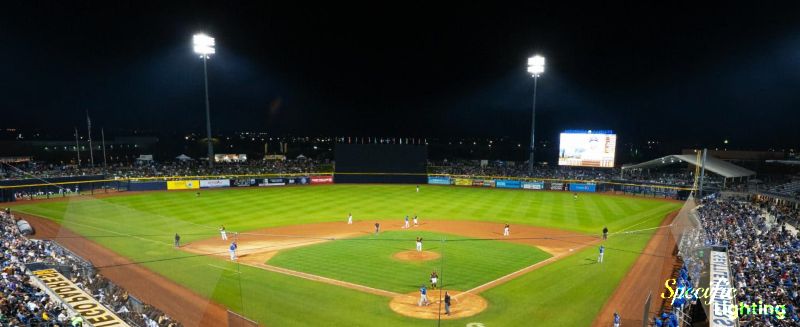
What Determines the Total Project Budget?
The playing area is one of the first things to consider, but it is only part of the calculation. A stadium with a large footprint may need more light sources, yet a smaller venue with higher competition requirements can demand more expensive fixtures and a more precise optical layout.
The required illuminance, measured in lux, influences the quantity and output of the fixtures. Mounting height and beam angle affect how effectively light reaches the playing surface. The design must also account for uniformity, glare, shadows, vertical illumination, and light spill beyond the field.
Site conditions matter just as much. A facility with an existing high-capacity electrical supply and usable poles may have a relatively straightforward installation. A remote site requiring new transformers, extensive trenching, road closures, or difficult crane access can incur much higher construction costs.
The operating schedule also deserves attention. A venue that runs practice sessions five evenings per week will have different energy requirements from a stadium that hosts occasional weekend matches. Lighting controls can help both facilities, but the greatest savings often come from matching the amount of light to the activity taking place.
For a realistic budget, separate the fixture purchase from the cost of poles, foundations, electrical work, installation, engineering, controls, and commissioning. Include a contingency for unexpected site conditions rather than assuming every part of the project will proceed exactly as planned.
Stadium Lighting Cost by Sport
Different sports have different lighting requirements, so there is no single price that works for every stadium. American football and soccer use large outdoor fields, baseball and softball require good visibility across both the infield and outfield, and cricket grounds may cover particularly large areas. Indoor sports such as basketball and volleyball have different mounting arrangements and glare considerations.
The following sport-specific ranges are preliminary budgeting bands for 2027–2028. They are not official industry tariffs, and the ranges overlap because a basic recreational facility and a broadcast-ready venue may differ by several times in cost. Use them to establish an initial budget, then refine the estimate with a photometric design and local installation quotations.
| Sport or facility | Preliminary installed cost in US$ | Main cost drivers |
|---|---|---|
| American football field | US$150,000–US$600,000 | Field size, poles, competition level |
| Soccer stadium | US$100,000–US$700,000 | Pitch size, uniformity, broadcasting |
| Baseball field | US$100,000–US$600,000 | Infield and outfield coverage |
| Softball field | US$60,000–US$300,000 | Diamond layout, pole positions |
| Cricket ground | US$200,000–US$2 million+ | Large oval, mounting height, cameras |
| Basketball arena | US$20,000–US$250,000+ | Indoor structure, ceiling height |
| Tennis court | US$10,000–US$60,000 per court | Court layout, glare, mounting |
| Field hockey pitch | US$100,000–US$500,000 | Uniformity, competition standards |
| Volleyball court | US$10,000–US$100,000+ | Indoor layout, ceiling and camera needs |
| Rugby field | US$120,000–US$700,000 | Playing area, poles, competition level |
The estimates above generally describe lighting projects rather than the construction of the stadium itself. They do not automatically include grandstands, scoreboards, roofing, changing rooms, or other sports infrastructure. For indoor venues, the figures can vary depending on whether lighting is being installed in an existing gym or included in a much larger arena construction project.
Football Stadium
American football stadiums require lighting across the playing field, including the end zones. The design must provide consistent visibility for players, officials, spectators, and, where applicable, broadcast cameras. Because the field is large and the ball moves quickly, the distribution of light matters as much as the total amount produced by the fixtures.
A high school football field might have an installed lighting budget of approximately US$150,000 to US$600,000. A smaller practice field with modest requirements could cost less, while a college stadium with higher lighting levels, upgraded poles, and broadcast equipment could require US$500,000 to US$2 million or more. Professional stadium projects can run into several million dollars, especially when the lighting system is part of a wider renovation.
For a school project, the first step is to confirm whether the facility will be used for training, local competition, regional tournaments, or televised events. A system designed mainly for practice may not meet the requirements of a venue hosting higher-level competition. Paying for unnecessary output can inflate the budget, but installing too little lighting may lead to expensive modifications later.
Pole placement also affects cost. Tall poles can provide broad coverage, but they require suitable foundations and structural engineering. The distance between poles, the fixture beam angles, and the aiming direction all influence uniformity. A carefully planned layout can reduce the number of fixtures needed without creating dark areas near the sidelines or end zones.
LED systems offer another way to control costs. A football field may operate at full output during a game, reduced output during training, and a lower setting for cleaning or maintenance. This approach avoids running every fixture at maximum power whenever the field is occupied.
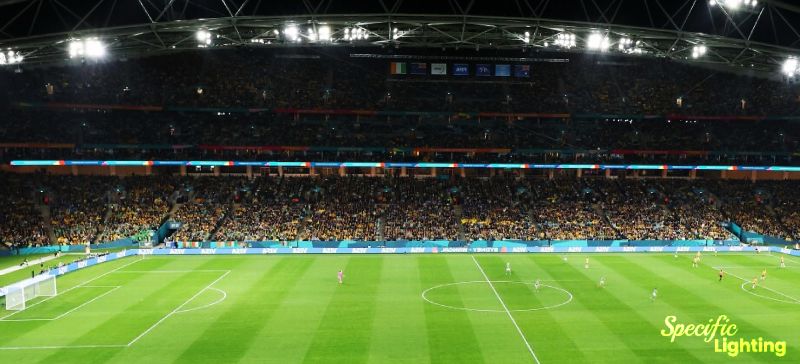
Soccer Stadium
Soccer lighting projects range from small community pitches to international stadiums with sophisticated television requirements. A recreational field may need relatively straightforward floodlighting, while a venue hosting high-level competition must pay closer attention to uniformity, glare, vertical illumination, and the demands of cameras.
A community soccer pitch may cost approximately US$50,000 to US$200,000 to light, depending on its size and infrastructure. A school or competitive club facility might fall between US$100,000 and US$500,000, while a larger stadium with higher performance requirements may exceed US$1 million. A full professional stadium project can cost several million dollars when towers, electrical infrastructure, and broadcast systems are included.
The first design question is not simply how many fixtures the field needs. It is how much light must reach different parts of the pitch and how evenly that light must be distributed. A field with bright central areas and dark corners may have a high average lux reading but still provide poor playing conditions.
The surrounding environment also affects the design. Residential properties near the pitch may require careful control of upward light, glare, and spill beyond the field boundary. Shielding and precision optics can help, although the best solution is usually to address these issues during the initial layout rather than attempting to correct them after installation.
For clubs upgrading old metal-halide lighting, the existing pole positions and cabling should be reviewed before new equipment is selected. If the poles are suitable, the project may be considerably cheaper than a complete rebuild. However, changing fixture output without checking the beam distribution can produce disappointing results even when the new lights are more energy-efficient.
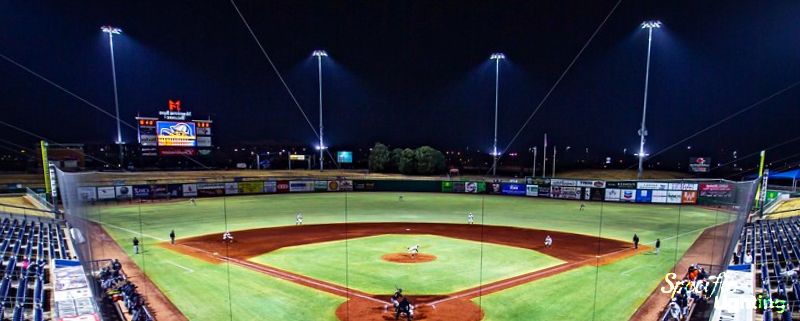
Baseball Stadium
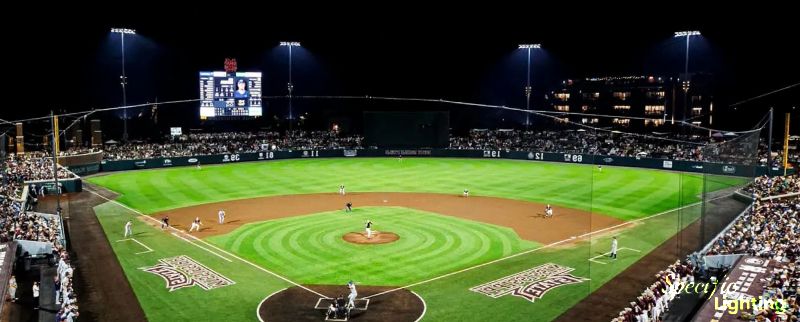
Baseball presents a different lighting challenge because the infield and outfield have distinct visibility requirements. Players need to track the ball against the sky, react to fast pitches, and judge its movement across different parts of the field. Poorly controlled shadows or uneven illumination can make those tasks harder.
A youth or community baseball field may need approximately US$50,000 to US$200,000 for lighting, while a high school or college facility may cost US$100,000 to US$600,000. Larger venues with high-mast systems and broadcast requirements can cost substantially more.
Fixture placement is especially important because the infield geometry differs from the outfield. The design must avoid creating distracting glare when players look upward to track a fly ball. It should also provide adequate illumination around the bases, pitcher’s mound, batter’s area, and outfield warning track.
A baseball field may require a more complex arrangement than its dimensions alone suggest. The poles need to cover a broad area while limiting shadows and avoiding unwanted light near neighboring properties. The design should also consider whether the venue uses artificial turf, natural grass, or a combination of playing surfaces, although the surface material does not replace the need for a proper photometric study.
Existing facilities should assess the condition and location of their poles before selecting replacement fixtures. A retrofit that retains suitable infrastructure can reduce costs, but the new beam angles may need to differ from those of the old equipment. A lighting simulation can help identify these issues before installation begins.
Softball Field
Softball facilities often have a smaller playing area than baseball fields, but this does not mean their lighting projects are always inexpensive. The number of fixtures, pole heights, competition requirements, electrical supply, and site layout all influence the final price.
A basic community softball field might cost US$30,000 to US$120,000 to light. A high school or competitive facility may require US$60,000 to US$300,000, while larger tournament venues can exceed that range if they include multiple diamonds, spectator areas, or advanced lighting controls.
One opportunity for savings is shared infrastructure. A complex with two or more softball fields may be able to combine electrical distribution, control systems, maintenance access, and procurement. The design must still ensure that each field receives suitable lighting without creating glare or light spill across neighboring diamonds.
For facilities used for both practice and tournaments, separate operating modes can make a difference to electricity costs. Training sessions may not need the same output as competitive games, so dimming or zone control can reduce consumption when full lighting is unnecessary.
Cricket Stadium
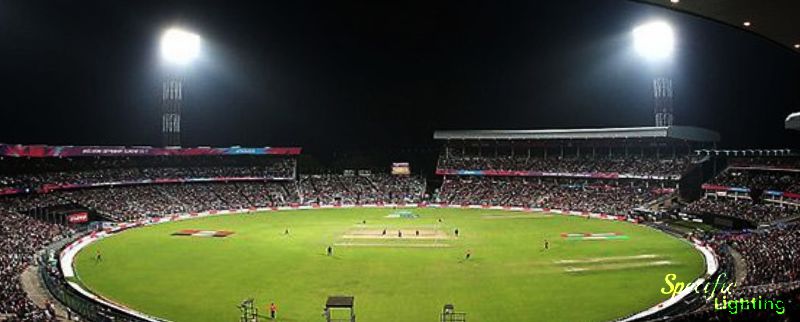
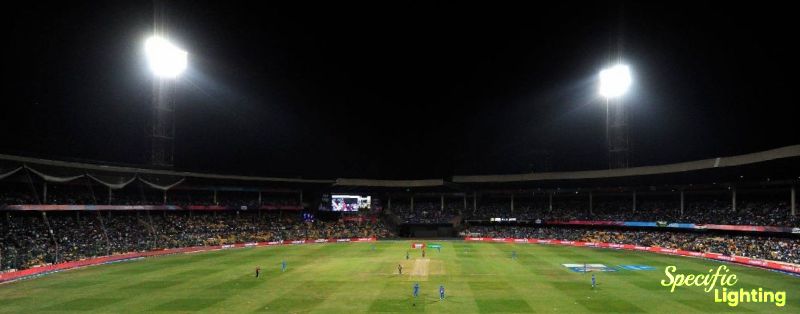
Cricket stadium lighting can be more expensive than lighting a smaller field because the playing area often extends across a large oval. Club grounds and local training facilities have relatively modest requirements, but major venues may need high-output floodlights, tall masts, and carefully designed illumination for televised day-night matches.
A local cricket ground may require US$100,000 to US$400,000 for lighting, depending on its dimensions and infrastructure. A larger domestic venue could fall between US$300,000 and US$1.5 million, while an international stadium with broadcast-grade lighting may cost US$1 million to US$5 million or more. These figures describe possible project budgets, not standard prices for every cricket ground.
The large playing area makes light distribution a major design consideration. The system needs to provide suitable visibility across the pitch, boundary, and outfield without producing excessive brightness in one area and insufficient light in another. The placement of high-mast poles must also account for player sightlines, spectator views, surrounding buildings, and camera positions.
Broadcast requirements can add to the cost. Cameras recording fast action may need controlled flicker performance and adequate vertical illumination. The system may also need to support different lighting levels for training, domestic matches, and televised events. Those additional requirements should be included in the design brief rather than added after the fixtures have been purchased.
Cricket venues should also consider maintenance access. High-mast installations can require specialized lifting equipment or lowering systems to service fixtures safely. A design that makes routine maintenance easier may have a higher initial price but reduce long-term service expenses and downtime.
Basketball Arena
Basketball lighting differs from outdoor stadium floodlighting because most courts are located indoors. The ceiling structure, mounting height, reflective surfaces, and camera positions all influence how the lights should be arranged. Glare can be particularly noticeable when players look upward toward the basket.
A school gymnasium may require approximately US$20,000 to US$80,000 for a lighting upgrade, while a larger collegiate arena may need US$100,000 to US$500,000 or more if the project includes substantial electrical work, high ceilings, or broadcast-ready equipment. A simple fixture replacement in an existing gym can cost less than a complete redesign.
Indoor basketball courts do not usually require the same tall poles and foundations as outdoor fields. However, installation may involve elevated work platforms, specialized rigging, ceiling access, and temporary closure of the venue. These factors can make labor and access equipment a meaningful part of the budget.
For facilities hosting livestreamed or televised games, flicker performance and vertical illumination should be checked alongside ordinary playing-surface lighting. The system should also avoid excessive contrast between the court and the surrounding seating areas. In multi-purpose arenas, lighting controls can provide different settings for basketball, volleyball, ceremonies, and community events.
Tennis Court
Tennis lighting budgets depend heavily on whether the project covers one recreational court or an entire tennis complex. A single outdoor court may cost approximately US$10,000 to US$30,000 to light, while a more demanding competition installation may cost US$20,000 to US$60,000 or more per court.
A club with six courts should not simply multiply the cost of one court by six and assume the result will be exact. Shared electrical infrastructure, procurement, and installation access may reduce the average cost per court. On the other hand, complex pole arrangements, long cable routes, and strict requirements for tournament play can increase the overall budget.
Glare control is particularly relevant in tennis because players regularly look upward to follow the ball. The lighting layout should provide consistent coverage without directing bright sources into players’ lines of sight. Pole placement, mounting height, and beam angles should be designed around the court rather than selected solely according to fixture output.
Tennis facilities can also benefit from zoning. Courts that are not in use should not remain fully illuminated just because another court is hosting a match. Independent switching and scheduling can reduce operating expenses while keeping the lighting convenient for staff and players.
Field Hockey
Field hockey venues need consistent illumination across the pitch, with particular attention to visibility of the ball and player movement. The cost depends on the level of competition, the playing area, the existing infrastructure, and whether the venue needs lighting for televised matches.
A school or community field might cost US$80,000 to US$250,000 to light, while a higher-level competition facility may require US$150,000 to US$500,000 or more. International venues can exceed these ranges when they require higher lighting performance, additional infrastructure, or broadcast-specific features.
The design should balance average illuminance with uniformity. If the center of the pitch is much brighter than the edges, players can experience distracting changes in visibility as the ball moves across the field. A professional photometric layout helps determine fixture quantity, aiming direction, and pole positions before equipment is ordered.
Field hockey facilities may share their grounds with soccer, rugby, or athletics. A multi-sport design can reduce duplicated infrastructure, but the lighting system must still satisfy the requirements of each activity. The cheapest approach is not necessarily a single fixed setting for every sport. Multiple operating modes may provide better performance and lower electricity consumption.
Volleyball Arena
Volleyball courts are commonly located in school gyms, community sports halls, and larger indoor arenas. Lighting costs are influenced by ceiling height, court layout, existing electrical infrastructure, and whether the venue is used for recreational play or high-level competition.
A basic court lighting upgrade may cost US$10,000 to US$40,000, while a larger gymnasium or competition arena may require US$50,000 to US$150,000 or more. Broadcast-ready facilities can incur higher costs if they need advanced controls, camera-compatible performance, or extensive electrical upgrades.
The ball moves quickly and frequently travels above the players’ heads, so glare and visual comfort need to be considered carefully. The design should avoid placing intense light sources where they distract players as they look upward. For televised events, the lighting system may also need to provide suitable vertical illumination and consistent performance across the court.
Schools and colleges often use the same venue for volleyball, basketball, assemblies, examinations, and community activities. A controllable LED system can provide different lighting levels for each use, helping reduce energy consumption without making the facility less flexible.
Rugby Stadium
Rugby fields have large playing areas and can require extensive floodlighting, especially at competitive levels. A community ground may cost around US$80,000 to US$250,000 to light, while a school or club stadium may require US$120,000 to US$700,000 depending on the design and infrastructure.
Higher-level venues may need more demanding uniformity, improved vertical illumination, and lighting suitable for broadcast cameras. Pole foundations, electrical distribution, and access for maintenance can account for a considerable share of the budget.
For clubs that host both rugby and soccer, a shared lighting system may be a sensible option. The design should accommodate the dimensions and requirements of both sports, with controls allowing staff to choose the right operating mode for each event.
Athletics, Lacrosse, and Other Sports
Athletics facilities present a different challenge because a stadium may contain a running track, a central field, and areas for throwing and jumping events. Lighting must support more than one activity, and the requirements may differ between training and competition. A school track facility might need US$100,000 to US$500,000 or more, depending on the track layout and level of use.
Lacrosse fields have lighting needs broadly comparable to other full-size outdoor team sports. A community or school facility may cost US$80,000 to US$300,000, while larger college venues can exceed that range. The final design depends on the field dimensions, competition requirements, pole positions, and whether the facility is used for multiple sports.
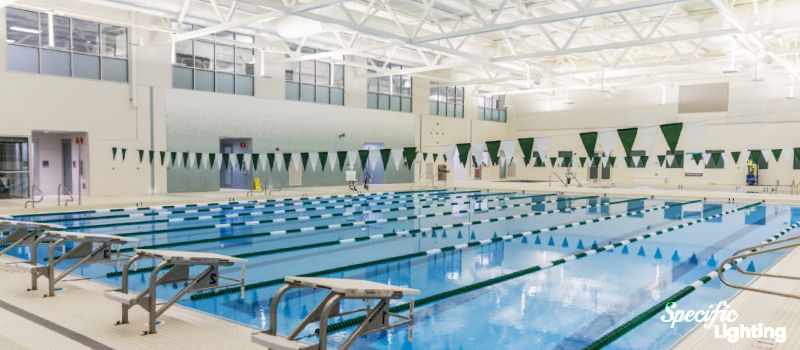
Badminton halls, swimming facilities, and multi-purpose indoor venues need separate consideration. Badminton lighting should avoid distracting glare as players look upward, while swimming facilities must account for reflections, moisture, and corrosion. A multi-purpose venue can sometimes reduce overall costs by using shared infrastructure and adjustable controls, provided that the lighting meets the needs of each activity.
The most reliable way to compare these sports is to use the same budget categories for each project. Estimate the fixtures, structural work, electrical installation, labor, controls, annual electricity, and maintenance separately. This creates a more useful comparison than looking at the total installation price alone.
Stadium Lighting Cost by Country in 2027–2028
The country where a stadium is located can make a substantial difference to the final project budget. Labor costs, locally available equipment, import duties, transportation, electrical standards, construction methods, and exchange rates all influence the price. Electricity tariffs also vary, which means the country with the cheapest installation may not deliver the lowest lifetime cost.
International comparisons need to be handled carefully. A quotation from one country might include poles, foundations, installation, and commissioning, while another might cover only the LED fixtures. The comparisons below are broad early-stage planning ranges for a school or community outdoor sports field. They are not verified national averages or guaranteed 2027–2028 supplier prices.
United States
In the United States, a school or community stadium lighting project might fall within a preliminary range of US$150,000 to US$600,000. Smaller projects and straightforward retrofits can cost less, while facilities with new poles, extensive electrical work, or high competition requirements may cost considerably more.
Labor, engineering, permitting, and electrical infrastructure can represent a substantial share of the budget. Projects may also need structural assessments, photometric reports, inspections, and controls that comply with local requirements. These costs vary by state, municipality, site access, and contractor availability.
Schools and colleges should investigate utility incentives and public funding before finalizing their budgets. The availability of support depends on the local utility, the institution’s eligibility, the equipment selected, and the timing of the application. Some programs may require approval before the project begins.
Electricity costs should be estimated using the actual tariff paid by the facility. A stadium operating 1,000 kW of connected lighting for 600 hours per year would use 600,000 kWh if the system ran at full rated load throughout those hours. At an electricity price of US$0.15 per kWh, that would equal US$90,000 annually before accounting for dimming, demand charges, or other billing details.
United Kingdom
A school or community sports ground in the United Kingdom might have a preliminary lighting budget of US$120,000 to US$500,000. Costs depend on field dimensions, lighting requirements, local labor, electrical infrastructure, and the amount of civil work involved.
Planning permission and light-spill considerations may influence the design, particularly where playing fields are close to residential properties. Shielded optics, careful aiming, and suitable pole positions can help address these concerns, although the design must still meet the required performance for the sport.
Football, rugby, cricket, and hockey facilities may also have different competition requirements. A community training ground should not automatically be priced using specifications intended for a televised professional venue. Establishing the actual use case can prevent unnecessary spending on equipment that the facility does not need.
Funding may be available through sports development programs, local authorities, energy-efficiency initiatives, or other eligible sources. Application windows and rules can change, so institutions should confirm the current terms before including grant income in a project budget.
Canada
A school or community stadium in Canada might require approximately US$160,000 to US$650,000 for a complete lighting project. Cold-weather conditions, soil and foundation requirements, electrical infrastructure, and access to specialized contractors can influence the final price.
Existing facilities should consider whether their poles and foundations are suitable for the replacement equipment. Structural assessments can be especially useful when upgrading older installations, because changes in fixture size, mounting arrangement, or wind loading may affect the safety of the existing structure.
Energy costs depend on the local utility tariff and operating schedule. A facility with frequent evening practices may gain more from high-efficiency fixtures and automatic scheduling than a stadium used only for occasional events. A proper operating model helps estimate the likely payback period.
Canadian institutions should investigate federal, provincial, municipal, and utility funding opportunities. Eligibility varies by program and applicant type, and a grant aimed at general community recreation may have different conditions from an energy-efficiency incentive.
Australia
A school or community sports facility in Australia might have an indicative installed budget of US$140,000 to US$600,000. Cricket, rugby, Australian football, soccer, and athletics facilities all have different requirements, so the final price will depend on the sport and competition level.
Transportation can be a factor for remote venues, particularly where specialist contractors or equipment need to travel long distances. Local manufacturing and distributor networks may also influence equipment availability and lead times.
Australian sports facilities should assess energy consumption alongside upfront cost. A club with regular evening training sessions may be able to lower its running expenses by using dimming, separate lighting zones, and scheduled shutoff. These features are most effective when the lighting design and control strategy are developed together.
Funding options can include state and territory sports infrastructure programs, local council grants, eligible energy incentives, and community fundraising. Institutions should verify the current application conditions and confirm whether the program covers lighting fixtures, installation, electrical upgrades, or only selected project components.
India
A school or community sports lighting project in India may have a preliminary budget of US$60,000 to US$300,000, although larger venues and high-performance facilities can cost much more. Local manufacturing, labor costs, import requirements, and the condition of existing infrastructure all influence the total.
Cricket grounds may require more extensive systems than smaller football or school fields because of their playing area and, at higher levels, broadcast requirements. A basic training ground should not be budgeted in the same way as a venue designed for domestic or international televised matches.
Local sourcing may help reduce transportation costs and simplify after-sales service. However, buyers should compare verified performance data, efficiency, warranty terms, and the complete installed cost rather than choosing equipment based on the lowest fixture price.
Institutions should also assess the reliability of the electrical supply and whether transformers, distribution panels, cabling, or protective devices need upgrading. These items can change the project budget substantially and should be included in the quotation from the beginning.
China
A school or community sports field in China might have an indicative installed cost of US$70,000 to US$350,000. The price depends on local labor, equipment selection, project scale, electrical infrastructure, and whether the fixtures are sourced from domestic manufacturers or imported suppliers.
China has a large lighting manufacturing sector, which can provide a wide range of fixture options. Even so, factory pricing should not be confused with the cost of a completed stadium lighting system. Shipping, installation, structural work, controls, testing, and after-sales support can add substantially to the initial equipment price.
For buyers exporting fixtures from China, it is worth comparing the full landed cost with the cost of purchasing locally. Import duties, transportation, insurance, certification, and the availability of replacement components can change the economics of the project.
A supplier should be able to provide detailed photometric files and performance specifications for the proposed fixtures. A lower-cost product that does not deliver the required beam distribution or lighting uniformity may lead to additional purchases and higher total expenditure.
UAE and Saudi Arabia
A school or community stadium in the UAE or Saudi Arabia might have an early planning budget of US$180,000 to US$800,000, depending on the size and requirements of the venue. Larger professional stadiums can cost several million dollars, especially when the project includes new towers, major electrical works, and broadcast-grade systems.
High temperatures, dust, wind loading, and local site conditions can affect equipment selection and maintenance planning. Fixtures should be specified for the environment in which they will operate, with suitable protection and thermal performance.
Large sports developments may also have requirements for sophisticated controls, energy monitoring, and integration with wider building systems. These features can increase the initial cost but may improve operational management over the life of the facility.
Projects should use local quotations and applicable engineering requirements rather than relying on generic international prices. Differences in procurement arrangements, construction scope, and tax treatment can make apparently similar projects difficult to compare.
Germany, France, and Other European Countries
A school or community sports lighting project in Germany, France, or another European market might fall within a broad planning range of US$150,000 to US$650,000. The actual cost depends on local labor, electrical work, the equipment specification, and the need to manage light spill or comply with environmental requirements.
Sports grounds near residential neighborhoods may need careful optical design and operating schedules. Reducing unnecessary light spill can improve relations with nearby residents and may also reduce wasted energy.
European institutions should review the applicable national and local rules before choosing equipment. Funding for sports facilities and energy-efficiency projects varies by country and program, so a grant available in one region should not be assumed to apply elsewhere.
For international buyers, exchange rates should be recorded when comparing quotations. A price converted into US dollars today may look different several months later, particularly for projects with long procurement periods. Budgets should state the conversion date and identify whether taxes and import charges are included.
International Cost Comparison and How to Read It
The table below summarizes the preliminary ranges discussed above. It is intended for early budget planning rather than ranking countries from cheapest to most expensive. The ranges are not based on one verified, identical project tendered in every country, so differences should not be interpreted as a direct measure of local market efficiency.
| Country or market | Indicative installed cost in US$ | Costs to investigate |
|---|---|---|
| United States | US$150,000–US$600,000 | Labor, permitting, utility rates |
| United Kingdom | US$120,000–US$500,000 | Planning, labor, light spill |
| Canada | US$160,000–US$650,000 | Foundations, weather, contractors |
| Australia | US$140,000–US$600,000 | Transport, regional labor |
| India | US$60,000–US$300,000 | Local sourcing, electrical supply |
| China | US$70,000–US$350,000 | Equipment scope, export costs |
| UAE and Saudi Arabia | US$180,000–US$800,000 | Climate, engineering, specifications |
| Germany and France | US$150,000–US$650,000 | Labor, environmental requirements |
Before using these numbers for procurement, define a common project specification. For example, compare a full-size school soccer field with the same target illuminance, similar operating hours, equivalent pole arrangements, and the same scope of electrical and civil work. Ask each supplier to price fixtures, installation, controls, poles, foundations, and commissioning separately.
The country with the lowest initial price may not have the lowest lifetime cost. Electricity tariffs, maintenance availability, warranty support, and replacement-part lead times can change the total over 10 or 15 years. A well-supported local system may offer better long-term value than a cheaper installation that is difficult to maintain.
Stadium Lighting Fixture Costs in 2027–2028
Fixtures are one of the most visible parts of a stadium lighting budget, but they are only one part of the system. A floodlight must deliver the right amount of light to the playing surface, work with the chosen mounting height, and provide a suitable beam pattern. A high-wattage fixture is not automatically the best choice if much of its output misses the target area.
For 2027–2028 planning, LED floodlights are likely to remain a common option for new projects and upgrades. Buyers should compare efficacy, optical performance, glare control, thermal management, protection ratings, warranty, and serviceability. These details help determine whether a fixture can deliver the required performance without consuming more electricity than necessary.
How Much Does One LED Stadium Floodlight Cost?
As a broad equipment-only planning range, a basic sports floodlight may cost around US$300 to US$800 per fixture. Mid-range stadium fixtures may fall between US$800 and US$1,800, while high-output or broadcast-oriented products can cost US$1,500 to US$3,500 or more. These are indicative ranges rather than current quotations, and product prices vary with output, optics, controls, certification, manufacturer, and purchase volume.
The price of the fixture should be considered alongside the number needed for the project. A cheaper product may require more units to reach the desired lighting level, while a more efficient fixture with suitable optics may achieve the same result using fewer luminaires. The only reliable way to compare those options is to model their performance across the actual field.
Buyers should also check whether the quotation includes brackets, aiming accessories, surge protection, control interfaces, and the required mounting hardware. A low headline price can become less attractive when these items are added separately.
LED Stadium Lighting Cost by Wattage
LED floodlights are available in a wide range of power ratings, including 500 W, 750 W, 1,000 W, 1,500 W, and 2,000 W. Larger ratings are not necessarily better. The correct output depends on the field dimensions, mounting height, beam distribution, target illuminance, and number of fixtures.
A 1,000 W fixture operating for 1,000 hours consumes 1,000 kWh if it runs continuously at its rated electrical input. At US$0.12 per kWh, that is US$120 in energy for the fixture over those hours. A 1,500 W fixture under the same conditions consumes 1,500 kWh and costs US$180, while a 500 W fixture consumes 500 kWh and costs US$60.
These calculations are useful for estimating electricity use, but they do not show which fixture is better for a stadium. If the 500 W fixture produces insufficient light over the target area, more units may be needed. A properly designed 1,000 W system could therefore use less total power than an inefficient layout relying on many smaller fixtures.
The relevant figure is the total connected load required to meet the lighting specification, not simply the wattage printed on an individual product. A photometric simulation helps establish the fixture count and layout before the purchase order is placed.
LED vs. Metal-Halide Stadium Lights
Metal-halide lighting has been used for many years in sports facilities, but LED systems offer several potential advantages, including lower energy consumption, instant switching, dimming, and reduced routine relamping. The actual savings depend on the existing equipment, the operating schedule, and the performance of the proposed LED system.
Suppose an existing stadium uses 120 metal-halide fixtures rated at 2,000 W each. The connected lighting load is 240 kW before accounting for any additional electrical losses. If the lights operate for 800 hours annually, the system uses approximately 192,000 kWh. At US$0.15 per kWh, the annual energy cost would be US$28,800.
Now assume an LED replacement uses 120 fixtures rated at 1,000 W each and meets the same lighting requirements. The new connected load would be 120 kW, and annual energy consumption at the same operating schedule would be 96,000 kWh. At US$0.15 per kWh, the annual electricity cost would be US$14,400.
Under these assumptions, the reduction is 96,000 kWh and US$14,400 per year, or 50% of the original energy cost. The example is illustrative, not a promise of savings. Actual results depend on the old system’s measured input power, the performance of the new fixtures, the lighting design, and how the venue is operated.
A retrofit should not be approved based on wattage alone. The proposed LED system must deliver the required light levels and uniformity. If the new fixtures are poorly selected or aimed, the stadium may end up with lower energy consumption but worse visibility.
Fixture Efficiency and Optical Design
Fixture efficiency is commonly expressed in lumens per watt, which indicates how much visible light a fixture produces for each watt of electrical power. However, total lumens are not the same as useful light on the field. The beam pattern determines how much output reaches the areas where players need it.
For example, two fixtures may each consume 1,000 W, but one may direct more light toward the playing surface while the other sends more output beyond the field. If the first fixture provides the required distribution, it may allow the designer to use fewer units or lower the total connected load.
The optical design also affects glare and spill light. Narrower beams can be useful for directing light over longer distances, while broader distributions may suit different field areas. The right combination depends on mounting height, pole positions, and the geometry of the playing surface.
When comparing fixtures, request photometric files, efficiency data, beam-angle information, and the proposed lighting simulation. These documents help the buyer understand the performance of the complete system rather than relying on marketing claims or wattage figures alone.
Additional Components Beyond the Fixtures
The fixtures are only part of the equipment bill. A stadium may need mounting brackets, high-mast poles, foundations, underground cables, distribution panels, transformers, surge protection, grounding, control equipment, and safety systems. The exact list depends on whether the project is a new installation or a retrofit.
For a small retrofit, existing poles and cabling may be suitable, allowing the budget to focus on fixtures, electrical modifications, and commissioning. A new outdoor installation may require substantial civil work before the lights can be mounted. In some projects, poles and foundations cost as much as or more than the lighting equipment itself.
Controls can also add to the upfront budget. Basic switching is usually less expensive than a networked system with individual fixture addressing, automated scheduling, dimming, fault reporting, and energy monitoring. The additional cost may be worthwhile for a busy venue that hosts different sports and activities throughout the week.
A detailed quotation should list the fixtures and every supporting component separately. That makes it easier to compare suppliers, identify missing items, and understand why two proposals for apparently similar systems have different prices.
Stadium Lighting Installation Cost Breakdown
Installation is often where early budget estimates start to drift. A fixture price may look attractive until the project adds poles, foundations, cabling, crane hire, labor, engineering, permits, and testing. A complete budget should account for each stage of the work rather than treating installation as a small percentage of the equipment cost.
Electrical Installation and Wiring Costs
Electrical work may include distribution panels, circuit protection, underground cabling, control wiring, grounding, and connections to the existing supply. If the facility does not have enough electrical capacity, the project may also require a transformer or other supply upgrades.
For a small retrofit, electrical modifications might cost several thousand to tens of thousands of dollars. Larger outdoor projects can require US$20,000 to US$100,000 or more for electrical infrastructure, depending on cable lengths, trenching, panel capacity, and site conditions. These are preliminary planning figures, not fixed contractor rates.
The location of the electrical supply can make a noticeable difference. A field close to an existing distribution panel may need relatively short cable runs, while a remote playing area may require extensive trenching and additional protective equipment. Underground obstacles, hard surfaces, drainage systems, and existing utilities can add further expense.
The electrical design should also consider how the lighting will be controlled. A facility may need separate circuits for different zones, dimming capability, remote switching, or preset operating modes. Planning these features at the beginning is usually easier than adding them after the installation is complete.
Lighting Pole and Foundation Costs
Poles and foundations are major cost items for outdoor stadiums. A project may use several medium-height poles or a smaller number of taller structures, depending on the field layout and lighting requirements. The correct arrangement depends on the site geometry, fixture distribution, wind loading, and access for maintenance.
A basic pole might cost several thousand dollars, while taller or more specialized structures can cost tens of thousands of dollars each once engineering, mounting hardware, transport, and installation are included. Foundations add further costs because their size and design depend on soil conditions, pole height, wind loads, and local engineering requirements.
A stadium using six poles at an installed cost of US$12,000 each would spend US$72,000 on those structures alone. If the poles instead cost US$20,000 each installed, the same six-pole arrangement would cost US$120,000. This simple example shows why pole specifications should be confirmed early in the budgeting process.
Existing poles may offer an opportunity to save money, but they should be inspected before reuse. Corrosion, foundation movement, fatigue, and changes in wind loading can affect whether a structure remains suitable for the new fixtures. A professional assessment can help avoid unsafe assumptions and unexpected reconstruction costs.
Labor, Lifting Equipment, and Site Access
Installation labor includes electrical contractors, lighting technicians, crane operators, rigging teams, and other specialists. Outdoor stadium projects may require heavy lifting equipment to position poles and fixtures at significant heights. The cost depends on local labor rates, project duration, access restrictions, and the complexity of the work.
A straightforward retrofit can sometimes be completed with limited site disruption, especially when the existing poles remain in place. A new installation may need several stages of work, including excavation, foundation construction, pole erection, cable installation, fixture mounting, aiming, and commissioning.
Site access can also affect the budget. A stadium surrounded by buildings or operating facilities may need special arrangements for cranes, deliveries, and work zones. Schools may schedule installation during holidays to avoid disrupting classes and sports activities, although the timing can affect contractor availability.
A realistic quotation should identify the expected installation duration and any assumptions about access, working hours, and site readiness. That helps the institution understand whether the quoted price includes all required equipment and labor.
Engineering, Lighting Design, Permits, and Testing
Professional design services help establish the number of fixtures, mounting positions, aiming angles, and expected light distribution. A photometric report should show the proposed performance across the field, including average illuminance, minimum illuminance, uniformity, and other relevant criteria.
For smaller projects, design and engineering fees may amount to several thousand dollars. More complex stadiums may require tens of thousands of dollars in design, structural engineering, electrical engineering, and commissioning services. Projects with broadcast requirements or unusual structures may need additional specialist input.
Permits and inspections depend on the jurisdiction and project scope. Structural approval, electrical permits, planning requirements, and environmental conditions may all affect the schedule and cost. The institution should confirm the local requirements before signing the final construction contract.
Commissioning is the stage where the completed system is tested and adjusted. This can include checking electrical safety, aiming the fixtures, verifying control settings, and measuring light levels on the playing surface. A project should not be considered complete simply because every fixture turns on. The finished installation needs to perform as intended.
How the Installation Budget Adds Up
Consider a hypothetical school football field with a total project budget of US$300,000. The figures below show one possible allocation. They are illustrative rather than a standard cost split, because the balance between equipment, civil works, and labor changes from one project to another.
| Cost category | Example budget | Share |
|---|---|---|
| LED fixtures | US$90,000 | 30% |
| Poles and foundations | US$75,000 | 25% |
| Electrical work | US$45,000 | 15% |
| Installation and lifting | US$36,000 | 12% |
| Controls and commissioning | US$24,000 | 8% |
| Design, permits, and testing | US$15,000 | 5% |
| Contingency | US$15,000 | 5% |
| Total | US$300,000 | 100% |
In this example, the fixtures account for less than one-third of the total project budget. That is why choosing a product that is 10% cheaper does not necessarily reduce the overall cost by 10%. If the fixture savings amount to US$9,000, the total project cost falls from US$300,000 to US$291,000, a reduction of 3%.
The same principle works in reverse. A design that reduces the number of fixtures may save money on equipment, wiring, mounting hardware, and installation labor. A good photometric plan can therefore deliver savings across several budget categories at once.
Allowing for Contingency and Unexpected Costs
Even a well-planned project can encounter unexpected conditions. A foundation may need reinforcement, existing wiring may be unsuitable, or the electrical supply may require additional work. Delivery delays and changes in material prices can also affect the final cost.
A preliminary contingency of around 5% to 15% may be reasonable for planning, depending on how much is known about the site. A project involving older infrastructure or uncertain ground conditions may need a larger allowance than a straightforward fixture replacement.
For a US$300,000 project, a 10% contingency equals US$30,000. That money should not be treated as a guaranteed expense, but keeping it in the budget gives the project team room to handle legitimate changes without immediately seeking additional funding.
The contingency should be based on the project’s actual risks rather than chosen as an arbitrary percentage. A detailed site inspection, structural assessment, and electrical review can reduce uncertainty before construction begins.
Stadium Lighting Running Costs – Electricity and Maintenance
The purchase price is only the beginning of the financial commitment. Once the stadium is operating, electricity and maintenance become recurring expenses. A lighting system that costs less to install but consumes considerably more power may prove more expensive over its lifetime.
Annual running costs depend on the total connected load, operating hours, electricity tariff, control strategy, and maintenance requirements. A stadium used for evening training several days per week will have a different cost profile from a venue that hosts a handful of events each month.
How to Calculate Annual Electricity Consumption
The basic calculation is straightforward:
Annual energy consumption in kWh equals the total lighting load in kW multiplied by the number of operating hours.
For example, a stadium with a total connected lighting load of 150 kW that operates for 800 hours per year would consume 120,000 kWh if the system ran at full rated load throughout those hours. At US$0.15 per kWh, the annual electricity cost would be US$18,000.
A larger stadium with a 300 kW lighting load and 1,200 operating hours would use 360,000 kWh. At the same electricity rate, the annual energy cost would be US$54,000. These examples exclude demand charges, taxes, and other billing components that may apply to commercial electricity accounts.
The formula provides a starting point, but the actual load should reflect the system’s operating behavior. If the venue uses dimming, switches off unused zones, or runs different lighting levels for practice and competition, its average power consumption may be lower than the rated load suggests.
Stadium Lighting Electricity Cost Examples
The table below shows how operating hours and electricity prices affect annual energy expenses. The calculations assume the stated connected load operates at full power during all listed hours.
| Connected lighting load | Annual operating hours | Annual energy use | Cost at US$0.12/kWh |
|---|---|---|---|
| 50 kW | 600 | 30,000 kWh | US$3,600 |
| 100 kW | 800 | 80,000 kWh | US$9,600 |
| 150 kW | 1,000 | 150,000 kWh | US$18,000 |
| 250 kW | 1,000 | 250,000 kWh | US$30,000 |
| 400 kW | 1,200 | 480,000 kWh | US$57,600 |
The figures show why operating hours deserve as much attention as fixture efficiency. A 100 kW system running for 1,200 hours consumes 120,000 kWh, while the same system operating for 600 hours uses half as much energy.
Electricity tariffs also matter. If a 150 kW system uses 150,000 kWh annually, its energy cost would be US$18,000 at US$0.12 per kWh, US$22,500 at US$0.15 per kWh, and US$30,000 at US$0.20 per kWh. The same lighting system can therefore produce very different annual bills depending on the location and tariff.
Facility managers should use actual utility bills whenever possible. A national average may be useful for an early estimate, but it cannot account for local tariffs, time-of-use pricing, demand charges, or special arrangements for schools and public institutions.
Annual Maintenance and Repair Costs
Maintenance costs include cleaning, inspection, electrical testing, replacement components, control-system servicing, and access equipment. Outdoor stadiums may need periodic checks of mounting hardware, cable connections, protective devices, and pole structures.
For a small or medium-sized LED sports facility, a preliminary annual maintenance allowance of US$2,000 to US$10,000 may be reasonable for budgeting. Larger stadiums may require US$10,000 to US$50,000 or more annually, particularly when the installation includes many fixtures, high-mast structures, specialized access systems, and demanding operating schedules. These figures are planning allowances rather than universal maintenance rates.
LED fixtures can reduce routine lamp replacement compared with older technologies, but they are not maintenance-free. Drivers, surge protection components, connectors, controls, and other parts can still fail. Dirt and environmental exposure can also affect optical performance over time.
The height of the installation affects service costs. Reaching a fixture mounted on a high mast may require specialized lifting equipment or a lowering system. A system designed for convenient maintenance can reduce the time and expense required for inspections and repairs.
A maintenance plan should include the expected service life of the equipment, warranty coverage, availability of replacement parts, and the cost of access equipment. These details are especially useful when comparing suppliers whose initial quotations look similar.
Total Cost of Ownership Over 10–15 Years
Total cost of ownership combines the initial project cost with the money spent operating and maintaining the system over its expected service life. This approach helps compare lighting systems that have different upfront prices and different energy requirements.
Suppose a stadium installs an LED system for US$300,000. If electricity costs US$18,000 annually and maintenance averages US$5,000 per year, the combined operating expense is US$23,000 annually. Over 10 years, that equals US$230,000 before inflation, replacement costs, financing, or changes in operating hours.
The simple 10-year total would therefore be US$530,000, including the initial installation. If the same system operates for 15 years at unchanged costs, the total would reach US$645,000. Actual expenses will vary, but the example shows how ongoing costs accumulate after the construction budget has been spent.
Now consider an older lighting system that costs US$300,000 to install and consumes twice as much electricity under the same operating conditions. If annual energy costs rise from US$18,000 to US$36,000, the difference is US$18,000 each year. Over 10 years, that difference alone amounts to US$180,000.
A fair comparison should use systems that meet the same lighting requirements. It should also account for equipment replacement, maintenance, residual value where relevant, and the expected timing of future expenses. A simple payback calculation is useful, but a longer-term financial model can provide a more complete view.
Example – Annual Running Costs for a School Stadium
Imagine a high school installs LED stadium lighting with a connected load of 120 kW. The field is used for 15 hours per week over 40 weeks each year, giving an annual operating schedule of 600 hours.
At full rated load, the system would use 72,000 kWh annually. If the electricity tariff is US$0.15 per kWh, the annual energy cost would be US$10,800. If maintenance costs US$4,000 per year, the combined energy and maintenance expense would be US$14,800 annually.
If the school uses controls to reduce average power consumption by 20% during selected training sessions, its annual energy use could fall to 57,600 kWh, assuming the reduction applies across the full operating schedule. The electricity bill would then be US$8,640, producing an annual saving of US$2,160.
The actual saving depends on how frequently dimming is used and whether the reduced lighting level is suitable for the activity. Schools should not reduce lighting below the level required for safe and appropriate play. The best approach is to create separate operating modes for training, competition, and other uses, then measure the results after installation.
Stadium Lighting Grants and Funding for 2027–2028
Funding can make a stadium lighting upgrade more affordable, particularly for schools, colleges, nonprofit sports clubs, and public recreation facilities. The challenge is that grants differ by country, region, institution type, and project purpose. Some support general sports infrastructure, while others focus on energy efficiency, community participation, or public facilities.
For 2027–2028 projects, funding should be treated as a potential source of support rather than money that is guaranteed to be available. Application windows, budgets, and eligibility rules can change from year to year. Before including a grant in the final financing plan, the institution should confirm that the program is open and that the proposed lighting work qualifies.
Grants for High School Stadium Lighting
High schools may be able to seek support through school district capital improvement budgets, state or regional facility programs, municipal recreation funds, utility incentives, and community foundations. The available options depend on the school’s ownership structure, location, financial position, and the purpose of the project.
A school replacing old lighting may have a stronger case when it can document expected energy savings, improved facility access, and the benefits of extending usable hours. A project that serves several sports or supports broader community participation may also align with the objectives of some public recreation programs.
The application should include an itemized budget covering fixtures, poles, electrical work, labor, design, and commissioning. A photometric plan can demonstrate that the proposed system is designed for the facility’s needs, while energy calculations can estimate the reduction in electricity consumption.
Schools should check whether the grant requires matching funds or prohibits work from starting before approval. If the school signs a construction contract before the funding decision, it may lose eligibility under programs that require advance authorization. Confirming these conditions early can prevent a costly administrative mistake.
Grants for Colleges and Universities
Colleges and universities may have access to campus capital improvement funds, sustainability programs, energy-efficiency incentives, athletic department budgets, alumni donations, and public infrastructure funding. The best route depends on whether the project is a standalone sports facility upgrade or part of a larger campus energy plan.
Universities often operate several sports venues, which creates opportunities to evaluate lighting upgrades as a portfolio rather than as isolated projects. Replacing lighting across multiple fields or arenas may allow the institution to combine procurement, standardize equipment, and coordinate maintenance.
A strong funding proposal should explain the initial cost, expected annual energy consumption, projected savings, maintenance requirements, and anticipated service life. If the project includes smart controls, the proposal can also describe how the facility will track operating hours and manage different lighting modes.
Alumni and donor funding may be useful when the project directly supports student athletics or community use. Institutions should still prepare a transparent budget and explain how the lighting investment fits within wider campus priorities. A clearly defined project scope is easier to assess than a request that combines lighting with unrelated construction work.
Grants for Community Sports Clubs and Nonprofit Organizations
Community clubs often operate with tighter budgets than universities or professional teams. Funding may come from municipal sports programs, nonprofit foundations, regional sports associations, corporate community initiatives, and local fundraising.
A club can improve its funding case by showing how the project will increase access to training, support youth participation, reduce energy bills, or make the facility more usable throughout the year. Evidence of current operating costs and an itemized installation quotation can help explain why the project is needed.
Shared facilities may have additional opportunities. A lighting upgrade that supports several local teams or sports can provide broader community benefits than a project serving a single group. Clubs should document the intended users and explain how the facility will be managed after the installation.
The funding application should also include a plan for ongoing maintenance. A grant may pay for the initial equipment, but the club still needs to budget for electricity, repairs, and inspections. Demonstrating that the organization can maintain the system can make the project plan more credible.
Funding Opportunities by Country
In the United States, schools and public facilities can investigate federal, state, local, and utility programs, along with eligible nonprofit funding sources. The exact options depend on the project location and applicant type. Energy-efficiency incentives may have separate equipment requirements and application procedures from sports infrastructure grants.
In the United Kingdom, institutions can explore sports development funding, local authority programs, and eligible energy-efficiency schemes. Community sports clubs should confirm whether a program supports capital improvements and whether lighting is an eligible expense. Rules can differ between regions and funding bodies.
In Canada, potential channels include federal, provincial, municipal, community sport, and utility programs. Institutions should check whether the funding supports facility construction, accessibility improvements, energy upgrades, or a narrower set of project types.
In Australia, schools and sports clubs can investigate federal, state, territory, local council, and energy-efficiency programs. The application requirements may differ according to whether the venue is publicly owned, nonprofit-operated, or privately managed.
In India, institutions can explore government sports infrastructure initiatives, state-level programs, local development funds, and eligible institutional financing. The applicable route will depend on the project location, the ownership of the facility, and the current program rules.
In European countries, national sports funding, municipal budgets, and energy-efficiency schemes may offer potential support. Eligibility should be checked country by country, because programs do not necessarily operate under the same rules across the region.
Utility Rebates and Energy-Efficiency Incentives
Utility incentives can sometimes help reduce the upfront cost of an LED upgrade. Depending on the program, support may be calculated according to the equipment installed, the expected energy savings, or the verified reduction in electricity consumption.
Consider a project costing US$250,000 that receives an eligible incentive of US$25,000. The net project cost would fall to US$225,000 before considering other funding or financing costs. If the incentive is conditional on a specific product list or approval process, the institution must satisfy those requirements to receive the money.
The timing of the application matters. Some programs require approval before equipment is purchased or work begins. Others may require an energy audit, baseline consumption data, or proof of installation before payment is made.
Facility managers should ask the utility whether the proposed fixtures and controls qualify, what documentation is needed, and how long the approval process normally takes. A supplier’s statement that a product is eligible should be checked against the program’s own rules.
How to Apply for Stadium Lighting Grants
The first step is to define the project clearly. Identify the sports, playing areas, operating hours, required lighting performance, and the problems with the existing system. A clear scope helps the institution obtain comparable quotations and identify programs that match the project.
Next, obtain a professional lighting design and an itemized estimate. The budget should separate fixtures, installation, poles, foundations, electrical work, controls, design, and commissioning. If the project is an upgrade, record the existing system’s power consumption and annual electricity expenses where reliable data are available.
The funding proposal should explain the expected benefits without overstating them. Energy savings should be based on a transparent calculation, while improvements to community access or sports participation should be described in measurable terms where possible. If the school expects to save US$10,000 annually on electricity, the calculation should show the connected load, operating hours, tariff, and expected reduction.
Before submitting the application, confirm the eligibility rules, matching-fund requirements, deadlines, and restrictions on starting work. Keep copies of quotations, approvals, invoices, test results, and commissioning documents. These records can help with reimbursement, reporting, and future maintenance.
Alternative Funding Options
Grants are not the only way to finance a stadium lighting project. Institutions may also consider equipment leasing, loans, energy performance contracts, sponsorship, naming rights, and community fundraising. Each approach has different costs, risks, and contractual requirements.
An energy performance contract may be worth exploring when a project is expected to deliver measurable energy savings. Depending on the arrangement, a service provider may help design, install, or finance the upgrade, with payment terms linked to the project agreement. The institution should examine the contract carefully to understand fees, performance guarantees, and responsibility for maintenance.
Sponsorship and naming rights may suit community clubs and school facilities with strong local support. A sponsor might contribute to the installation in exchange for agreed recognition, subject to the institution’s policies and applicable rules.
A phased project can also spread costs over several budget periods. For example, a sports complex might upgrade its main field first, then improve training fields or secondary courts in later stages. Phasing works best when the overall lighting plan is developed in advance, so the first stage does not create unnecessary costs for future installations.
How to Save Money on Stadium Lighting
Reducing the cost of stadium lighting does not mean choosing the cheapest equipment or cutting the number of fixtures without checking performance. The better approach is to eliminate waste, design the system around the venue’s actual needs, and avoid paying for infrastructure that does not provide a useful benefit.
Choose Fixtures Based on Performance, Not Wattage Alone
A fixture with a higher wattage is not automatically more effective. What matters is how much useful light reaches the playing surface and how evenly it is distributed. A product with suitable optics may deliver the required result with fewer fixtures or a lower total connected load.
Before selecting equipment, request a photometric simulation using the actual field dimensions, pole locations, and mounting heights. The report should show the expected light distribution and identify whether the design meets the relevant requirements.
Compare suppliers using the same design criteria. One quotation may appear cheaper because it includes fewer fixtures, but that advantage is not useful if the field fails to meet the target lighting level. The comparison should cover the full installed system, not just the price per luminaire.
Reuse Existing Poles and Infrastructure Where Suitable
Existing poles, foundations, and cabling can represent a significant investment. If they remain structurally sound and compatible with the new equipment, reusing them may reduce the cost of an LED retrofit.
However, the condition of the infrastructure must be assessed before reuse. Corrosion, fatigue, foundation damage, and changes in wind loading can affect whether the existing structures remain suitable. A structural assessment may cost money at the beginning, but it can prevent larger expenses caused by an unsuitable installation.
Electrical infrastructure should be checked as well. Existing panels and cabling may not support the proposed system or its controls. A detailed inspection can identify which components can be retained and which need replacement.
Use a Professional Photometric Lighting Plan
A photometric design models how light from each fixture reaches the playing surface. It helps the designer choose the number of luminaires, their output, mounting height, beam angle, and aiming direction.
Suppose two proposed systems both meet the required lighting specification. System A costs US$300,000 to install, while System B costs US$270,000 because it uses a more suitable optical arrangement and reduces the number of fixtures. The US$30,000 difference represents a 10% reduction in the initial budget, provided both systems genuinely meet the same performance requirements.
The saving may extend beyond the equipment. Fewer fixtures can mean less mounting hardware, less cabling, reduced installation labor, and a lower connected load. A well-planned design can therefore reduce both capital and operating costs.
Install Smart Lighting Controls
Smart controls allow the facility to adjust lighting according to the activity taking place. A stadium might use full output for a competition, reduced output for training, and a lower setting for cleaning or maintenance. Separate zones can also be switched independently when only part of the facility is occupied.
Consider a 150 kW lighting system that operates for 1,000 hours annually. Its full-load consumption would be 150,000 kWh. If controls reduce average power use by 15% across those hours, the saving would be 22,500 kWh. At US$0.15 per kWh, that equals US$3,375 per year.
The result depends on how the venue is used and whether lower lighting settings are suitable for the activity. Controls should be configured to maintain appropriate visibility and comply with the applicable requirements.
Reduce Light Spill and Glare
Poorly aimed fixtures can send light beyond the playing area, wasting energy and creating problems for nearby residents. Precision optics, appropriate mounting heights, careful aiming, and shielding can help direct more light where it is needed.
Reducing spill light can also improve the visual experience for players and spectators. The designer should consider nearby roads, homes, windows, and other sensitive areas when positioning the poles and selecting beam patterns.
These measures are generally more effective when included in the original design. Correcting glare after installation may require additional shielding, fixture adjustments, or replacement equipment, all of which can increase costs.
Compare Multiple Supplier Quotations
Obtaining at least three comparable quotations can help the buyer understand the available options. Each supplier should receive the same field dimensions, performance requirements, operating assumptions, and installation scope.
Compare the total project cost, fixture performance, warranty terms, controls, spare-part availability, and expected maintenance requirements. A low-cost fixture may not offer the best value if it has a short warranty or limited service support.
Ask suppliers to identify exclusions clearly. Poles, foundations, electrical upgrades, commissioning, and lifting equipment should not be left ambiguous. A detailed comparison makes it easier to see which quotation offers the strongest value for the money.
Combine Projects Where Practical
Schools, municipalities, and sports organizations that manage several fields may be able to reduce costs by purchasing equipment in one procurement round. Shared engineering, standardized fixtures, coordinated installation, and consolidated maintenance can improve efficiency.
For example, a district upgrading four sports fields may be able to negotiate better equipment pricing than a single small facility. The actual saving depends on the supplier, project timing, equipment selection, and installation logistics, so it should be confirmed through competitive quotations rather than assumed.
Combining projects can also simplify maintenance. Using compatible fixtures and controls across several facilities may reduce the number of spare parts that need to be stocked and make staff training easier.
Plan Maintenance Before Buying
A lighting system should be evaluated according to its expected service life, repair requirements, and the cost of accessing fixtures. High-mast installations can be expensive to service if every repair requires specialized lifting equipment.
Ask suppliers about warranty coverage, replacement drivers, surge protection, spare parts, and the expected procedure for servicing the fixtures. A system with readily available components may be easier to maintain than one that relies on proprietary parts with long lead times.
Preventive maintenance can also help protect the investment. Regular inspections and timely repairs may prevent small problems from developing into larger failures. The maintenance budget should be included in the project’s financial plan from the beginning.
Stadium Lighting Trends for 2027–2028
The stadium lighting market in 2027–2028 is likely to continue emphasizing energy efficiency, connected controls, improved optical design, and better integration with modern sports broadcasting. These are forward-looking expectations rather than guarantees about every supplier or market. Actual adoption will depend on equipment prices, local regulations, project budgets, and the needs of each facility.
Continued Shift Toward LED Lighting
LED technology is expected to remain a common choice for new stadium projects and upgrades. The appeal comes from the combination of controllability, energy efficiency, long service life, and reduced routine relamping compared with many older lighting technologies.
The financial case varies by project. A stadium with long operating hours may achieve a faster payback than a facility used only a few evenings each month. Electricity tariffs, the performance of the existing system, and the cost of the replacement installation all influence the result.
Buyers should avoid assuming that every LED product offers the same efficiency or service life. Fixture quality, thermal management, driver performance, environmental exposure, and maintenance conditions affect real-world results. Product data should be checked against the requirements of the intended venue.
Smart Controls and Connected Lighting Systems
Connected controls can help facility managers schedule operating hours, dim selected zones, monitor energy consumption, and identify equipment faults. A stadium that hosts different sports throughout the week can use presets for training, competition, and other activities.
These systems may also make it easier to track performance after installation. Facility managers can compare operating hours and energy consumption with the original budget assumptions, then adjust schedules if the data show that the system is being used inefficiently.
The additional cost depends on the control architecture and the number of fixtures being managed. A simple zone-based system may be relatively affordable, while a networked installation with individual fixture control and detailed reporting can cost more. The project team should choose features that solve a real operational problem rather than paying for functions that staff are unlikely to use.
Broadcast-Ready Lighting and Flicker Management
Sports broadcasting places additional demands on stadium lighting. High-speed cameras and slow-motion replays can reveal flicker that may not be obvious to spectators watching in person. Broadcast-oriented venues may also need suitable vertical illumination and consistent light distribution across the playing area.
These requirements can increase the equipment and design budget. The fixtures, drivers, and control system must work together to deliver the desired performance. A stadium should confirm its broadcast requirements before selecting the lighting system, particularly if televised events are planned.
Not every school or community field needs a broadcast-grade installation. Facilities should match the specification to their actual use and avoid paying for features that do not provide a practical benefit.
Better Glare Control and Reduced Light Pollution
Lighting design is increasingly concerned with where the light goes, not simply how much is produced. Improved optics, shielding, aiming, and control settings can help reduce glare and unwanted illumination beyond the playing area.
This trend is especially relevant for sports grounds located near residential properties. A system that directs light more accurately may improve the playing experience while reducing complaints from neighbors.
Operating schedules can also help. If the field is not being used, automatic shutoff prevents lights from remaining on unnecessarily. The combination of suitable optics and sensible controls can reduce wasted energy without compromising the intended lighting performance.
Sustainability and Lifecycle Planning
Sports facilities are likely to continue paying attention to energy consumption, equipment longevity, and maintenance. LED systems can support these goals, but the environmental and financial benefits depend on the performance of the complete installation.
A useful sustainability plan should include energy use, repairability, replacement parts, and end-of-life handling. Fixtures that can be serviced rather than discarded after a single component fails may offer advantages over products with limited repair options.
Institutions can also track annual kWh consumption before and after an upgrade. Measuring actual results provides a more reliable account of savings than relying only on theoretical projections. The data may also help support future grant applications or campus energy plans.
Modular Fixtures and Easier Maintenance
Modular lighting designs can make it easier to replace selected components instead of an entire fixture. Depending on the product, serviceable drivers, replaceable parts, and accessible mounting arrangements may reduce maintenance disruption.
The value of modularity depends on the product design and the availability of replacement components. A fixture should not be considered easier to maintain merely because the manufacturer describes it as modular. Buyers should ask how parts are replaced, whether technicians can access them safely, and how long components are expected to remain available.
For high-mast installations, the maintenance method deserves particular attention. A lowering system or a practical service arrangement can reduce the cost and complexity of reaching fixtures. These considerations should be part of the supplier comparison, especially for facilities with limited maintenance budgets.
Stadium Lighting Price Outlook for 2027–2028
Predicting exact lighting prices two years in advance is difficult because equipment costs, labor, freight, exchange rates, and construction demand can change. A more useful approach is to build several budget scenarios and update them as quotations become available.
A lower-cost scenario might assume stable component prices, competitive procurement, and reuse of suitable poles and electrical infrastructure. Under these conditions, the project may remain close to its initial estimate or benefit from savings identified during design.
A baseline scenario might allow for moderate changes in labor, equipment, and installation costs. The institution could use current supplier quotations as the starting point and apply an explicit contingency based on the project’s risks rather than assuming a particular market-wide price increase.
A higher-cost scenario might account for new electrical infrastructure, difficult site access, changes in exchange rates, longer delivery times, or more demanding lighting specifications. The point is not to predict that these events will occur, but to understand how the project budget would respond if they did.
For example, a project currently estimated at US$300,000 would rise to US$315,000 if costs increased by 5%, or US$330,000 with a 10% increase. These calculations are planning scenarios, not forecasts that prices will necessarily rise by those percentages. They help decision-makers understand the financial effect of potential changes.
Stadium Lighting Standards and Compliance
A lighting system needs to satisfy the requirements of the venue, the sport, and the applicable jurisdiction. The target illuminance may differ between recreational practice, local competition, elite competition, and televised events. The design should therefore begin with the actual activities planned for the facility.
Understanding Lux and Foot-Candles
Lux measures illuminance in the metric system, while foot-candles are commonly used in some markets that follow imperial measurements. One foot-candle is approximately 10.764 lux. For example, 20 foot-candles is about 215 lux, while 50 foot-candles is about 538 lux.
These conversions are useful when comparing specifications from different countries. However, an illuminance number alone does not describe the full quality of the lighting. Uniformity, glare, vertical illumination, and the location of measurement points also matter.
A specification should state the required lighting level and how it is measured. It should also identify whether the target applies to training, competition, or broadcasting. Without those details, two systems may appear comparable on paper while delivering different results on the field.
Uniformity, Glare, and Player Visibility
Uniformity describes how evenly light is distributed across the playing surface. A field with bright patches and dark corners can be uncomfortable to use even if its average illuminance appears adequate.
Glare can distract players and spectators, particularly when fixtures are visible within the normal line of sight. The design should consider pole positions, mounting height, beam direction, and the viewing angles of athletes.
Player visibility also depends on the sport. Baseball and cricket involve tracking balls over different backgrounds, while basketball and volleyball require players to follow fast-moving balls above their heads. The optical layout should reflect those visual demands rather than relying on a generic sports lighting arrangement.
Broadcast and Competition Requirements
A facility hosting televised matches may need more demanding lighting performance than a recreational field. Camera compatibility, flicker behavior, vertical illumination, and consistency across the playing area can all influence fixture selection and layout.
The institution should identify the relevant competition and broadcast requirements before purchasing equipment. If a venue plans to move from local competitions to higher-level events in the future, it may be worth considering a design that allows some flexibility without immediately paying for the highest possible specification.
The final requirements should be confirmed with the relevant governing body, competition organizer, broadcaster, or qualified lighting designer. Rules can differ between sports and levels of competition, so general estimates should not replace project-specific verification.
Electrical Safety, Structural Engineering, and Environmental Considerations
Outdoor lighting systems need suitable electrical protection, grounding, weather resistance, and structural support. Poles and foundations must be designed for the site conditions and applicable wind loads. The fixtures should also be suitable for the temperature, moisture, dust, and other environmental factors they will encounter.
Environmental considerations include glare, light spill, operating hours, and effects on nearby properties. Local planning rules may impose limits or require specific documentation. Addressing these matters during the design phase can help avoid delays and modifications later.
The project should include appropriate inspection and commissioning procedures. Electrical safety and structural suitability should be verified by qualified professionals, and the completed system should be tested against the agreed lighting specification.
How to Choose a Stadium Lighting Supplier
Choosing a supplier involves more than comparing the price of individual fixtures. The supplier should understand the sport, the facility’s lighting requirements, the site conditions, and the practical needs of the people who will operate the system.
Check Experience and Technical Documentation
Ask for examples of completed projects with similar field dimensions and lighting requirements. A supplier with experience in school football fields may not automatically have the right expertise for a broadcast-ready cricket stadium or indoor basketball arena.
Request photometric files, fixture specifications, efficiency data, warranty terms, and a lighting simulation. These documents help confirm whether the proposed equipment is suitable for the project and make it easier to compare competing quotations.
The proposal should also identify the target illuminance, uniformity, fixture count, mounting height, and control strategy. A quotation that lists only wattage and product price does not provide enough information to judge the performance of the complete system.
Compare Warranty and After-Sales Support
A stadium lighting installation can remain in service for many years, so access to replacement components and technical support matters. Buyers should check the length and scope of the warranty, including whether it covers fixtures, drivers, controls, and other components.
Ask how faults are handled and whether replacement parts are available locally. A product with a longer stated lifespan may still be inconvenient if repairs require long shipping times or the entire fixture must be replaced when a single component fails.
The supplier should explain the recommended maintenance schedule and identify any special access equipment required. These details help the institution estimate the ongoing cost of owning the system.
Review the Full Quotation
A complete quotation should separate equipment, poles, foundations, electrical work, installation, controls, design, testing, and commissioning. It should also identify exclusions, taxes, shipping, delivery schedules, and assumptions about existing infrastructure.
When comparing three proposals, make sure each supplier is pricing the same scope and performance level. If one proposal includes new poles and foundations while another assumes they can be reused, the headline prices are not directly comparable.
The institution should also ask suppliers to explain any unusually low or high figures. Differences may reflect product quality, the number of fixtures, installation methods, or omitted work. Understanding those differences is more useful than simply choosing the cheapest bid.
Frequently Asked Questions About Stadium Lighting Costs
How Much Does It Cost to Install Stadium Lighting in 2027–2028?
A small recreational field may cost around US$25,000 to US$150,000, while a high school stadium may require US$150,000 to US$600,000. College facilities can cost US$250,000 to US$900,000 or more, and professional stadium projects may reach several million dollars.
These are broad preliminary estimates rather than guaranteed prices. The final cost depends on the sport, required lighting performance, fixture quantity, poles, foundations, electrical infrastructure, installation labor, and site conditions.
How Much Does It Cost to Replace Stadium Lights With LEDs?
A relatively straightforward LED retrofit may cost approximately US$50,000 to US$300,000, although large or complex facilities can cost substantially more. Reusing suitable poles and electrical infrastructure may reduce the budget, while major electrical upgrades or structural work can increase it.
The project should include a photometric design to verify that the replacement system meets the required lighting level and uniformity. The cost should also be compared with expected electricity savings and maintenance expenses over the system’s service life.
How Much Does One LED Stadium Floodlight Cost?
As a broad planning estimate, basic sports floodlights may cost around US$300 to US$800 each, mid-range fixtures US$800 to US$1,800, and high-output or broadcast-oriented products US$1,500 to US$3,500 or more. Prices depend on output, optics, efficiency, controls, certification, warranty, and purchase quantity.
Fixture price alone does not determine the project cost. The buyer also needs to account for brackets, poles, electrical work, installation, aiming, and commissioning.
How Many Lights Does a Football Stadium Need?
The required number depends on the field dimensions, mounting height, fixture output, beam distribution, and target lighting performance. A smaller school field may use a few dozen fixtures, while a larger or broadcast-ready stadium may need considerably more.
The fixture count should be established through a photometric simulation rather than a simple rule based on field size. A properly designed system can reduce wasted output and avoid bright and dark patches across the playing surface.
Is Cricket Stadium Lighting More Expensive Than Soccer Lighting?
Cricket lighting can be more expensive because many cricket grounds have large oval playing areas and may require tall masts and broadcast-ready performance. However, the cost depends on the venue rather than the sport alone.
A local cricket ground may cost less to light than a professional soccer stadium, while an international cricket venue may require a much larger investment than a community soccer pitch. The fairest comparison uses the same project scope and clearly defined lighting requirements.
How Much Electricity Does Stadium Lighting Use During One Match?
Electricity consumption depends on the system’s total load and the number of hours it operates. A 150 kW lighting system running for four hours at full power would use 600 kWh.
At US$0.15 per kWh, that would cost US$90 in energy for the four-hour period. Actual bills may differ because of dimming, additional operating hours, demand charges, and other components of the electricity tariff.
What Is the Annual Running Cost of LED Stadium Lighting?
A smaller facility might spend several thousand dollars per year on electricity, while a larger stadium may spend tens of thousands or more. Maintenance, repairs, and control-system servicing add to the annual cost.
The best estimate uses the actual connected load, annual operating hours, and electricity tariff. Facility managers should also include maintenance and replacement expenses rather than treating the electricity bill as the entire operating budget.
Are Grants Available for School Stadium Lighting?
Potential funding sources include school district capital budgets, public sports infrastructure programs, local government funding, community foundations, and eligible utility incentives. Availability depends on the school’s location, ownership, project scope, and the funding program’s current rules.
Schools should confirm eligibility, application deadlines, matching-fund requirements, and whether work can begin before approval. Grant funding should not be included as confirmed income until the institution has verified the program and its conditions.
Can Colleges Receive Grants for LED Lighting Upgrades?
Colleges and universities may be eligible for campus sustainability programs, energy-efficiency incentives, public infrastructure funds, and certain sports facility grants. Some institutions may also use athletic department budgets, alumni donations, or financing arrangements.
The application should explain the project cost, expected energy savings, maintenance plan, and benefits to students or the wider community. Program rules should be checked carefully because funding for general campus energy improvements may not cover every type of sports lighting project.
Which Country Has the Lowest Stadium Lighting Installation Costs?
There is no reliable universal ranking because project scope, local labor, equipment quality, import duties, and electrical infrastructure vary. A lower equipment price in one country does not necessarily translate into a lower fully installed cost.
For international procurement, compare projects with the same lighting requirements and include shipping, taxes, poles, foundations, installation, and commissioning. Warranty support and replacement-part availability should also be considered.
How Long Do LED Stadium Lights Last?
Some LED stadium fixtures are designed for rated operating lives of 50,000 hours or more, depending on the product and the conditions used for the rating. Actual service life depends on temperature, driver quality, surge protection, installation conditions, and maintenance.
A rated life does not mean that every component will operate without failure for the entire period. Buyers should review the manufacturer’s warranty, maintenance recommendations, and availability of replacement components.
How Much Can LED Lighting Save Compared With Metal Halide?
Savings vary with the existing system and the replacement design. In an illustrative example, replacing 120 metal-halide fixtures rated at 2,000 W each with 120 LED fixtures rated at 1,000 W each reduces the connected load from 240 kW to 120 kW.
At 800 operating hours per year and US$0.15 per kWh, annual electricity costs would fall from US$28,800 to US$14,400, assuming both systems meet the same lighting requirements and operate at full rated power. A professional design and actual operating data are needed to estimate savings for a specific venue.
What Factors Increase Stadium Lighting Installation Costs?
Common cost drivers include higher lighting requirements, more fixtures, new poles and foundations, electrical supply upgrades, difficult site access, specialized lifting equipment, and broadcast-related specifications. Import charges, shipping, permitting, and structural work may also affect the budget.
The best way to manage these costs is to establish the lighting requirements early and obtain a complete site assessment before purchasing equipment. That reduces the chance of expensive changes during construction.
How Can a Sports Facility Reduce Lighting Costs Without Compromising Safety?
The facility can use a suitable photometric design, efficient fixtures, smart controls, appropriate beam angles, and sensible operating schedules. Reusing infrastructure that has been professionally assessed can also reduce the installation budget.
The goal is to eliminate unnecessary energy use and construction expense while meeting the required lighting performance. Cutting fixture quantities without checking the design can create poor visibility and may lead to additional costs later.
Planning a Stadium Lighting Investment That Pays Off
Stadium lighting is a long-term investment, and the best decision usually comes from looking beyond the initial fixture price. A suitable LED system, a well-planned layout, practical controls, and a realistic maintenance budget can help schools, colleges, clubs, and stadium operators manage their costs over time.
For 2027–2028 projects, start with a clear understanding of the sport, the venue’s operating schedule, and the required lighting performance. Obtain an itemized quotation, compare the full installed cost, estimate annual electricity consumption, and check whether grants or utility incentives may be available. Treat market forecasts as planning assumptions, then replace them with current supplier quotations before making a final commitment.
If you are planning a new stadium lighting installation, upgrading an existing field to LED, or exploring a more energy-efficient lighting design, contact our team for a project consultation. We can help you review your facility’s requirements, assess potential fixture and installation options, estimate running costs, and identify practical ways to make your lighting investment work harder for your budget.