Food processing facilities have a lot going on behind the scenes. Raw ingredients come in, products move through several stages of processing, equipment is cleaned, packaging lines run for hours, and every part of the operation has to work together to maintain a hygienic production environment.
That is one reason ultraviolet, particularly UV-C technology, has attracted attention across the food processing industry. When properly designed and installed, UV-C systems can provide an additional layer of microbial control for air, water, surfaces, equipment, and selected production processes.
However, buying a UV system is not as simple as choosing a lamp with the highest wattage. A system that works well in an air-handling unit may not be suitable for a conveyor or process-water application. UV performance depends on factors such as wavelength, irradiance, exposure time, UV dose, airflow, water quality, distance, equipment design, and maintenance.
Cost also deserves a closer look. The purchase price is only one part of the equation. Energy consumption, lamp or LED replacement, cleaning, monitoring, installation, and downtime can all affect the actual cost of ownership over several years.
For food manufacturers considering UV technology, the better question is not simply, “How much does a UV light cost?” It is, “What UV system fits our process, delivers the required performance, and makes financial sense over its operating life?”
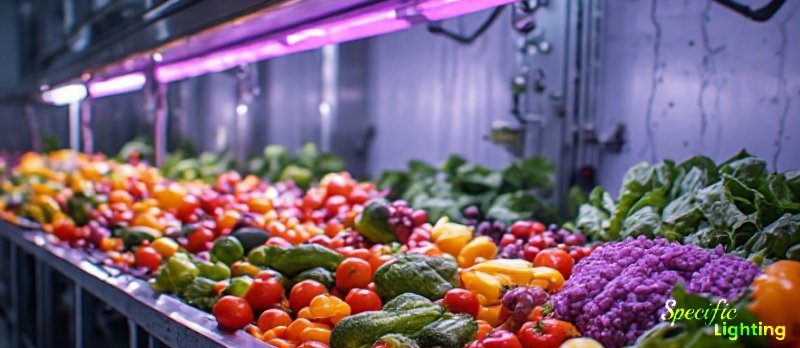
How Is UV Lighting Used in Food Processing Facilities?
There is no single UV application that fits every food factory. Different parts of a facility may have very different requirements.
A beverage plant, for instance, may be more interested in UV treatment of process water or liquid products. A meat or poultry facility may investigate UV treatment for air, surfaces, or selected equipment areas. A bakery may consider environmental air treatment, packaging-area applications, or surface treatment.
The starting point should always be the actual process rather than the product brochure.
UV-C for Air Disinfection
Air treatment is one of the better-known applications for UV-C technology.
In food processing facilities, air can move through production rooms, HVAC systems, air-handling units, and ductwork. Depending on the facility design, airborne microorganisms can become part of the overall hygiene management challenge.
UV-C systems can be installed inside air-handling equipment or air ducts so that moving air passes through a controlled UV treatment zone. The system needs to be designed around the actual airflow conditions rather than simply the room size.
For HVAC applications, ASHRAE maintains testing standards including Standard 185.1 for UV-C lights used in air-handling units or air ducts and Standard 185.2 for ultraviolet lamps used to inactivate microorganisms on irradiated surfaces within HVAC&R equipment.
The distinction matters because UV performance in a real HVAC system is affected by airflow, temperature, humidity, lamp placement, reflective surfaces, and the time microorganisms spend in the treatment zone.
UV-C for Surface Disinfection
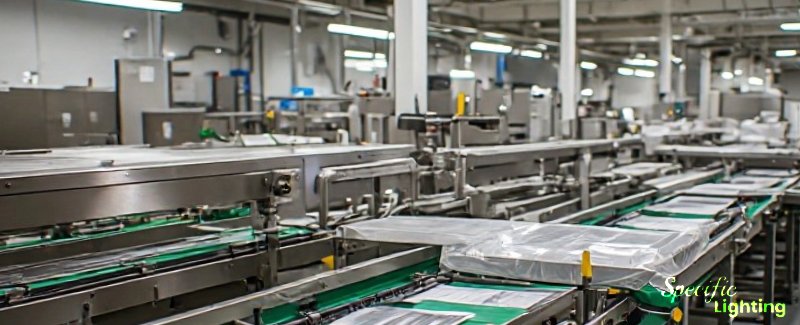
Surface treatment is another potential application, particularly where food-processing equipment or production surfaces need additional microbial control.
UV-C can be directed toward exposed surfaces such as conveyor belts, equipment surfaces, packaging materials, or other components within a controlled treatment zone.
The phrase “exposed surfaces” is doing a lot of work here. UV-C travels in a straight line and does not behave like a liquid sanitizer that can flow around an object. A surface hidden behind another component may receive little or no useful UV dose.
That means system layout matters enormously.
If a conveyor has multiple levels, raised edges, guides, brackets, or other components that create shadows, simply increasing lamp power may not solve the problem. A better design may use multiple lamps, different mounting angles, reflectors, or changes to the treatment chamber.
For this reason, surface UV systems should be evaluated according to the dose delivered at the least-exposed relevant location, rather than only the output measured directly in front of the lamp.
UV-C for Water and Process Water
UV is also widely considered for water treatment.
In food processing, water may be used for ingredients, rinsing, processing, cleaning, or other plant operations. UV treatment can be incorporated into a water-treatment system when the water characteristics and microbial targets are suitable.
Water quality has a major influence on performance. Suspended particles, color, organic matter, and other components can reduce UV transmission and prevent microorganisms from receiving the intended dose.
The FDA’s guidance for UV treatment of juice provides a useful example of why process-specific validation matters. FDA notes that UV effectiveness can vary with factors such as juice color and particle content, and that approved UV processes have specific operating parameters.
That lesson extends beyond juice: UV system performance should be validated for the actual fluid and process rather than assumed from a generic laboratory result.
UV-C in Packaging and Production-Line Applications
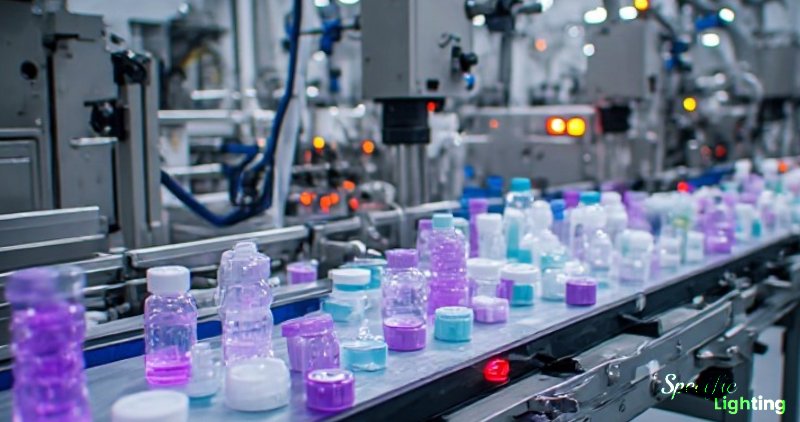
Packaging is another area where UV technology may be considered.
Depending on the process, UV systems can be used to treat packaging materials, containers, caps, or other exposed components before filling or sealing.
The production line introduces another variable: speed.
Imagine a conveyor moving at 20 meters per minute compared with one moving at 60 meters per minute. Even if both systems use the same UV source, the available exposure time is very different.
That is why line speed should be one of the first pieces of information provided to a UV supplier. The supplier may need to calculate the required treatment-zone length, lamp arrangement, intensity, or number of UV sources to achieve the target dose.
How Much Does UV Lighting for Food Processing Facilities Cost?
For food manufacturers, cost is usually one of the first questions on the table. A purchasing manager may want a quick equipment price, while an engineer is more likely to ask about UV output, dose, airflow, lamp life, and maintenance. The plant manager, meanwhile, may simply want to know how much the system will cost to install and run for the next 5 to 10 years.
There is no single price for an industrial UV-C system because the application can vary dramatically. A compact UV unit for a small air-handling application might cost a few thousand dollars, while a larger custom system for a production line, water-treatment process, or multiple HVAC units can reach $20,000, $50,000, $100,000 or more, depending on the scope.
As a rough budgeting exercise, a small commercial UV-C installation may fall around $3,000 to $10,000, a medium industrial installation around $10,000 to $40,000, and a larger custom food-processing project can exceed $50,000 once multiple treatment zones, stainless-steel housings, sensors, control panels, installation, commissioning, and validation are included.
These figures are not universal market prices. They are useful starting points for budgeting only. A supplier should calculate the actual system based on the required UV dose, airflow or water flow, treatment area, operating hours, environmental conditions, and safety requirements.
The key is to look at UV as a complete treatment system rather than the price of a UV lamp. A $500 lamp is not a $500 disinfection system once you add the housing, power supply, controller, sensors, mounting, wiring, safety interlocks, installation, and ongoing maintenance.
| Cost / Item | Typical Budget or Share |
|---|---|
| Small UV-C installation | $3,000–$10,000 |
| Medium industrial installation | $10,000–$40,000 |
| Larger custom project | $50,000+ |
| Large/complex systems | $100,000+ possible |
| UV lamps or LED modules | 20%–40% of equipment cost |
| Installation and related work | 10%–30%+ of project cost |
| Example HVAC UV equipment | $8,000–$15,000 |
| Example HVAC installation & commissioning | $2,000–$6,000 |
| Custom conveyor UV system | $20,000–$50,000+ |
Average UV Lighting System Cost
The total project price can be divided into several major components.
For a relatively straightforward UV-C installation, the UV lamps or LED modules may account for around 20% to 40% of the equipment cost. The remaining cost can come from housings, electrical components, controllers, sensors, monitoring equipment, mounting hardware, safety devices, and engineering.
Installation can add another 10% to 30% or more to the project, particularly when electrical work, duct modifications, pipework, production-line modifications, or custom fabrication are required.
For example, consider a food processing facility installing UV-C treatment inside an existing HVAC system. A basic project might involve $8,000 to $15,000 in UV equipment and another $2,000 to $6,000 for installation, electrical work, controls, and commissioning.
A conveyor application can be more complicated. If the UV system needs a custom stainless-steel enclosure, multiple lamps, safety interlocks, sensors, cooling, PLC integration, and a specially designed treatment chamber, the total project could move into the $20,000 to $50,000+ range.
A larger water-treatment installation can have another cost structure. The UV chamber itself may represent only part of the investment, with flow meters, valves, sensors, pipework, control systems, pre-filtration, and integration adding to the final project price.
For this reason, when requesting quotations, ask suppliers to separate equipment, installation, commissioning, validation support, and ongoing maintenance costs. It becomes much easier to compare two proposals when you can see where the money is going.
What Factors Affect UV System Pricing?
Facility size is one factor, but it is far from the only one.
The required UV dose is often more useful than square footage when determining system capacity. A 100-square-meter production room and a 100-square-meter storage room may require completely different systems depending on airflow, occupancy, target microorganisms, and treatment objectives.
For air treatment, airflow is particularly important. A system treating 2,000 m³/h of air has very different requirements from one handling 20,000 m³/h.
For water treatment, flow rate is one of the first numbers a supplier will want to know. A system handling 5 m³/h does not require the same UV capacity as one treating 50 m³/h.
Production-line speed also affects the cost of surface and packaging applications. A conveyor moving at 10 meters per minute provides considerably more exposure time than a line running at 60 meters per minute.
The treatment distance matters too. UV intensity generally decreases as the distance from the source increases, so a system treating a surface at 10 cm may require a very different configuration from one treating a surface at 50 cm.
The operating environment can add another layer of cost. Food processing facilities often involve humidity, water spray, cleaning chemicals, grease, temperature changes, and frequent washdowns. Equipment installed in these areas may require stainless-steel construction, sealed electrical components, protective housings, and appropriate ingress protection.
Controls can also push the price upward.
A basic UV system may simply switch on and off. A more advanced industrial system could include UV intensity monitoring, lamp-status monitoring, temperature sensors, alarms, access interlocks, emergency shutdowns, PLC integration, and data logging.
A system with 4 UV lamps and basic controls will naturally cost less than a system with 20 lamps, 8 sensors, automated monitoring, remote alarms, and PLC integration.
Custom engineering is another major variable. Standard equipment may be relatively affordable, while a custom system designed around a particular conveyor, duct, tank, or production machine can require engineering drawings, fabrication, testing, and on-site commissioning.
UV-C Lamp vs. UV-C LED Cost
UV-C LEDs have attracted growing attention in industrial applications because they can be compact, electronically controlled, and switched on and off rapidly. Traditional UV lamps, particularly low-pressure mercury lamps, remain widely used in many established UV applications.
The purchase price can vary considerably between the two technologies.
For example, a UV-C LED system may have a higher initial cost in certain applications, particularly where high-output LED modules and sophisticated thermal management are required. A conventional lamp system may have a lower initial equipment cost but require periodic lamp replacement.
The better comparison is therefore not simply:
Lamp price vs. LED price
It should be:
Initial cost + electricity + replacement parts + maintenance + downtime over the expected service life.
Consider a hypothetical facility operating a UV system for 16 hours per day, 300 days per year. That equals approximately 4,800 operating hours annually.
A facility running three shifts may operate closer to 8,000 hours per year.
Even a difference of 500 watts becomes meaningful over time. At 8,000 operating hours per year, a 500 W difference represents approximately 4,000 kWh per year.
At an electricity rate of $0.12 per kWh, that equals about $480 per year. At $0.20 per kWh, the same difference becomes $800 per year.
Over 10 years, the difference could reach $4,800 to $8,000, before considering changes in electricity prices.
That is why energy consumption should be included when comparing UV technologies.
Lamp replacement should also be included. If a facility has 20 UV lamps and each replacement lamp costs $150, one complete replacement cycle represents $3,000 in lamp costs, before labor.
If replacement takes a technician two hours and labor is valued at $75 per hour, another $150 would be added to that service event. If production needs to stop during maintenance, the real cost can be considerably higher.
UV-C LEDs can have different service-life characteristics, but buyers should still ask for the manufacturer’s definition of rated life. A quoted LED lifetime of 10,000, 20,000, or 30,000 hours does not automatically mean the system will deliver the same UV output throughout that entire period.
For either technology, ask suppliers for actual UV output over operating life, energy consumption, replacement procedures, and expected maintenance costs.
UV Lighting Operating and Maintenance Costs
The equipment purchase is only the beginning.
A UV system operating 8,000 hours per year can accumulate tens of thousands of operating hours over its lifetime. Even relatively small maintenance requirements can therefore become significant.
Lamp replacement is one of the most obvious recurring costs.
Suppose a system contains 12 UV lamps, each costing $180 to replace. A complete lamp replacement would cost $2,160 in parts alone.
If replacement occurs every 12,000 operating hours and the facility operates 8,000 hours per year, the lamps might require replacement roughly every 18 months, depending on the manufacturer’s actual performance specifications and the application’s requirements.
Over five years, that could mean several replacement cycles.
Cleaning is another consideration. Dust, deposits, moisture, and other contaminants can reduce UV transmission. In a food processing environment, the cleaning schedule may need to be more frequent than in a clean technical room.
A system that requires cleaning every 500 operating hours would need approximately 16 cleaning cycles per year at 8,000 operating hours. If each maintenance visit takes one hour and costs $75 in labor, that alone represents about $1,200 per year in labor.
The actual schedule will vary by environment, of course
What Specifications Should You Compare When Buying UV Lighting?
Choosing UV lighting for a food processing facility involves more than comparing lamp wattage or looking for the lowest quotation. Two systems can both be marketed as UV-C disinfection equipment but deliver very different performance, operating costs, maintenance requirements, and service life.
When comparing suppliers, look at wavelength, UV irradiance, UV dose, lamp or LED life, power consumption, treatment capacity, environmental protection, controls, monitoring, safety features, certifications, and warranty. These specifications become even more important when a system is expected to operate 16 to 24 hours a day for several years.
| Specification / Parameter | Typical Figure |
|---|---|
| Traditional UV-C lamp wavelength | ~254 nm |
| Example UV irradiance | 8 mW/cm² |
| Example exposure time | 5 seconds |
| Example UV dose | 40 mJ/cm² |
| Example conveyor speed | 20–40 m/min |
| UV operating time | 8,000 hours/year |
| 5-year operating time | 40,000 hours |
| Example UV system power | 2 kW |
| Example annual electricity use | 13,200 kWh/year |
| Example electricity cost | ~$1,980/year at $0.15/kWh |
| Example air-treatment capacity | 3,000–30,000 m³/h |
| Example water flow range | 10–30 m³/h |
| Example washdown frequency | 2 times/day × 300 days = 600/year |
| HVAC example operating range | 16–24 hours/day |
UV-C Wavelength and Irradiance
Traditional low-pressure mercury UV lamps are commonly associated with output around 254 nm, while UV-C LEDs are available at different wavelengths. The appropriate wavelength depends on the application, target microorganisms, UV source, and available validation data.
UV irradiance, normally expressed in mW/cm², tells you how much UV energy reaches a particular area. It is more useful for evaluating treatment performance than electrical wattage alone.
For example, a lamp may consume 100 W of electrical power, but that does not mean 100 W of useful UV-C energy reaches the target. Ask suppliers for irradiance measurements at the actual treatment distance.
UV Dose and Exposure Time
UV dose is one of the most useful numbers when comparing systems.
UV dose = UV irradiance × exposure time
Dose is commonly expressed in mJ/cm². For example, an irradiance of 8 mW/cm² applied for 5 seconds gives a simplified dose of 40 mJ/cm².
In real installations, UV intensity can vary across the treatment area. Ask whether the quoted dose is a theoretical calculation, average measurement, or verified minimum dose.
For conveyor applications, line speed matters too. Increasing a production line from 20 m/min to 40 m/min roughly halves exposure time if the treatment zone remains unchanged.
Lamp Life and Energy Consumption
Lamp or LED life directly affects operating costs. A facility running UV equipment for 8,000 hours per year can accumulate 40,000 operating hours over five years.
Ask whether the quoted lamp life refers to physical operating life or the period during which the lamp maintains a specified percentage of its original UV output.
Energy consumption should also be compared. A 2 kW system operating 20 hours per day for 330 days consumes approximately 13,200 kWh per year. At $0.15/kWh, that is about $1,980 annually.
For larger facilities with multiple UV systems, the difference in electricity consumption can become significant.
Treatment Capacity, Airflow, and Water Flow
The system must match the actual process.
An air-treatment system designed for 3,000 m³/h should not be compared directly with one designed for 30,000 m³/h. Likewise, a water-treatment system rated for 10 m³/h may not deliver the required UV dose if operated at 30 m³/h.
For conveyor applications, provide the supplier with line speed, product dimensions, treatment distance, and operating hours.
For water systems, also provide water-quality information because suspended particles and color can reduce UV transmission.
Environmental Rating and Construction Materials
Food processing environments can involve humidity, chemicals, grease, water spray, and frequent washdowns. Check the equipment’s IP rating, construction materials, seals, cable glands, and chemical compatibility.
For example, a facility performing two washdowns per day for 300 production days could expose equipment to around 600 washdown cycles per year.
Stainless-steel construction and suitable protective enclosures may therefore be worthwhile in wet production areas.
Controls, Monitoring, and Safety
For industrial installations, compare whether the system includes UV intensity monitoring, lamp-status monitoring, alarms, PLC integration, access interlocks, and emergency shutdowns.
A basic system may only require an on/off switch, while a larger automated installation may need several sensors and communication with existing production controls.
Ask whether these features are included in the quotation or priced separately.
Test Data, Certifications, and Warranty
Finally, ask suppliers how their performance figures were obtained.
For HVAC applications, standards such as ASHRAE 185.1 and 185.2 can provide useful references for evaluating UV-C performance under defined conditions.
Do not compare one supplier’s laboratory lamp output with another supplier’s measured UV dose inside an operating duct. The numbers are not directly equivalent.
Ask for test reports, validation data, warranty terms, replacement-part pricing, and the expected maintenance schedule.
The best comparison is not simply which UV system has the highest wattage or lowest purchase price, but which system can demonstrate the required UV dose, capacity, service life, safety, and total cost of ownership under your actual food-processing conditions.
UV Lighting Installation Considerations
Installation can make or break the performance of a UV system.
Even a high-quality UV source cannot compensate for poor placement.
Where Should UV-C Systems Be Installed?
The location depends entirely on the application.
Inside HVAC equipment, UV sources are often positioned to treat moving air or irradiate surfaces such as coils and drain pans.
For conveyor applications, UV sources need to be positioned so that the relevant surfaces receive adequate exposure without being blocked by equipment components.
For water systems, the UV chamber needs to be installed in a way that provides controlled flow through the treatment zone.
Room-based systems require careful consideration of room geometry, airflow, occupied areas, and exposure control.
The installation drawing should show the treatment area, mounting positions, electrical connections, safety devices, and access requirements before equipment arrives on site.
Electrical and Mounting Requirements
Industrial UV installations may require dedicated electrical circuits, control panels, sensors, relays, PLC integration, and other components.
The mounting system also needs to withstand the operating environment.
If equipment vibrates, the mounting system should account for vibration. If the area is washed down regularly, electrical components and connections need appropriate protection.
A well-designed installation should leave technicians enough room to inspect and replace components without turning routine maintenance into a half-day project.
Integration With HVAC and Processing Equipment
UV systems often work as part of a larger process.
For HVAC systems, integration may involve airflow sensors, fan controls, access switches, alarms, and maintenance indicators.
On production lines, the UV system may need to stop automatically if the conveyor stops or if a safety enclosure is opened.
For process water, the UV system may need to communicate with pumps, flow meters, valves, or downstream controls.
Integration should be discussed during the quotation stage because it can significantly affect project scope and cost.
Installation in Washdown Areas
Washdown environments deserve special attention.
Food processing facilities may use water, foam, detergents, and sanitizing chemicals during cleaning. Electrical equipment that looks perfectly suitable in a dry environment may not survive long in such conditions.
Ask the supplier what environmental conditions the system has been designed for and what protection level applies to the complete installation.
Do not assume that a UV lamp being enclosed automatically means the entire system is suitable for washdown.
UV Lighting vs. Other Food Processing Disinfection Methods
UV technology is rarely evaluated in isolation.
Food manufacturers may compare it with chemical sanitation, thermal treatment, ozone, filtration, or other technologies depending on the application.
UV vs. Chemical Disinfection
Chemical sanitation remains widely used because chemicals can reach surfaces that UV cannot.
UV’s advantage is that it can provide physical treatment without leaving a chemical residue in the treatment zone.
At the same time, UV has line-of-sight limitations. A chemical solution can flow around equipment surfaces that a UV source cannot directly “see.”
For that reason, UV and chemical sanitation may sometimes work alongside each other rather than being treated as mutually exclusive options.
UV vs. Ozone
Ozone is another technology used in selected water and sanitation applications.
The two technologies operate differently. UV uses radiation, while ozone relies on oxidation.
The decision depends on the process, water characteristics, safety requirements, equipment design, and regulatory considerations.
Ozone also requires careful control because worker exposure can be hazardous. FDA’s juice HACCP training materials specifically note the need to prevent excessive worker exposure when ozone is used.
UV vs. Thermal Treatment
Heat is highly effective in many food processing applications, but not every product or process can tolerate elevated temperatures.
UV provides a non-thermal treatment option for applications where heating the product, water, air, or packaging would be undesirable.
That does not make UV a universal replacement for thermal treatment. Each technology has its own process window.
UV vs. Conventional Filtration
Filtration physically removes particles and microorganisms from a fluid or air stream, while UV works by exposing microorganisms to radiation.
The two can sometimes complement each other.
For example, improving filtration before UV treatment may reduce particles that block UV transmission in a water application.
The practical question is therefore not always “Which technology wins?” It is often “How should these technologies work together in this process?”
How to Get a Quote for UV Lighting for a Food Processing Facility
Getting an accurate UV lighting quotation starts with giving suppliers enough information about the actual production environment. The more specific your requirements are, the less likely you are to receive a generic system that later needs costly modifications.
Information for Air Treatment Systems
For an air application, provide the airflow rate, duct dimensions, air temperature, humidity, available installation space, and operating hours. If possible, include the duct layout and information about existing fans or air-handling equipment.
For example, a system treating 3,000 m³/h of air will have very different requirements from one handling 30,000 m³/h. Air velocity, available UV exposure time, and duct geometry all affect the required UV output.
Information for Water Treatment
For water applications, provide the flow rate, pipe diameter, water temperature, water quality, UV transmittance (UVT), and intended microbial target.
If UVT data is available, include it with the request. Water with lower UV transmittance may require higher UV output or additional treatment stages. Suppliers may also need turbidity or suspended-solids information to properly size the system.
Information for Conveyor and Surface Treatment
For conveyor or surface applications, provide the line speed, product dimensions, surface material, treatment distance, operating hours, and available installation area.
Photographs, equipment drawings, or simple layout sketches can make the quotation process much faster. A production line moving at 40 m/min, for example, requires a different exposure arrangement from one operating at 15 m/min.
If products have uneven surfaces, shadows, packaging, or areas that cannot receive direct UV exposure, mention these details as well.
Describe the Cleaning Environment
Food processing equipment may be exposed to frequent washdowns, moisture, detergents, and sanitizing chemicals. If the UV system will be installed in such an area, describe the cleaning frequency, water pressure, cleaning chemicals, and expected exposure.
This information helps suppliers select suitable enclosures, seals, materials, connectors, and IP protection. It can also affect installation costs and maintenance requirements.
Define Performance and Validation Requirements
Tell suppliers what reduction target you are trying to achieve and whether you have existing validation requirements. This could include a required microbial reduction, minimum UV dose, specific testing method, or documentation needed for internal quality procedures.
Ask suppliers to explain how their performance figures were calculated or measured. A quoted UV output under laboratory conditions is not necessarily the same as the delivered dose inside your production system.
Request a Detailed Quotation
Ask the supplier to separate the quotation into equipment, installation, commissioning, validation support, training, spare parts, and estimated annual maintenance. It is also worth requesting expected electricity consumption and lamp or LED replacement intervals.
This makes different proposals much easier to compare.
A quotation of $20,000 may initially appear cheaper than one for $27,000. However, if the first system requires expensive custom installation, more frequent lamp replacement, or additional monitoring equipment, the actual five-year cost could be considerably different.
A useful quotation should therefore show more than the purchase price. Look at the expected total cost of ownership, performance data, maintenance requirements, and included services before making the final purchasing decision.
Frequently Asked Questions About UV Lighting for Food Processing Facilities
Is UV-C lighting safe for food processing facilities?
UV-C systems can be used safely when properly engineered, installed, enclosed, and controlled. Direct exposure needs to be prevented through appropriate shielding, interlocks, access controls, procedures, and other safety measures suited to the installation.
The safety requirements depend on the specific UV source, application, exposure conditions, and facility design.
How much does a UV-C system cost?
There is no universal price. A small, standardized system may cost far less than a custom industrial installation with multiple treatment zones, sensors, controls, stainless-steel construction, and commissioning.
The best way to obtain a meaningful price is to provide the supplier with the actual application and operating conditions.
How long do UV-C lamps last?
Lamp life varies according to lamp type, operating conditions, switching frequency, temperature, and manufacturer specifications.
More importantly, useful UV output can decline before a lamp physically stops working. For that reason, replacement schedules should be based on UV performance requirements rather than simply whether the lamp still turns on.
Can UV-C replace chemical sanitation?
UV-C should not automatically be viewed as a complete replacement for established sanitation procedures.
Its usefulness depends on the application. UV works particularly well where direct exposure can be controlled, while chemical cleaning can reach areas that UV cannot.
Many facilities may use UV as an additional treatment rather than abandoning other sanitation methods.
Does UV-C work against bacteria and viruses?
UV-C can inactivate a wide range of microorganisms when sufficient UV dose reaches them.
However, performance varies between organisms and applications. A claim about one microorganism at a particular dose should not automatically be treated as proof of the same performance against every organism.
What wavelength is best for food processing?
There is no single wavelength that is automatically best for every food processing application.
The appropriate wavelength depends on the UV source, target microorganisms, treatment environment, equipment design, and validation data.
How much maintenance does UV-C lighting require?
Maintenance requirements depend on the system.
Typical tasks can include cleaning UV sources, inspecting electrical components, checking safety devices, monitoring UV output, replacing lamps or LEDs, and verifying sensors.
The supplier should provide a maintenance schedule based on actual operating conditions.
How do I calculate the UV dose required?
UV dose is generally related to irradiance and exposure time. However, selecting the target dose requires knowledge of the microorganisms involved, desired reduction level, product or environmental conditions, and system geometry.
For a commercial food-processing application, dose selection should be supported by appropriate technical data and, where necessary, process validation.
Can UV-C systems be installed in existing facilities?
Yes, depending on the application.
Existing HVAC units, ducts, conveyors, water-treatment lines, and other equipment may be suitable for retrofit systems.
However, available space, electrical supply, airflow, water flow, access, structural support, and safety controls need to be assessed before installation.
Should I use UV-C lamps or UV-C LEDs?
Both technologies have potential applications.
Traditional UV lamps can provide strong output and are established across many industrial applications. UV-C LEDs can offer compact designs, rapid switching, and other advantages depending on the application.
The right choice should be based on performance, total ownership cost, operating hours, maintenance requirements, and the specific treatment process.
Choosing a UV System With the Long View
UV technology can be a useful addition to a food processing facility, but buying the right system requires more than comparing product brochures.
The strongest purchasing decisions usually begin with the process itself. What needs to be treated? What flow rate or line speed is involved? What dose is required? What environmental conditions will the equipment face? How will performance be monitored? Who will maintain it? And what will the system cost after three, five, or ten years of operation?
Those questions help shift the conversation from “Which UV lamp should we buy?” to a much more useful question: “What complete UV treatment system will work reliably in our facility?”
It is also worth remembering that UV is one part of a wider food safety and sanitation strategy. FDA guidance, for example, makes clear that irradiation technologies do not replace good manufacturing practices and appropriate sanitation controls.
For facilities considering a new UV installation, upgrading an existing system, or comparing UV-C lamps with newer LED-based technology, getting application-specific advice before purchasing can save both money and headaches later. If you are evaluating UV lighting for a food processing facility, feel free to approach us for related consultation. We can discuss your application, operating conditions, required treatment area, system specifications, installation requirements, and cost considerations to help identify a UV solution that fits the way your facility actually operates.