
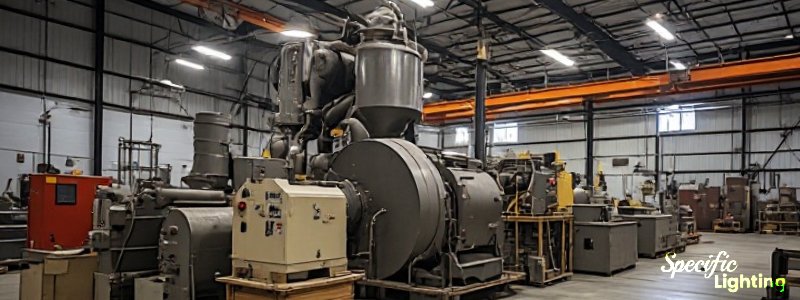
Lighting a factory is easy until the environment gets really hot.
In a typical warehouse or workshop, standard LED lighting usually works well. But near furnaces, kilns, foundries, glass-melting lines, boilers, or heat-treatment equipment, ambient temperatures can reach 80°C (176°F), 100°C (212°F), 150°C (302°F), 200°C (392°F), or higher. Radiant heat can add further thermal stress.
This is where high temperature LED lighting comes in. These specialized fixtures are designed for elevated-temperature environments where standard LEDs may suffer reduced performance, shortened service life, or failure. Commercial solutions are available for temperatures around 80°C, 100°C, 150°C, and 200°C, while applications approaching 300°C (572°F) require a more specialized approach.
For industrial buyers, temperature rating is only part of the equation. The LED, driver, heat sink, housing, wiring, optics, mounting position, and surrounding conditions all need to work together.
The key question is simple: Can the complete lighting system operate reliably at the actual temperature and conditions of the installation?
What Is High Temperature LED Lighting?
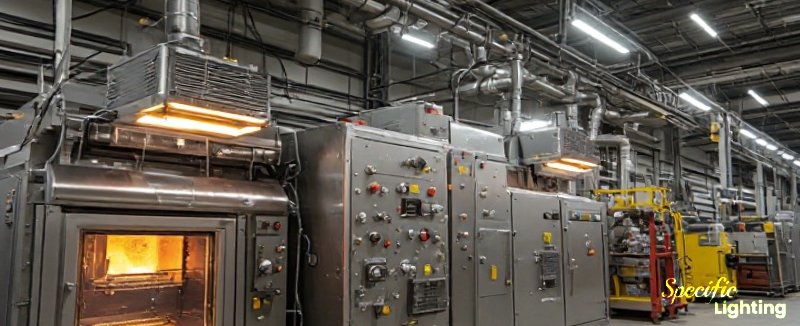
High temperature LED lighting refers to LED luminaires specifically engineered to operate in environments with elevated ambient temperatures.
A conventional industrial LED fixture may be designed for an ambient temperature of approximately 40°C to 50°C (104°F to 122°F). That can be more than adequate for a normal factory or warehouse. However, a fixture installed beside a furnace or industrial oven can encounter temperatures far beyond this range.
A high temperature resistant LED light uses thermal management and components selected for higher-temperature operation. Depending on the design, this can include a metal-core PCB, larger heat sink, high-temperature LED packages, specialized drivers, heat-resistant wiring, rugged metal housings, high-temperature optical materials, or a remote driver configuration.
The complete design matters because the LED chip is only one part of the lighting system. An LED component may tolerate a high junction temperature while the driver, lens, wiring, seals, adhesives, or connectors have considerably lower operating limits.
For this reason, buyers should focus on the ambient temperature rating of the complete luminaire, rather than relying on the maximum temperature specification of an individual LED component.
Why the Complete Fixture Matters
A high-temperature lighting system is only as reliable as its most temperature-sensitive component.
For example, imagine a light head designed to tolerate 150°C (302°F), but its driver is rated for only 100°C (212°F). The LED itself may be able to operate in the hot environment, but the driver cannot necessarily be installed alongside it.
This is one reason some high-temperature LED products separate the light head from the driver. The fixture can remain near the heat source while the driver is installed farther away in a cooler location.
The same principle applies to wiring, connectors, optical lenses, seals, mounting hardware, and other components. When evaluating a high-temperature LED, the temperature rating should describe the actual operating capability of the complete system.
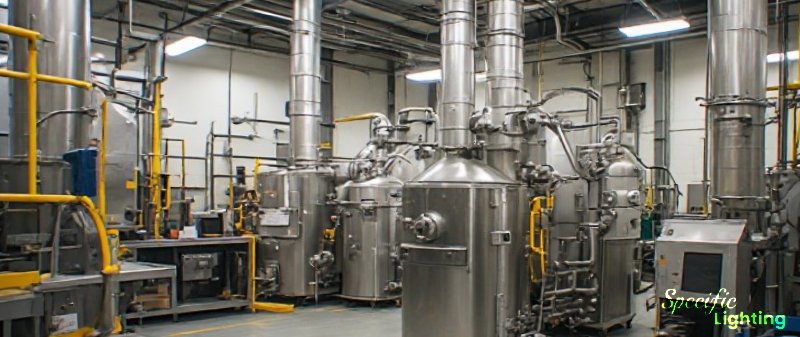
How Does High Temperature LED Lighting Work?
The fundamental principle behind high-temperature lighting is straightforward: the fixture needs to move heat away from sensitive components while using materials and electronics capable of tolerating the remaining temperature.
A simplified thermal path can be described as LED → PCB → thermal interface → heat sink → surrounding environment.
Every stage of this thermal path contributes to the final temperature of the LED and other internal components.
Thermal Management and Heat Sinks
High-temperature LED fixtures may use metal-core PCBs to transfer heat away from the LED package efficiently. The heat is then conducted into a heat sink designed to release that energy into the surrounding environment.
Heat-sink performance depends on several factors, including the material, surface area, geometry, airflow, fixture orientation, and electrical load.
Installation conditions therefore matter just as much as the fixture specification. A fixture installed in open air can behave differently from one enclosed in a small space or positioned close to a hot wall.
The fixture’s power level is also important. A 50 W fixture and a 400 W industrial high bay can require very different thermal architectures even if both are operating in the same room.
Heat-Resistant LED Components
The LED package itself needs to be appropriate for the intended temperature range.
High-temperature lighting systems can use LED components and packaging materials designed to tolerate greater thermal stress. However, the LED’s maximum junction temperature should not be confused with the ambient temperature rating of the complete fixture.
Junction temperature refers to the temperature inside the semiconductor junction, while ambient temperature refers to the surrounding environment. These values are related but they are not interchangeable.
A component might have a maximum junction temperature of 150°C while the complete luminaire is rated for a much lower ambient temperature because other components cannot tolerate the same conditions.
High-Temperature Driver Design
The driver deserves just as much attention as the LED.
The driver regulates and supplies the electrical power required by the LED system, and its electronic components also have temperature limits. In an extreme industrial environment, the driver can become one of the most temperature-sensitive parts of the fixture.
Some high-temperature lighting systems therefore use an external or remote driver. The light head can remain in the hot area while the driver is installed farther away where the ambient temperature is lower.
This architecture can be especially useful for applications around 150°C (302°F) or higher, depending on the manufacturer’s design and installation requirements.
Understanding Ambient, Case, and Junction Temperature
Before purchasing high-temperature LED lighting, it is important to understand what the temperature figures in a specification actually mean.
Ambient temperature, commonly represented as Ta, refers to the temperature surrounding the fixture under the conditions defined by the manufacturer.
Case temperature refers to the temperature measured at a specified point on the fixture or component.
Junction temperature, commonly represented as Tj, refers to the temperature inside the semiconductor junction of the LED.
These measurements should never be treated as interchangeable.
If a fixture is advertised as suitable for 100°C ambient temperature, that does not mean every component inside the fixture operates at exactly 100°C. Internal temperatures can be higher because the LED and electronics generate heat during operation.
For this reason, industrial buyers should pay particular attention to the ambient temperature rating of the complete luminaire.
| Temperature / Topic | Key Point | Typical Applications / Considerations |
|---|---|---|
| Ambient Temperature (Ta) | Temperature surrounding the complete fixture. | Most important rating for selecting a high-temperature luminaire. |
| Case Temperature | Temperature measured at a specified point on the fixture/component. | Not interchangeable with ambient or junction temperature. |
| Junction Temperature (Tj) | Temperature inside the LED semiconductor junction. | Can be higher than the surrounding ambient temperature. |
| 100°C (212°F) | Specialized LED fixtures can operate at this ambient temperature. | Boilers, ovens, turbines, heat-treatment areas, furnace surroundings. Allow for temperature fluctuations and radiant heat. |
| 150°C (302°F) | Requires more specialized high-temperature LED design. | Foundries, glass manufacturing, kilns, furnaces, metal processing. Installation distance and airflow matter. |
| 200°C (392°F) | Highly specialized industrial lighting. | Steel mills, foundries, furnace buildings, severe heat zones. Check continuous rating, electrical load, driver location, and lifetime. |
| 300°C (572°F) | Extreme temperature requiring specialized lighting architecture. | May require remote electronics, thermal isolation, heat shields, or greater mounting distance. |
| Driver Location | Keeping the driver away from extreme heat can reduce thermal stress. | Especially useful in 150°C–300°C applications. |
| Radiant Heat | Air temperature alone may not represent the fixture’s actual thermal load. | Consider distance from furnaces, hot walls, exhaust, and other heat sources. |
| Supplier Verification | Confirm what the stated temperature rating actually means. | Check whether it is continuous ambient, short-term exposure, case temperature, or another test condition. |
Can LED Lights Work at 100°C?
Yes. Specialized LED lighting can be designed for 100°C (212°F) ambient temperature.
This temperature range can be relevant to boiler rooms, industrial ovens, turbine areas, heat-treatment facilities, and production areas located close to furnaces or other heat sources.
However, if the measured ambient temperature is already close to 100°C, it is important not to assume that a fixture rated at exactly 100°C automatically provides additional thermal capacity.
Real industrial environments can fluctuate. A production process that normally operates at 90°C may temporarily reach 100°C or higher. Direct radiant heat can also cause the fixture to experience greater thermal stress than the surrounding air temperature alone would suggest.
For this reason, manufacturers should be given both the normal operating temperature and the maximum expected temperature when selecting the fixture.
What About 150°C LED Lighting?
At 150°C (302°F), LED lighting becomes considerably more specialized.
High-temperature fixtures in this range can be considered for environments such as glass manufacturing, foundries, metal processing, kilns, furnaces, and other severe industrial heat zones.
At this temperature, installation location becomes especially important. A fixture operating in free air may behave differently from one installed inside a confined structure, close to a hot wall, or directly in the path of hot exhaust.
The distance between the fixture and the heat source can therefore become part of the lighting specification.
A remote driver can also be valuable at this temperature. Keeping the driver away from the hottest area can reduce thermal stress on the electronics while allowing the light head to illuminate the required production area.
Can LED Lighting Work at 200°C?
Some specialized industrial LED fixtures are designed for ambient temperatures approaching 200°C (392°F).
This level of thermal exposure can occur around steel mills, foundries, furnace buildings, electric arc furnace areas, and other severe industrial processes.
At 200°C, product selection should be treated as an engineering decision rather than a simple retail purchase.
Buyers should ask how the temperature rating was established, whether the rating applies continuously, what electrical load is permitted at the maximum temperature, where the driver needs to be installed, and whether the stated lifetime applies under maximum-temperature conditions.
A 200°C-rated fixture is a fundamentally different product from a conventional industrial LED designed for a 40°C or 50°C ambient environment.
What About 300°C LED Lighting?
A 300°C ambient temperature is equivalent to 572°F, making it an extreme requirement for LED lighting.
A 300°C application should not simply be treated as the next step after a 200°C fixture. At this temperature, the entire lighting architecture may need to be reconsidered.
The LED package, electronics, wiring, lens, seals, adhesives, housing, mounting system, and thermal interfaces can all experience severe thermal stress.
Depending on the application, the solution may involve remote electronics, thermal isolation, greater distance from the heat source, heat shields, specialized light heads, or an optical arrangement that illuminates the hot area from a cooler position.
If a supplier offers 300°C LED lighting, the first question should be what the 300°C specification actually represents.
It could refer to continuous ambient temperature, short-term exposure, case temperature, or another test condition. These are very different claims.
For an application genuinely approaching 300°C, the supplier should provide clear technical documentation explaining the operating conditions, expected light output, service life, driver location, and installation requirements.
Where Is High Temperature LED Lighting Used?
High-temperature LED lighting is used across industries where heat makes conventional lighting difficult to operate reliably.
Foundries and Metal Casting
Foundries are among the most demanding environments for industrial lighting. Furnaces, molten-metal processes, casting equipment, dust, vibration, and airborne particles can all affect fixture performance.
Maintenance access is another consideration. A light mounted several meters above a production area may require lifting equipment or production downtime to replace.
For this reason, foundry lighting should be evaluated according to temperature, mechanical durability, ingress protection, optical performance, and maintenance requirements rather than temperature alone.
Steel Mills
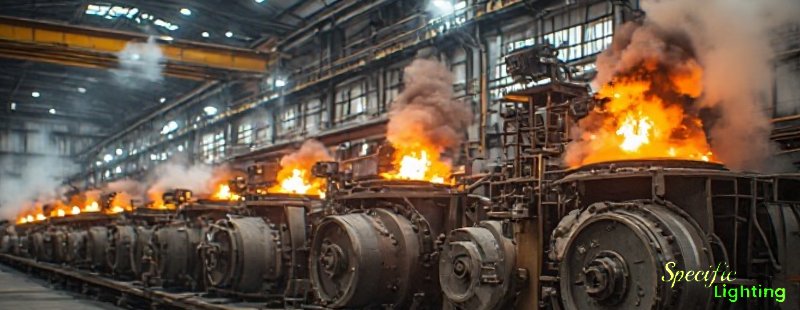
Steel mills can expose lighting equipment to elevated ambient temperatures and intense radiant heat.
Hot rolling areas, furnace buildings, steel-processing lines, and production halls can require specialized lighting capable of maintaining performance under demanding thermal conditions.
High-temperature LED high bays can be useful where fixtures are installed several meters above the production floor. Beam angle and mounting height should be considered alongside the fixture’s temperature rating because thermal performance alone does not guarantee adequate illumination.
Glass Manufacturing
Glass manufacturing is another important application.
Glass-melting and forming processes can generate substantial heat around furnaces and production equipment. Lighting may need to operate continuously while exposed to elevated ambient temperatures and radiant heat.
Depending on the layout, high-temperature flood lights can provide targeted illumination around equipment, while high-temperature high bays may be more appropriate for larger production spaces.
Aluminum and Metal Processing
Aluminum smelting and other metal-processing facilities can combine high temperature with dust, vibration, airborne particles, and difficult maintenance conditions.
The lighting system therefore needs to be evaluated as a complete industrial solution. A fixture with a high temperature rating may still be unsuitable if it does not provide adequate protection against the other environmental conditions present at the installation site.
Kilns and Ceramic Manufacturing
Ceramic, brick, and other kiln-based manufacturing processes can create localized high-temperature zones.
The fixture’s actual position can make a significant difference. A light installed immediately beside a kiln may experience much greater thermal stress than another fixture positioned several meters away.
Where practical, increasing the distance between the light and the heat source can reduce thermal exposure while still providing the required illumination.
Industrial Ovens and Heat-Treatment Facilities
Industrial ovens and heat-treatment equipment can expose lighting to continuous or cyclical temperatures.
This distinction is important.
A fixture continuously exposed to 120°C is subjected to a different thermal profile from one that repeatedly cycles between 30°C and 120°C.
Repeated heating and cooling can create additional mechanical and material stress. For these applications, buyers should tell the manufacturer whether the fixture will experience constant high temperature or regular thermal cycling.
Power Plants and Boiler Rooms
Boiler rooms can contain hot pipes, steam systems, turbines, and other heat-producing equipment.
Temperature can vary significantly depending on the location and mounting height. A fixture installed near the upper section of a boiler room may experience very different conditions from one installed closer to the floor.
Power-generation environments can also involve moisture, dust, vibration, and corrosion, so these factors should be evaluated alongside temperature.
Pulp and Paper Mills
Pulp and paper facilities can contain drying sections and other areas where elevated temperature and humidity occur simultaneously.
In such environments, the lighting fixture needs to handle both thermal and moisture exposure. A high-temperature rating alone does not guarantee suitability for a humid or wet production environment.
Chemical and Petrochemical Facilities
Chemical and petrochemical facilities can contain high-temperature process equipment and production zones.
However, high-temperature resistance is not the same as hazardous-location certification.
A fixture rated for 150°C does not automatically mean it is suitable for an area containing combustible gases, vapors, or dust. If the installation is located in a classified hazardous area, the appropriate certification and protection method must be evaluated separately.
How to Choose the Right High Temperature LED Light
The best place to start is the actual installation environment rather than the fixture wattage.
Measure Temperature at the Fixture Location
Do not rely only on the temperature measured at floor level or on a general factory temperature reading.
Hot air can rise, while radiant heat from furnaces and other hot surfaces can affect fixtures positioned nearby.
Ideally, measure the temperature at or near the intended mounting position while the production equipment is operating normally. It is particularly useful to measure during the hottest part of the production cycle.
For example, if the general factory temperature is 45°C but the intended lighting location reaches 95°C during production, the fixture needs to be selected for the latter condition.
Identify Normal and Maximum Temperature
Both normal and maximum temperature are important.
A facility might normally operate around 85°C but reach 105°C during certain production cycles. In that situation, telling the supplier only that the environment is approximately 85°C could result in an inappropriate fixture selection.
The supplier should know the normal temperature, maximum temperature, duration of the maximum exposure, and whether the temperature changes significantly throughout the day.
Consider Radiant Heat
Air temperature is only part of the thermal environment.
A fixture positioned near a furnace may receive direct infrared radiation from the furnace surface. The fixture’s distance from the heat source, orientation, surrounding structures, and any heat shielding can all affect its actual thermal exposure.
This is why two fixtures installed in the same factory can experience very different operating conditions.
Check the Driver
Always determine the driver’s temperature rating.
If the light head is rated for 150°C but the driver is rated for 100°C, the driver needs to be positioned in an environment within its specified operating range unless the manufacturer provides another approved configuration.
For extreme-temperature installations, the driver location should therefore be considered during the initial lighting design rather than after the fixture has been selected.
Check Light Output at the Intended Temperature
A fixture’s advertised lumen output is normally measured under defined test conditions.
For a high-temperature application, ask the manufacturer whether the fixture has thermal derating data or performance information at the intended ambient temperature.
The important question is not simply how many lumens the fixture produces under laboratory conditions. The more useful question is how much usable light it can provide under the actual conditions in the factory.
Check Environmental Protection
Heat rarely occurs by itself.
The same production area may contain dust, water, steam, oil, chemicals, corrosive gases, or vibration.
The lighting fixture should therefore be evaluated for its temperature rating together with its IP protection, material compatibility, corrosion resistance, mechanical durability, and any required industrial certifications.
Installation Considerations for High Temperature LED Lighting
Installation can have a major effect on the thermal performance of a high-temperature LED fixture.
Maintain Adequate Heat Dissipation
The fixture needs sufficient space around its heat-dissipation surfaces.
Heat-sink fins should not be blocked, and the fixture should not be enclosed in a way that traps hot air unless the manufacturer has specifically designed and tested it for that installation.
Increase Distance from the Heat Source
Distance can be an effective thermal-management strategy.
If a fixture can be moved farther away from a furnace while still achieving the required illumination, its thermal exposure may decrease significantly.
In some applications, relocating the fixture is more practical than simply selecting a product with a higher temperature rating.
Check Cables and Mounting Hardware
The lighting fixture is only one part of the installation.
At elevated temperatures, cables, cable glands, connectors, brackets, bolts, seals, and other accessories also need appropriate temperature ratings.
A 150°C-rated LED fixture connected to components designed for substantially lower temperatures does not create a complete 150°C-rated lighting system.
Consider Dust Accumulation
Industrial dust and process residue can accumulate on a fixture over time.
This can affect optical performance and, depending on the design, reduce the effectiveness of heat dissipation.
For dusty industrial environments, regular inspection and cleaning should therefore be incorporated into the maintenance plan.
High Temperature LED Lighting Cost
There is no single price for high-temperature LED lighting because the cost depends on the fixture’s power, temperature rating, driver architecture, materials, optics, environmental protection, certifications, and quantity.
What Determines the Cost?
Wattage is one factor. A 50 W high-temperature fixture does not require the same thermal architecture as a 400 W industrial high bay.
Temperature rating is another major factor. Designing a fixture for 80°C is generally less demanding than engineering one for 150°C or 200°C.
Driver configuration can also affect project cost. A remote driver may require additional cable, mounting hardware, and installation work, but it can make an extreme-temperature application possible.
Optical design, IP protection, corrosion resistance, hazardous-location certification, specialized housings, and custom mounting arrangements can also influence the final price.
Why the Cheapest Fixture May Not Be the Cheapest Solution
The purchase price is only one part of the economics of industrial lighting.
Consider a fixture installed 10 meters above a production line. If it fails frequently, every replacement may require access equipment, maintenance labor, production disruption, spare inventory, and additional safety procedures.
A properly engineered high-temperature fixture may have a higher initial purchase price while reducing replacement frequency and maintenance costs over its operating life.
For this reason, total cost of ownership can be more useful than comparing the initial price of individual fixtures.
Energy Consumption Example
Energy consumption should also be included when comparing lighting systems.
Suppose a factory operates 100 fixtures at 150 W each for 12 hours per day and 300 days per year. The annual energy consumption would be:
100 × 0.15 kW × 12 × 300 = 54,000 kWh per year
If a more efficient system can provide the required illumination using an average of 100 W per fixture, annual consumption would become:
100 × 0.10 kW × 12 × 300 = 36,000 kWh per year
That represents a difference of 18,000 kWh per year.
The actual financial saving depends on the facility’s electricity tariff, operating schedule, and the performance of the lighting system, but the example demonstrates why energy efficiency should be evaluated together with temperature resistance.
Get a High-Temperature LED Solution for Your Application
Choosing the right high-temperature LED lighting requires more than simply selecting a fixture with a high temperature rating. Ambient temperature, radiant heat, driver location, materials, installation conditions, energy efficiency, and long-term reliability all need to be considered together. From 80°C and 100°C environments to demanding applications approaching 200°C or beyond, the right lighting solution depends on the specific conditions of each facility. If your project requires a customized high-temperature LED lighting solution, contact us to discuss your operating temperature, installation environment, mounting requirements, and lighting needs. Our team can help develop a solution designed for your specific application.